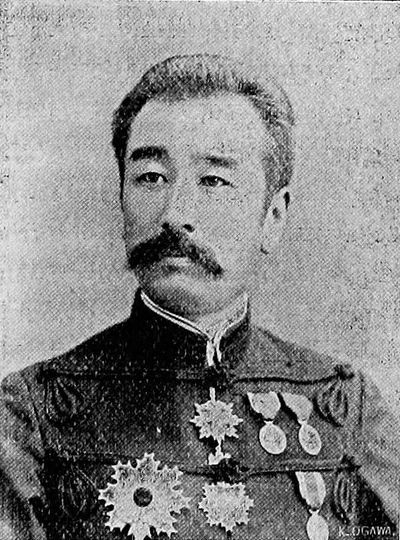
Ōshima Yoshimasa
| Name | Ōshima Yoshimasa |
| Title | Japanese general (1850–1926) |
| Gender | Male |
| Birthday | 1850-09-20 |
| nationality | Japan |
| Source | https://www.wikidata.org/wiki/Q713040 |
| pptrace | View Family Tree |
| LastUpdate | 2025-11-17T06:46:36.898Z |
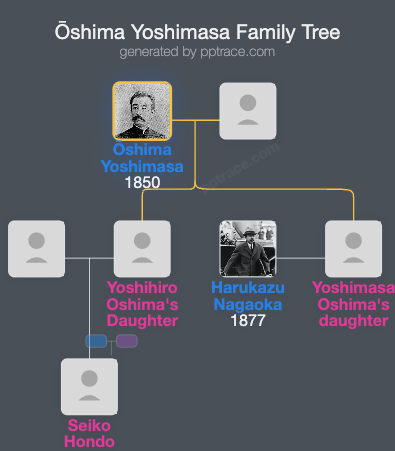
Family Tree
Tap  to expand more relatives
Introduction
Viscount Ōshima Yoshimasa (大島 義昌; September 20, 1850 – April 10, 1926) was a general in the Imperial Japanese Army. His military career spanned the late 19th and early 20th centuries, during which he participated in the First Sino-Japanese War and the Russo-Japanese War.
Biographical details indicate that Ōshima was born as the eldest son to a samurai of Chōshū Domain, located in what is now Yamaguchi Prefecture. He fought as part of the Satchō Alliance forces supporting Emperor Meiji during the Boshin War, which took place against the Tokugawa shogunate.
Following the Meiji Restoration, in 1870, Ōshima attended military school in Osaka. He received his commission as a lieutenant in August 1871, in the newly formed Imperial Japanese Army. He was assigned to the 4th Infantry Regiment and was promoted to captain in 1872. By 1873, he was serving as a battalion commander in the 1st Infantry Regiment. During the Satsuma Rebellion of 1877, he was promoted to the rank of major.
Post-rebellion, Ōshima held staff positions at the Sendai Garrison and was promoted to colonel in 1886. The following year, he became chief-of-staff of the Tokyo Garrison. Under the influence of the Prussian military advisor Jakob Meckel, the Imperial Japanese Army was reorganized, and Ōshima became chief-of-staff of the 1st Division.
In June 1891, he was promoted to major general and took command of the IJA 9th Infantry Brigade, also called the “Ōshima Combined Brigade.” His force of approximately 4,000 soldiers was dispatched to Korea in 1894 during the Donghak Rebellion, with the objective of expelling Chinese Beiyang Army forces from Korean territory. On July 28, 1894, his forces achieved victory at the Battle of Seunghwan outside Asan, south of Seoul, marking the first land engagement of the First Sino-Japanese War. In recognition of this victory, Ōshima was awarded the title of baron (danshaku) within the kazoku peerage system and was assigned to command the Tsushima Garrison.
He was promoted to lieutenant general in February 1898. During the Russo-Japanese War, Ōshima commanded the IJA 3rd Division under the Japanese Second Army, led by General Oku Yasukata. His division participated in key battles such as Liaoyang, Shaho, and Mukden. After the conclusion of hostilities, he was promoted to full general. From October 1905 to April 1912, he served as Governor-General of the Kwantung Leased Territory, where he laid the groundwork for what would become the Kwantung Army.
In 1907, Ōshima was elevated to the title of viscount (shishaku). He joined the Imperial Japanese Army General Staff in September 1911, and in June 1912, he received the Order of the Paulownia Flowers. He retired from military service in August 1915 and passed away in 1926.
Decorations received during his career include the Order of the Rising Sun (4th class in 1878; 3rd class in 1885; 2nd class in 1895; Grand Cordon in 1906), the Order of the Sacred Treasure (2nd class in 1895; Grand Cordon in 1903), the Order of the Golden Kite (3rd class in 1901; 2nd class in 1906), and the Order of the Paulownia Flowers (Grand Cordon in 1912).
His great-great-grandson is Shinzō Abe, who served as Prime Minister of Japan.