John Francis Fitzgerald
| Name | John Francis Fitzgerald |
| Title | Irish-American politician, Massachusetts (1863-1950) |
| Gender | Male |
| Birthday | 1863-02-11 |
| nationality | United States of America |
| Source | https://www.wikidata.org/wiki/Q966182 |
| pptrace | View Family Tree |
| LastUpdate | 2025-11-17T06:44:43.859Z |
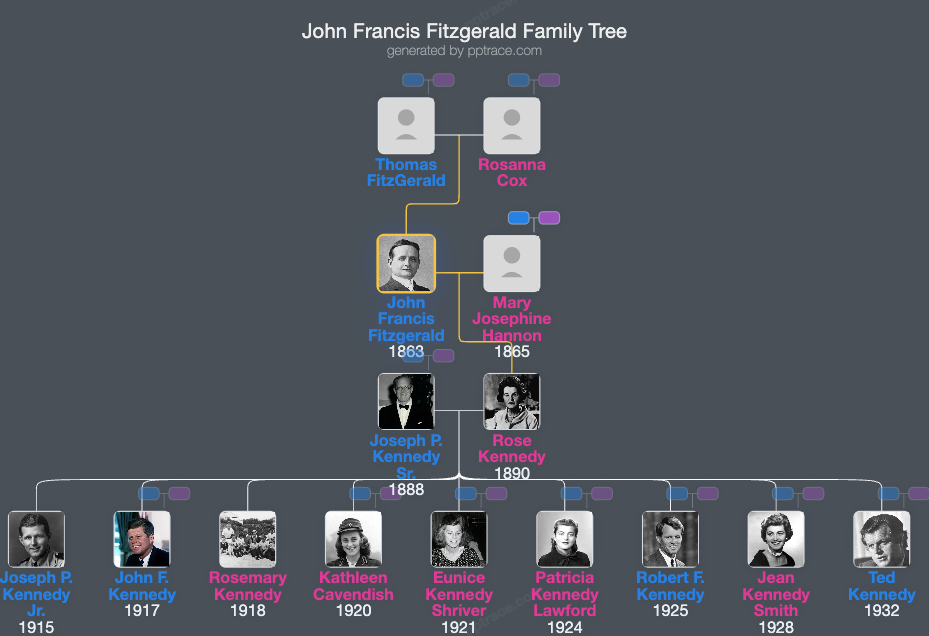
Family Tree
Tap  to expand more relatives
Introduction
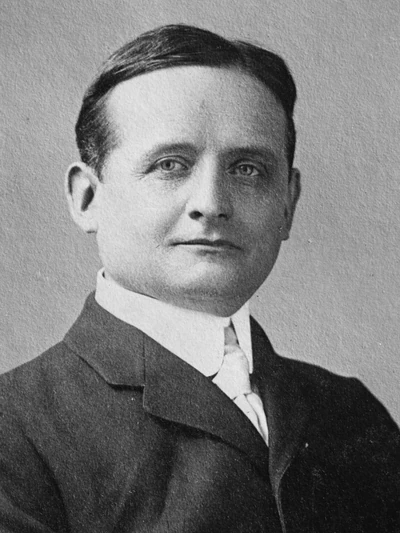
John Francis "Honey Fitz" Fitzgerald was born on February 11, 1863, in the North End of Boston, Massachusetts. He was the son of Irish immigrants Thomas Fitzgerald from Bruff, County Limerick, and Rose Anna Cox from Tonymore, Tomregan, Knockninny, County Fermanagh, Ireland. Fitzgerald was the fourth of twelve children, though only three siblings survived into adulthood: Ellen, Mary, and Joseph. His early family life was marked by the death of his mother when he was sixteen and the death of several siblings.
Fitzgerald received education at Boston Latin School and Boston College. He enrolled at Harvard Medical School but withdrew after his father's death in 1885 to pursue other career paths. He later worked as a clerk at the Boston Customs House and became active in local Democratic politics.
In the 1890s, Fitzgerald founded the Jefferson Club, a political organization aimed at mobilizing Irish Catholic voters in South Boston, modeled after organizations like Tammany Hall and the Hendricks Club. He was elected to Boston's Common Council in 1891 and to the Massachusetts Senate in 1892, with support from Martin Lomasney, a prominent Boston political figure.
Fitzgerald was elected to the United States House of Representatives in 1894, representing Massachusetts's 9th district. He served from 1895 to 1901. During his tenure, he was the only Democrat from New England in Congress for portions of his early terms. In 1901, Fitzgerald was among a small group of representatives advocating for the reduction of southern congressional delegations in response to voting rights suppression, but the measure was defeated.
He was elected Mayor of Boston first in December 1905, serving from 1906 to 1908, and again from 1910 to 1914. His initial election was notable as he became the first American-born Irish Catholic to hold the office. His early mayoralty was characterized by efforts to develop port facilities, promote industrial growth, and establish public amenities such as schools, playgrounds, and baths. Although his administration demonstrated energetic public service, it was also marred by allegations of corrupt practices, including patronage and appointments of unqualified individuals.
During his first term, city politics shifted with reforms aimed at reducing the influence of Irish Democratic ward bosses, which included restructuring the city government and extending the mayoral term to four years. Fitzgerald lost the 1907 election amid the reform efforts but returned to office in 1910, winning narrowly against James J. Storrow. His second term saw the promotion of a port revitalization plan, which led to increased European port traffic by 1912.
Fitzgerald made unsuccessful bids for the U.S. Senate in 1916 and 1942 and for governor of Massachusetts in 1922. He served on the Port of Boston Authority from 1934 to 1948. His 1918 election to the U.S. House was contested, leading to a vote in 1919 that declared he had not won the seat, which was awarded to his opponent, Peter F. Tague.
In his later years, Fitzgerald concentrated on business interests and mentoring his grandson, John F. Kennedy, particularly aiding Kennedy's first congressional campaign in 1946. Kennedy later named the presidential yacht "Honey Fitz" in his grandfather's honor after winning the presidency.
He married Mary Josephine "Josie" Hannon, his second cousin, on September 18, 1889. They had six children: Rose, Mary, Thomas, John Jr., Eunice, and Frederick. Fitzgerald died on October 2, 1950, in Boston.