Katō Takaaki
| Name | Katō Takaaki |
| Title | Japanese politician (1860-1926) |
| Gender | Male |
| Birthday | 1860-01-25 |
| nationality | Japan |
| Source | https://www.wikidata.org/wiki/Q315563 |
| pptrace | View Family Tree |
| LastUpdate | 2025-11-17T10:08:29.830Z |
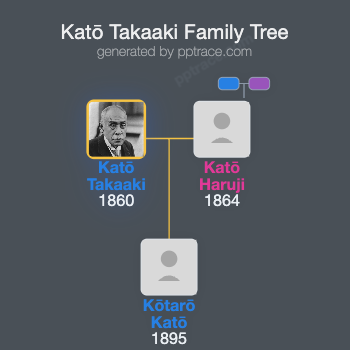
Family Tree
Tap  to expand more relatives
Introduction
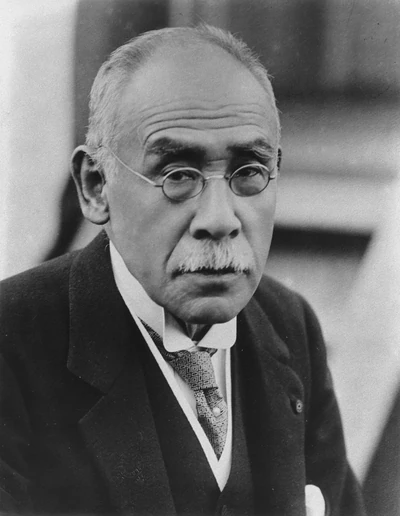
Count Katō Takaaki (Japanese: 加藤 高明, Kyujitai: 加藤󠄁 高明󠄁; born Hattori Sōkichi [服部 総吉]; 3 January 1860 – 28 January 1926) was a Japanese politician, diplomat, and Prime Minister of Japan from 1924 until his death in 1926. His tenure occurred during the period known as "Taishō Democracy."
Early Life:
Katō was born as Hattori Sokichi in Nagoya, Owari Province, in the town of Saya, Ama District, which is now part of Aisai City in Aichi Prefecture. He was the second son of a former samurai retainer of the Owari Tokugawa domain. At the age of 13, he was adopted by Katō Bunhei. He attended the University of Tokyo, graduating at the top of his class from the Law Department in 1881 with a specialization in English common law.
Following his graduation, Katō worked for Mitsubishi zaibatsu and was dispatched to London for two years. Upon returning to Japan in 1885, he became an assistant manager at Mitsubishi's headquarters in Marunouchi, Tokyo. In 1886, he married Haruji, the eldest daughter of Iwasaki Yatarō, Mitsubishi's president.
Career:
In 1887, Katō became a private secretary to Ōkuma Shigenobu, who was then serving as Minister of Foreign Affairs. During this period, he worked on the revision of the unequal treaties between Japan and Western powers. He later served as director of the Banking Bureau within the Ministry of Finance.
From 1894 to 1899, Katō served as the Japanese envoy to the United Kingdom. In 1900, during the 4th Itō administration, he became Japan's Foreign Minister; however, this administration lasted only a few months. During his diplomatic tenure in the UK and later as Foreign Minister, he contributed to establishing the foundations for the Anglo-Japanese Alliance, concluded in 1902.
In 1902, Katō was elected to the Japanese Diet's House of Representatives representing Kōchi Prefecture. He served again as Foreign Minister during the Saionji cabinet in 1906 but resigned after a brief period due to opposition to the nationalization of private railways. He was subsequently appointed ambassador to London in 1908, a position in which he received the honorary title of GCMG and gained a reputation as a prominent statesman. He resigned from this ambassadorship in December 1912.
He returned as Foreign Minister during the 3rd Katsura and 2nd Ōkuma administrations but soon resigned. In 1913, Katō founded the Constitutionalist Party, becoming its president in 1913. In April 1914, he again served as Foreign Minister and was in office at the outbreak of World War I. During this period, he notably leveraged the war to assert Japan's foreign policy authority domestically and to redefine Japan's relationship with China, notably issuing the Twenty-One Demands to China in January 1915, which generated international controversy.
Premiership (1924–1926):
In 1915, Katō was appointed to the House of Peers by Imperial command. He became president of the conservative Kenseikai political party in 1916. He was appointed Prime Minister of Japan in 1924 and served until his death in 1926. His cabinet was known as the "Goken Sanpa Naikaku," a coalition of three pro-constitutional factions.
During his premiership, Katō oversaw the enactment of the 1925 General Election Law, which extended voting rights to all male citizens over 25. He ratified the Peace Preservation Law, aimed at suppressing leftist groups, and signed the Soviet–Japanese Basic Convention. Additionally, he promoted policies for universal military service and sought to reduce government spending, although he faced scrutiny over family ties to Mitsubishi.
Death:
Katō Takaaki died of pneumonia while in office on 28 January 1926 at the age of 66.
Honors:
He received numerous honors, including the Grand Cordon of the Order of the Sacred Treasure in 1902, held the titles of Baron in 1911 and Viscount in 1916, and was posthumously awarded the Grand Cordon of the Order of the Chrysanthemum and the title of Count in 1926.