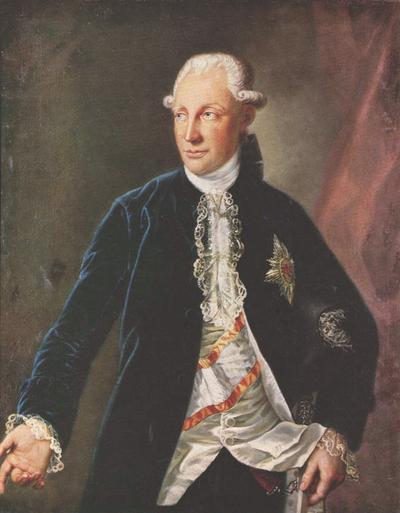
Alexander, Margrave Of Brandenburg-Ansbach
| Name | Alexander, Margrave Of Brandenburg-Ansbach |
| Title | margrave of Brandenburg-Ansbach and Brandenburg-Bayreuth |
| Gender | Male |
| Birthday | 1736-02-24 |
| nationality | Q34762 |
| Source | https://www.wikidata.org/wiki/Q214044 |
| pptrace | View Family Tree |
| LastUpdate | 2025-11-12T01:15:50.304Z |
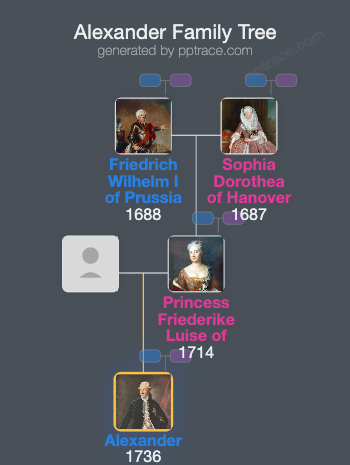
Family Tree
Tap  to expand more relatives
Introduction
Christian Frederick Charles Alexander (German: Christian Friedrich Carl Alexander) was born on 24 February 1736 and died on 5 January 1806. He was the last Margrave of the Franconian principalities of Bayreuth and Ansbach and sold these territories to the King of Prussia.
His parents were Charles William Frederick, Margrave of Brandenburg-Ansbach, and Friederike Luise of Prussia. Friederike Luise was a daughter of King Frederick William I of Prussia, making Christian Alexander a grandson of the Prussian monarch. His maternal uncles included Frederick II of Prussia, and his maternal grandparents included King George I of Great Britain. His relation to British royalty extended to being a nephew of King George II and a second cousin to King George III.
Following the death of his elder brother, Carl Frederick August, on 9 May 1737, Christian Alexander became Crown Prince of Ansbach. He studied at Utrecht from 1748 to 1759. During his youth, he traveled to Turin and Savoy and held the title of "Count of Sayn," associated with the county of Sayn-Altenkirchen in the Westerwald, which was incorporated into the principality of Ansbach in 1741.
On 22 November 1754, he married Princess Frederica Caroline of Saxe-Coburg-Saalfeld in Coburg. She was the daughter of Franz Josias, Duke of Saxe-Coburg-Saalfeld, and Princess Anne Sophia of Schwarzburg-Rudolstadt. Christian Alexander ascended to the position of Margrave of Brandenburg-Ansbach on 3 August 1757. His residence was primarily in Ansbach, but he spent considerable time at his estate in Triesdorf.
Throughout his reign, he commissioned renovations and constructions at Triesdorf, including the White Castle, the Red Castle, Villa Sandrina, and the Villa Rotunda. In 1758, he established a porcelain factory in Ansbach and engaged in agricultural ventures such as importing sheep. In 1769, he acquired Bayreuth, bringing it under his rule, pursuant to laws of the House of Hohenzollern.
In 1780, Christian Alexander founded a bank, the Hochfürstlich-Brandenburg-Anspach-Bayreuthische Hofbanco, which later became part of the Bavarian Hypotheken- und Wechselbank, known today as HypoVereinsbank. His financial activities included leasing troops to Britain during the American Revolutionary War, commanding a contingent of approximately 1,644 mercenaries, of whom about 1,183 returned after the conflict.
He worked to reduce the principality's debts from 5 million guilders inherited in 1757 to approximately 1.5 million guilders by his abdication.
On 16 January 1791, Christian Alexander sold his margraviate to Prussia, with the transaction facilitated by Karl August von Hardenberg. The contract stipulated an annual payment of 300,000 guilders as compensation. He formally abdicated on 2 December 1791, in Bordeaux, France.
Following his abdication, his first wife, Frederica Caroline, died on 18 February 1791. Christian Alexander then relocated to England on 19 May 1791 and married Elizabeth Craven, Baroness Craven, in either October or November of that year in Lisbon. In England, he engaged in horse breeding and acquired properties such as Brandenburgh House in Fulham and Benham Park near Newbury.
Christian Alexander died at Benham Park on 5 January 1806, aged 69, due to lung disease. A memorial in St Mary's Church, Speen, notes his death date.
The territories he formerly governed changed hands multiple times after his abdication, eventually being incorporated into Bavaria and the German Empire.