Yamamoto Gonnohyōe
| Name | Yamamoto Gonnohyōe |
| Title | Prime Minister of Japan (1852-1933) |
| Gender | Male |
| Birthday | 1852-11-26 |
| nationality | Japan |
| Source | https://www.wikidata.org/wiki/Q41556 |
| pptrace | View Family Tree |
| LastUpdate | 2025-11-17T10:08:12.469Z |
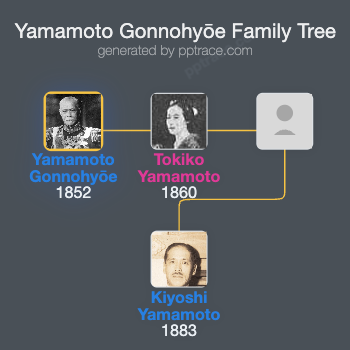
Family Tree
Tap  to expand more relatives
Introduction
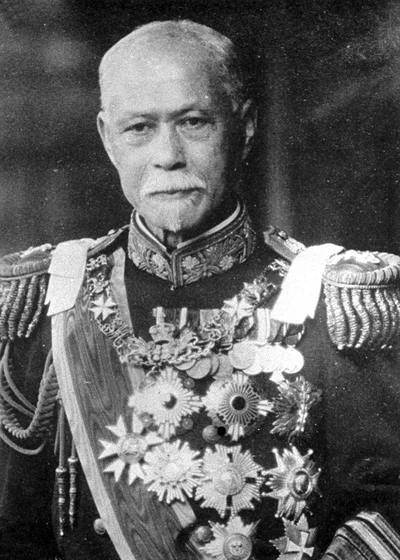
Yamamoto Gonbē (山本 権兵衛), also known as Gonnohyōe, was born on November 26, 1852, in Kagoshima Prefecture, Japan, and died on December 8, 1933. He was an admiral in the Imperial Japanese Navy and served as Prime Minister of Japan on two occasions: from 1913 to 1914 and from 1923 to 1924.
Early Life:
Yamamoto was the sixth son of a samurai affiliated with the Shimazu clan, serving as a secretary and a master of sōjutsu (swordsmanship). During his youth, he participated in the Anglo-Satsuma War. Later, he joined Satsuma's Eighth Rifle Troop during the Boshin War that culminated in the Meiji Restoration, fighting at the Battle of Toba–Fushimi and other engagements. He was aboard a ship involved in the pursuit of Enomoto Takeaki and other remnants of the Tokugawa fleet to Hokkaido in 1869.
Following the success of the Meiji Restoration, Yamamoto attended preparatory schools in Tokyo and entered the Imperial Japanese Naval Academy in 1870, in the second class. At that time, he briefly returned to Kagoshima during the Satsuma Rebellion but was encouraged by Saigo Takamori to rejoin the Naval Academy, avoiding combat.
Naval Career:
Yamamoto graduated in 1874 and subsequently undertook a training cruise to Europe and South America aboard ships of the Imperial German Navy from 1877 to 1878, gaining extensive sea experience. He authored a gunnery manual that became a standard reference in the Imperial Japanese Navy. He served as executive officer of the cruiser Naniwa during its shakedown voyage from Elswick to Japan (1885–1886). Later, he captained the corvette Amagi and traveled with Navy Minister Kabayama Sukenori on a diplomatic mission to the United States and Europe (1887–1888).
In 1890, as commander of the cruiser Takao, Yamamoto undertook a confidential mission to meet Qing General Yuan Shikai in Hanseong (present-day Seoul, Korea). He then commanded the cruiser Takachiho. Under Navy Minister Saigō Tsugumichi from 1893, he became a key figure in naval reforms, aiming to reduce favoritism and profiteering among officers and to elevate the Navy's status to be roughly equal with the Army in the Supreme War Council. He promoted an aggressive stance toward China in the First Sino-Japanese War.
Yamamoto was promoted to rear admiral in 1895 and to vice admiral in 1898. As Navy Minister from 1898, he contributed to Japan's naval modernization and strategic planning against Russia. He supported the Anglo-Japanese Alliance and promoted naval intelligence gathering abroad. In 1902, he was ennobled as a baron (danshaku), and in 1904, he achieved the rank of admiral.
During the Russo-Japanese War, Yamamoto appointed Tōgō Heihachirō as commander-in-chief of the Combined Fleet and publicly supported Tōgō’s reports.
Political Career:
Yamamoto became Prime Minister for the first time in February 1913, succeeding Katsura Taro and leading the Rikken Seiyukai party. His administration enacted reforms that removed military control over civilian governments by abolishing the rule requiring both Navy and Army Ministers to be active officers, allowing civilians to serve as ministers. Despite initial perceptions of liberalism, his first term was marred by charges of corruption, leading to his resignation in April 1914 amid the Siemens-Vickers Naval Armaments scandal, which he was not proved to have personally involved.
He was transferred to naval reserves after his first term and remained sidelined during World War I and subsequent naval disarmament negotiations. He was recalled as Prime Minister on September 2, 1923, in the "earthquake cabinet" following the death of Prime Minister Katō Tomosaburō and the Great Kantō earthquake. During this brief second term, he focused on urban reconstruction and electoral reform. He resigned again in January 1924 following the Toranomon Incident, where an assassination attempt on Prince Regent Hirohito was foiled.
Post-Political Life and Death:
Yamamoto withdrew from political life after his second resignation. He was opposed by political enemies such as Saionji Kinmochi regarding his potential appointment to the Privy Council or as one of the Genrō. He lived until December 1933, passing away at age 82 from complications related to benign prostatic hyperplasia at his home in Takanawa, Tokyo. He was laid to rest at Aoyama Cemetery in Tokyo.
Honors:
Yamamoto was awarded numerous orders and honors from Japan and foreign nations, including the Order of the Rising Sun (6th class in 1887, 4th class in 1895, Grand Cordon in 1901), the Order of the Golden Kite (4th class in 1895, 1st class in 1906), the Order of the Sacred Treasure (2nd class, 1900), and the Order of the Chrysanthemum (1928). Foreign honors included the Order of the Red Eagle (Prussia), Legion of Honour (France), and the Order of St Michael and St George (UK). He was ennobled as baron in 1902 and count in 1907.