John Hay Whitney
| Name | John Hay Whitney |
| Title | (1904-1982) American diplomat, publisher, aviator |
| Gender | Male |
| Birthday | 1904-08-17 |
| nationality | United States of America |
| Source | https://www.wikidata.org/wiki/Q2918336 |
| pptrace | View Family Tree |
| LastUpdate | 2025-11-29T01:01:12.260Z |
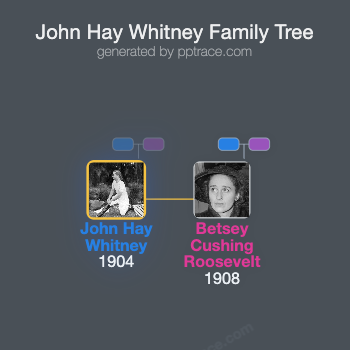
Family Tree
Tap  to expand more relatives
Introduction
John Hay Whitney (August 17, 1904 – February 8, 1982) was an American businessman, diplomat, and patron of the arts. He was born in Ellsworth, Maine, to Payne Whitney and Helen Hay Whitney. Whitney was a descendant of early American settlers, including John Whitney, who arrived in Massachusetts in 1635, and William Bradford of the Mayflower.
Whitney attended Groton School and Yale College, where he was an oarsman and a member of the Delta Kappa Epsilon fraternity and Scroll and Key. After graduating in 1926, he studied at Oxford University but returned after his father's death in 1927. He inherited a substantial family trust, initially valued at $20 million, and later increasing to four times that amount.
In 1929, Whitney participated in a hostile takeover of Lee, Higginson & Co., with Langbourne Meade Williams Jr., becoming the company's chairman at age 29. This event is regarded as an early example of corporate activism or "corporate raiding." In 1946, he founded J. H. Whitney & Company, recognized as the oldest venture capital firm in the United States, coining the term "venture capital." The firm invested in various enterprises, including Spencer Chemical and Minute Maid.
Whitney served in the U.S. Army Air Forces during World War II as an intelligence officer in the Office of Strategic Services (OSS). During his service, he was captured by German forces in southern France but escaped from a train en route to a POW camp.
He was also involved in media and publishing, acquiring the New York Herald Tribune in 1958 while serving as U.S. Ambassador to the United Kingdom (appointed in 1957 by President Dwight D. Eisenhower). Whitney's tenure as ambassador included efforts to mend relations between the U.S. and the U.K. following the Suez Crisis. Through the Tribune, he influenced New York City politics, notably the election of Mayor John Lindsay in 1965.
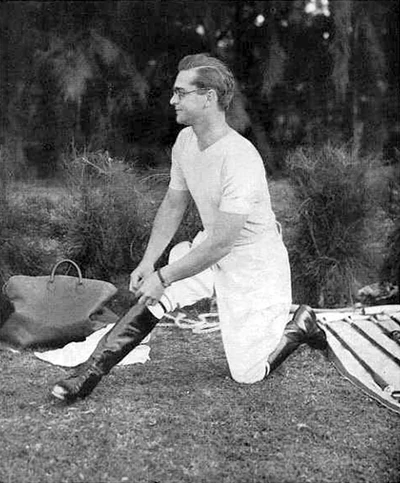
Whitney was an avid sportsman, engaging in polo and thoroughbred horse racing. He was the youngest member elected to The Jockey Club in 1928 and owned racehorses that competed in events such as the Cheltenham Gold Cup and the Kentucky Derby. His horses included Easter Hero, the first horse to win the Gold Cup twice consecutively. He entered several horses in the Kentucky Derby and was recognized posthumously by the National Museum of Racing's Hall of Fame.
In addition to his business ventures, Whitney invested in Broadway productions and films. His patronage extended to Hollywood, financing films such as "Gone with the Wind" (1939) and "Rebecca" (1940), both of which received Academy Awards for Best Picture. He supported film pioneer Technicolor and was an investor in Selznick International Pictures, serving as its chairman. He also helped secure Fred Astaire's initial film contract with RKO Pictures.
As a collector of fine art, Whitney amassed works by prominent artists, including Renoir, Monet, Degas, Manet, Hopper, Matisse, Whistler, Sargent, Cézanne, Gauguin, Blake, and Van Gogh. His collection has been exhibited at major institutions like the Tate Gallery, the National Gallery of Art, and the Museum of Modern Art.
Whitney died in 1982. His career encompassed finance, diplomacy, arts patronage, and sporting pursuits, making him a prominent figure in 20th-century American cultural and political life.