Sir Charles Davers, 6th Baronet
| Name | Sir Charles Davers, 6th Baronet |
| Title | politician |
| Gender | Male |
| Birthday | 1737-06-04 |
| nationality | — |
| Source | https://www.wikidata.org/wiki/Q19664783 |
| pptrace | View Family Tree |
| LastUpdate | 2025-11-26T23:26:37.103Z |
Family Tree
Tap  to expand more relatives
Introduction
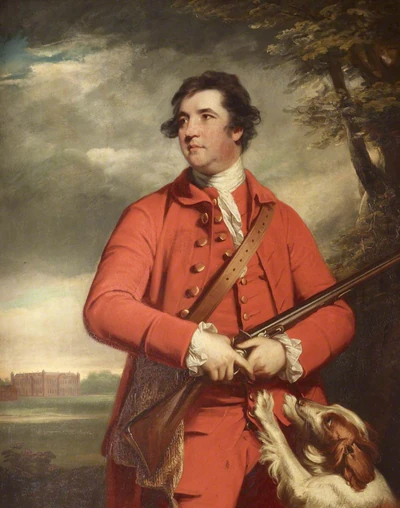
Sir Charles Davers, 6th Baronet (4 June 1737 – 4 June 1806), was a British Army officer and politician who served in the House of Commons from 1768 to 1802.
**Early Life and Education**
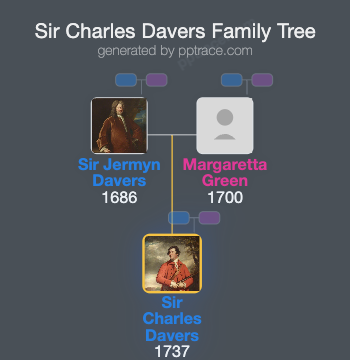
Davers was born on 4 June 1737 as the second surviving son of Sir Jermyn Davers, 4th Baronet, and Margaretta Green. He was raised at Rushbrooke Hall, located in Suffolk. For his education, he attended King Edward VI School in Bury St Edmunds and subsequently enrolled at Trinity College, Cambridge, graduating in 1755. Following his university studies, he undertook the Grand Tour, a customary period of travel for young men of his social standing.
**Military Career**
In 1758, Davers commenced his military career by receiving a commission in the British Army, serving in the 44th (East Essex) Regiment of Foot. During the Seven Years' War, he served in North America. In January 1761, while serving with the 99th Regiment of Foot, he was promoted to the rank of Captain. By 1766, he was garrisoned in Ireland, and he achieved the rank of Major in that year.
**Political Career**
In 1763, Davers inherited his brother's baronetcy and estates. He was elected as a Member of Parliament (MP) for Weymouth in the 1768 general election. Subsequently, in the 1774 general election, he was elected as MP for Bury St Edmunds. His parliamentary career was notably influenced by his close personal association with Augustus FitzRoy, 3rd Duke of Grafton, who encouraged Davers to develop his familial influence in Bury St Edmunds, favoring this over the interests of his brother-in-law, Frederick Hervey, 4th Earl of Bristol. Though publicly opposed to William Pitt the Younger, Davers did not formally align with the Whigs and maintained an independent stance.
**Personal Life**
Davers resided at Rushbrooke Hall with Frances Treice, with whom he had five illegitimate sons and three illegitimate daughters. Rumors suggest that he was previously married to Miss Coutts, a planter's daughter in America, during his military service, and that they had a son named Rushbrook. Upon his death on 4 June 1806, he was buried at St Nicholas Church in Rushbrooke. He left his estates to his nephew, Frederick Hervey, 1st Marquess of Bristol. With no surviving legitimate male heirs, his baronetcy became extinct.