
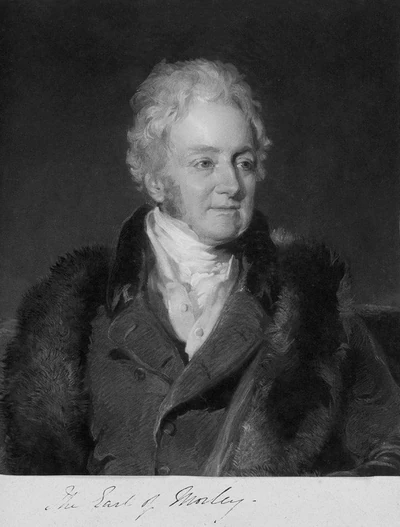
John Parker, 1st Earl Of Morley
| Name | John Parker, 1st Earl Of Morley |
| Title | British earl |
| Gender | Male |
| Birthday | 1772-05-03 |
| nationality | — |
| Source | https://www.wikidata.org/wiki/Q6251894 |
| pptrace | View Family Tree |
| LastUpdate | 2025-11-26T23:27:08.783Z |
Family Tree
Tap  to expand more relatives
Introduction
John Parker, 1st Earl of Morley, FRS (3 May 1772 – 14 March 1840), was a British peer and politician. He was born in 1772, the only son of John Parker, 1st Baron Boringdon, and his second wife Theresa Robinson. His father was associated with several estates in Devon, including Boringdon Hall in Plympton, Court House in North Molton, and Saltram. The Parker family had risen to prominence in the 16th century, originating as bailiffs of the manor of North Molton under Baron Zouche of Haryngworth.
Parker’s mother, Theresa Robinson, was a daughter of Thomas Robinson, 1st Baron Grantham. She died when Parker was three years old, and his father passed away when he was fifteen. The family commissioned architect Robert Adam to complete the interior of Saltram House, a major residence rebuilt by Parker’s father, which became one of the finest houses in Devon.
He received a local education at Plympton Grammar School, a school attended by Sir Joshua Reynolds, a close friend of his family. Parker furthered his studies at Christ Church, Oxford.
He assumed his seat in the House of Lords in 1793, at the age of 21. Initially, he supported government policies, aligning with the administration of William Pitt the Younger until Pitt's death in 1806. Following Pitt's death, Parker supported George Canning, with whom he maintained correspondence on political issues over the years. In 1815, he was elevated to the peerage as Viscount Boringdon of North Molton and was created Earl of Morley, both titles reflecting his Devon heritage.
After Canning's death in 1827, Parker shifted his political support to the Whigs and notably voted in favor of the Reform Act of 1832. Besides his national political engagements, Morley contributed to public works in Devon and was elected a Fellow of the Royal Society. His modifications to Saltram House included minor additions such as the porch and the enlargement of the library between 1818 and 1820.
Morley was married twice. His first marriage was in 1804 to Lady Augusta Fane, the second daughter of John Fane, 10th Earl of Westmorland. The marriage ended in divorce by Act of Parliament in 1809; Lady Augusta remarried Sir Arthur Paget. From this union, Morley had a son, Henry Villiers Parker, Viscount Boringdon, born in 1806, who died young in 1817.
In 1809, Morley married Frances Talbot, the only daughter of Thomas Talbot of Gonville and Wymondham. They had two children: Edmund Parker, who became the 2nd Earl of Morley (1810–1864), and Caroline Parker (1814–1818). Their son Edmund served as a lord-in-waiting to Queen Victoria.
John Parker died at Saltram House in March 1840, aged 67. He was succeeded by his son Edmund Parker as the 2nd Earl of Morley.
