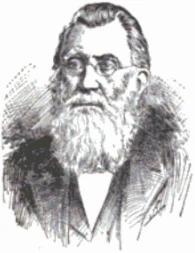
James Woodrow
| Name | James Woodrow |
| Title | American clergyman (1828-1907) |
| Gender | Male |
| Birthday | 1828-05-30 |
| nationality | — |
| Source | https://www.wikidata.org/wiki/Q17305550 |
| pptrace | View Family Tree |
| LastUpdate | 2025-11-17T06:43:13.895Z |
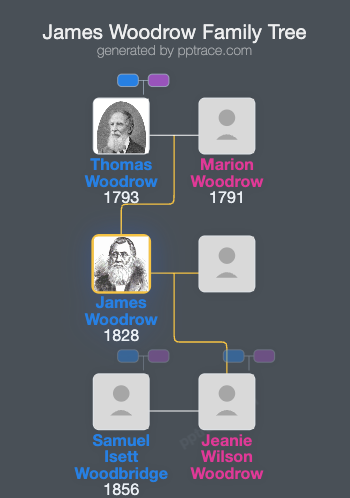
Family Tree
Tap  to expand more relatives
Introduction
James Woodrow (May 30, 1828 – January 17, 1907) was born in Carlisle, England. He was the son of Thomas Woodrow, a minister. At age eight, Woodrow's family emigrated to Canada; however, due to unfavorable climatic conditions, they later relocated to Chillicothe, Ohio, in the United States.
Woodrow attended Jefferson College, from which he graduated in 1849. Following his graduation, he served as a professor of natural science at Oglethorpe University in Milledgeville from 1850 to 1853. He then studied at the Lawrence School of Science at Harvard University under Louis Agassiz. Later, during 1855 and 1856, he studied at Heidelberg University in Germany, earning an A.M. degree and a Ph.D. summa cum laude.
In 1859, Woodrow was ordained by the Hopewell Presbytery, then part of the Presbyterian Church in the United States of America. Although appointed as Professor of Chemistry, Geology, and Natural Philosophy at the University of Georgia, he did not assume this position. Instead, in 1861, he joined Columbia Theological Seminary as the first Perkins Professor of Natural Science. In 1866, with financial assistance from his brother, Woodrow established a printing business and revitalized the Southern Presbyterian Review, a publication originally started in 1846 that ceased in 1864 due to the Civil War. Woodrow served as owner, publisher, and chief editor of the revue, engaging in debates regarding geology with R.L. Dabney, a fellow Presbyterian theologian.
The publication of Charles Darwin's "On the Origin of Species" in 1859 sparked controversy within religious circles. Initially opposing evolution, Woodrow later accepted the scientific theory, asserting that evolution was compatible with the Bible. Throughout the late 1860s and 1870s, he remained largely silent on the issue, leading to rumors that he had adopted evolutionary views. In 1879, J.B. Mack, a board member of Columbia Seminary, advised him to publicly clarify his stance. Woodrow responded that his main departure from orthodox teaching was his rejection of a literal six-day creation.
In 1883, a joint statement from Columbia Seminary and Woodrow indicated that embracing evolution did not conflict with Scripture, given that the Bible did not specify God's method of creation. Subsequently, in 1884, Woodrow disclosed his views before the Seminary’s Alumni Association, suggesting that Adam's physical body could have organic continuity with pre-existing creation, while his soul was uniquely created. He emphasized that he believed the Bible to be true but saw no obligation to reconcile probable scientific truths with Scripture.
This disclosure produced considerable controversy. The Presbyterian Church in the United States (PCUS) considered removing Woodrow from his professorship. Although a 1884 statement from the Seminary clarified disagreements over Adam's creation, internal conflict persisted, leading to his resignation in December 1884, which he refused to accept or explain. In subsequent years, conflicts over his views caused the Seminary to close temporarily during the 1887–1888 academic year, and he faced heresy charges in 1886; he was ultimately exonerated, though higher church authorities overturned this decision the next year. His removal from Columbia Theological Seminary culminated from the ongoing disputes.
The controversy influenced the PCUS to adopt a strict stance against evolution, a position not reversed until 1969. In 1891, Woodrow was elected president of South Carolina College, serving until 1897. Despite the disputes, he remained a minister in good standing with the PCUS, serving as moderator of the Augusta Presbytery in 1888 and of the Synod of Georgia in 1901. Additionally, between 1888 and 1891, he served as president of a local bank.
James Woodrow died in Columbia, South Carolina, on January 17, 1907, at the age of 78.
In his personal life, Woodrow married Felie S. Baker in 1857. Felie was the daughter of Rev. J.W. Baker, a fellow Presbyterian minister. The couple had four children, including a son, James, who died in 1892 and was survived by a widow and three children, as well as three daughters named Jeanie, Marion, and Charlotte.
The World War II Liberty Ship SS James Woodrow was named in his honor.