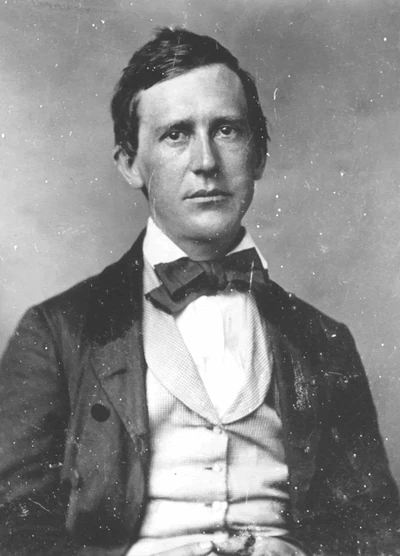
Stephen Foster
| Name | Stephen Foster |
| Title | American songwriter (1826-1864) |
| Gender | Male |
| Birthday | 1826-07-04 |
| nationality | United States of America |
| Source | https://www.wikidata.org/wiki/Q305202 |
| pptrace | View Family Tree |
| LastUpdate | 2025-11-17T06:39:59.279Z |
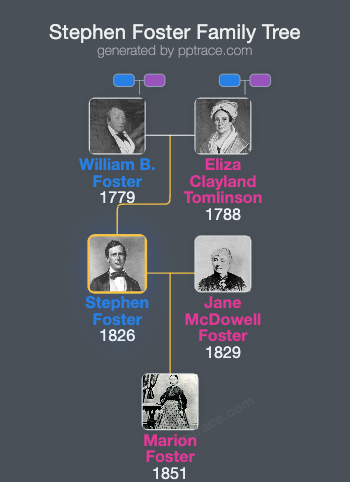
Family Tree
Tap  to expand more relatives
Introduction
Stephen Collins Foster (July 4, 1826 – January 13, 1864) was an American composer recognized for his contributions to parlour and folk music during the Romantic period. He composed over 200 songs, including notable titles such as "Oh! Susanna," "Hard Times Come Again No More," "Camptown Races," "Old Folks at Home" ("Swanee River"), "My Old Kentucky Home," "Jeanie with the Light Brown Hair," "Old Black Joe," and "Beautiful Dreamer." Many of his compositions remain part of American musical heritage.
Foster was born on July 4, 1826, in Lawrenceville, Pennsylvania. His parents were William Barclay Foster and Eliza Clayland Tomlinson Foster, of Ulster Scots and English descent. He had three older sisters and six older brothers. Foster attended private academies in Allegheny, Athens, and Towanda, Pennsylvania, where he studied English grammar, diction, classics, penmanship, Latin, Greek, and mathematics. He was largely self-taught in music, learning to play the clarinet, guitar, flute, and piano.
In 1839, Foster’s brother William, then apprentices as an engineer in Towanda, arranged for Stephen to study music under Henry Kleber, a Pittsburgh-based German-born music dealer. Under Kleber’s tutelage, Foster studied compositions of Mozart, Beethoven, Weber, Mendelssohn, and Schubert. The site of the Camptown Races, which later inspired one of Foster’s well-known songs, was located nearby Athens and Towanda. Foster also briefly attended Jefferson College in Canonsburg, Pennsylvania, but left without completing his studies.
On July 22, 1850, Foster married Jane Denny McDowell. During their honeymoon, they visited New York and Baltimore. Following his marriage, Foster returned to Pennsylvania and authored many of his best-known songs, including "Camptown Races" (1850), "Nelly Bly" (1850), "Ring de Banjo" (1851), "Old Folks at Home" ("Swanee River," 1851), "My Old Kentucky Home" (1853), "Old Dog Tray" (1853), and "Jeanie with the Light Brown Hair" (1854), the latter written for his wife.
Most of Foster's early work was associated with blackface minstrel performances, which were popular during that era. Foster aimed to elevate the taste of popular songs by creating lyrics suited to refined audiences, avoiding what he considered "trashy" content. After the early 1850s, his focus shifted toward parlor music. Although many of his songs featured Southern themes, Foster never resided in the South and visited it only once during his honeymoon. Archival evidence does not indicate that he held abolitionist views.
The final years of Foster’s life were spent in New York City, but personal details about this period are limited. In January 1864, Foster fell ill with a fever. It is suggested that he may have fallen and cut his neck or attempted self-harm. His colleague George Cooper found him alive but bleeding in a hotel in the Bowery. Foster died three days later at Bellevue Hospital, at the age of 37. A scrap of paper was found in his wallet, bearing the words "Dear friends and gentle hearts," along with 37 cents in Civil War scrip and three pennies. Alternative accounts of his death exist, with historian JoAnne O'Connell and musicologist Ken Emerson suggesting possible suicide or accidental injury, citing certain songs Foster composed in his last years that foreshadowed his death.
Foster was interred at Allegheny Cemetery in Pittsburgh. Following his death, his brother Morrison Foster became his literary executor, managing requests for manuscripts, autographs, and biographical information. The song "Beautiful Dreamer" was published posthumously in 1864, becoming one of his most enduring works.
As a composer, Foster grew up amidst Pittsburgh’s diverse European immigrant community, influenced by Italian, Scots-Irish, and German musical traditions. His first composition, the "Tioga Waltz," was written at age 14. His earliest published song was "Open thy Lattice Love" in 1844. Foster’s work included songs supporting drinking, temperance, and church hymns, the latter published until around 1910. His hymns include "Seek and ye shall find," "All around is bright and fair, While we work for Jesus," and "Blame not those who weep and sigh." During the Civil War era, some of his hymns were performed by groups such as The Old Stoughton Musical Society.
Foster also arranged works by prominent European composers for flute and guitar and often sent handwritten scores directly to publishers, which retained his manuscripts. Some of his original scores are held in private collections and in the Library of Congress.
Foster's music has had enduring influence through its adaptation and reinterpretation. His songs, lyrics, and melodies have been altered over time, and his compositions have appeared in various popular and cultural contexts, including recordings by artists such as Ray Charles and references in musical and literary works.