Herbert Feis
| Name | Herbert Feis |
| Title | American historian (1893-1972) |
| Gender | Male |
| Birthday | 1893-06-07 |
| nationality | United States of America |
| Source | https://www.wikidata.org/wiki/Q5734072 |
| pptrace | View Family Tree |
| LastUpdate | 2025-11-16T10:16:56.384Z |
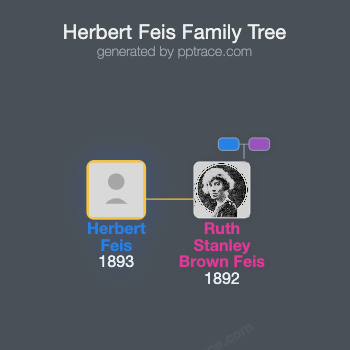
Family Tree
Tap  to expand more relatives
Introduction
Herbert Feis (June 7, 1893 – March 2, 1972) was an American historian, author, and economist. He held the position of Advisor on International Economic Affairs within the United States Department of State during the administrations of Presidents Herbert Hoover and Franklin D. Roosevelt. This role was the highest-ranking economic official in the department at the time. Following his government service, Feis dedicated approximately 25 years to scholarly research and writing, focusing on the diplomatic history of the United States during the period surrounding World War II.
Feis was born in New York City. His parents, Louis Feis and Louise Waterman Feis, were Jewish immigrants from Alsace, France, who emigrated to the United States in the late 1800s. The family initially resided in the Lower East Side of Manhattan before relocating to the Upper West Side, where Feis completed his high school education at Townsend Harris Hall Prep School. He attended Harvard College for his undergraduate studies, subsequently earning a doctoral degree (Ph.D.) in Economics from Harvard University.
He married Ruth Stanley-Brown, the granddaughter of the 20th U.S. President James A. Garfield; together, they had one daughter. Professionally, Feis was an instructor at Harvard University from 1920 to 1921. He then served as an associate professor of economics at the University of Kansas from 1922 to 1925, and as a professor and department head at the University of Cincinnati from 1926 to 1929. His early scholarly work included a series of studies in economics, and from 1922 to 1927, he was an adviser on the American economy to the International Labor Office (ILO) of the League of Nations, based in Geneva, Switzerland.
In 1930, Feis published his first significant book, "Europe, the World's Banker, 1870-1914," which examined European foreign investment and the intersection of global finance with diplomacy before the outbreak of World War I. His work drew the attention of U.S. Secretary of State Henry L. Stimson, who recruited Feis to serve in the State Department. Feis worked there from 1931 to 1943, advising successive secretaries of state, including Stimson and Cordell Hull. His duties included shaping U.S. international economic policies and representing the country at numerous international conferences, such as the 1933 London economic conference and the Conferences of American Republics in Buenos Aires (1936), Lima (1938), and Panama (1939).
As World War II drew closer, Feis chaired the U.S. government's Interdepartmental Committee on Stockpiling strategic and critical raw materials. From 1943 to 1947, he rejoined Stimson, who had become Secretary of War. After leaving government service, Feis devoted the remainder of his career to historical scholarship, writing extensively on U.S. diplomatic history covering the pre-war, wartime, and early Cold War periods. His access to classified documents and personal experience informed his analysis of U.S. foreign policy shifts, particularly the transition from isolationism to active international engagement.
Feis authored eleven books, including "Between War and Peace: The Potsdam Conference" (1960), which received the Pulitzer Prize for History in 1961. This book explores the Potsdam Conference and the origins of the Cold War. His interpretations of the Cold War's origins, particularly regarding the use of nuclear weapons and global intervention, have been subjects of scholarly debate and reassessment over the decades.
Critics have noted that Feis's close involvement with governmental policy led some to question his objectivity. Some argued that his perspective was influenced by his insider experience, with accusations that he adhered too closely to an "establishment line." Nonetheless, many scholars recognize his work as a detailed and informed account of diplomatic history, leveraging unique access to government documents and personal insight.
The Herbert Feis Award, established in 1984 by the American Historical Association, recognizes recent scholarship by public historians or independent scholars in the field of history.
Feis's published works include titles such as "The Road to Pearl Harbor" (1950), "Churchill, Roosevelt, Stalin" (1957), "Japan Subdued" (1961), "The Atomic Bomb and the End of World War II" (1966), and "From Trust to Terror" (1970), among others.