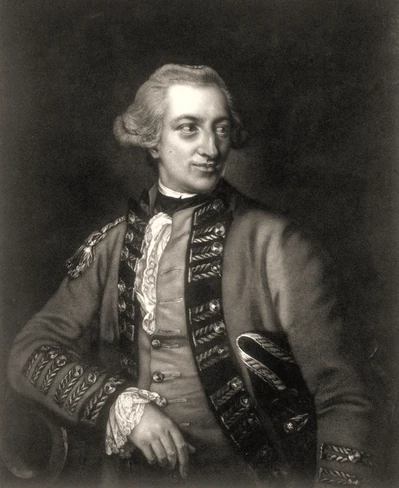
Hugh Percy, 2nd Duke Of Northumberland
| Name | Hugh Percy, 2nd Duke Of Northumberland |
| Title | British Army general (1742-1817) |
| Gender | Male |
| Birthday | 1742-08-14 |
| nationality | Great Britain |
| Source | https://www.wikidata.org/wiki/Q335502 |
| pptrace | View Family Tree |
| LastUpdate | 2025-11-26T23:23:01.549Z |
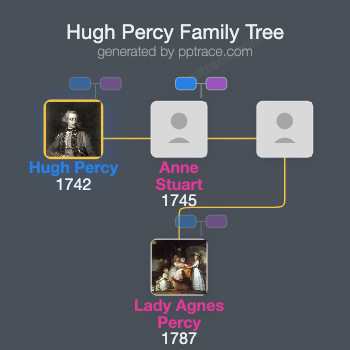
Family Tree
Tap  to expand more relatives
Introduction
Hugh Percy, 2nd Duke of Northumberland, born Hugh Smithson on 14 August 1742, was a British Army officer and politician. He died on 10 July 1817. Percy was the son of Sir Hugh Smithson and Lady Elizabeth Seymour, who was the heiress of the House of Percy. In 1750, following the death of his maternal grandfather, Algernon Seymour, 7th Duke of Somerset, his father inherited the title of Earl of Northumberland and changed his surname to Percy by Act of Parliament. Hugh Percy was styled Lord Warkworth from 1750 until 1766 and Earl Percy from 1766, when his father was created Duke of Northumberland. He succeeded to the dukedom in 1786 after his father's death.
Percy joined the British Army in 1759 as a teenager. By age 17, he had attained the rank of captain in the 85th Regiment of Foot. He participated in battles at Bergen and Minden in 1759. In 1760, he enrolled at St John's College, Cambridge. On 2 July 1764, he married Lady Anne Crichton-Stuart, daughter of Lord Bute. The same year, he was promoted to full colonel and appointed aide-de-camp to the King.
Throughout his early career, Percy was known to have health issues, including gout and poor eyesight. He was described as physically unattractive, being overly thin with a large nose. Despite these traits, he was recognized for his bravery, manners, and generosity.
In Parliament, Percy served as the member for Westminster from 1763 to 1776, where he opposed policies leading to the American War of Independence. In 1774, Percy was deployed to Boston with the rank of brigadier general and colonel of the 5th Regiment of Foot, later known as the Northumberland Fusiliers. His views on military discipline were progressive for the time; he opposed corporal punishment and led by example. Percy’s actions during the Battles of Lexington and Concord involved organizing his forces to provide protection and using artillery to break American militia formations. He demonstrated tactical skill during these confrontations, including a strategic maneuver that surprised colonial forces and turned the tide of the British retreat from Cambridge.
Percy was absent during the Battle of Bunker Hill, reportedly due to a disagreement with General Howe. In 1776, he commanded a division at the Battle of Long Island and led the assault on Fort Washington. By 1777, he held the rank of lieutenant general but resigned from his command owing to disagreements with General Howe, especially regarding military strategy and conduct in New England.
Percy’s personal life included a divorce from Lady Anne Crichton-Stuart in 1779 due to her alleged adultery. Subsequently, he married Frances Julia Burrell on 23 May 1779, with whom he had six daughters and three sons. Three daughters and two sons survived him.
In 1786, Percy succeeded to his father’s dukedom and engaged in agricultural improvements and estate management. He was involved in political influence but never held office. He was created a Knight of the Garter in 1788, promoted to full general in 1793, and held various military commands, including the Percy Yeomanry Regiment and the Royal Horse Guards.
Percy was known for his temper and considerable wealth. He died suddenly of rheumatic gout in July 1817 and was interred in the Northumberland Vault within Westminster Abbey. His successor was his son, Hugh Percy, 3rd Duke of Northumberland. His illegitimate half-brother was James Smithson, the founder of the Smithsonian Institution.