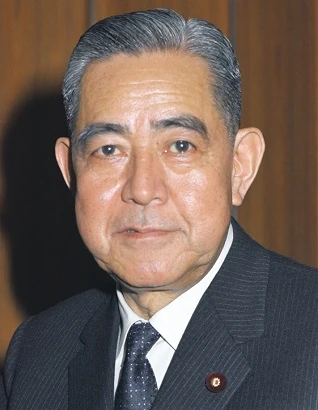
Eisaku Satō
| Name | Eisaku Satō |
| Title | Prime Minister of Japan from 1964 to 1972 |
| Gender | Male |
| Birthday | 1901-03-27 |
| nationality | Japan |
| Source | https://www.wikidata.org/wiki/Q179871 |
| pptrace | View Family Tree |
| LastUpdate | 2025-11-17T06:46:26.794Z |
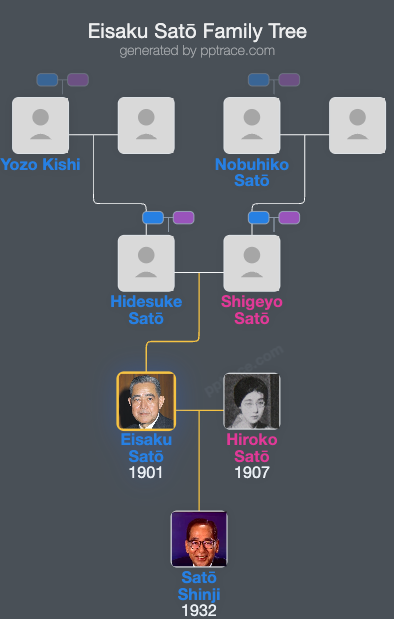
Family Tree
Tap  to expand more relatives
Introduction
Eisaku Satō (佐藤 栄作, Satō Eisaku) was a Japanese politician born on 27 March 1901 in Tabuse, Yamaguchi Prefecture, Japan. He died on 3 June 1975. Satō was a member of the Satō–Kishi–Abe family and was the younger brother of Nobusuke Kishi, who served as Prime Minister of Japan from 1957 to 1960. His father, Hidesuke Satō, had worked in the Yamaguchi Prefectural Office before establishing a sake brewing business.
Satō graduated from Tokyo Imperial University in 1924, where he studied German law. After graduation, he joined the Ministry of Railways, eventually serving as Director of the Osaka Railways Bureau from 1944 to 1946 and Vice-Minister for Transport from 1947 to 1948. His career in civil service laid the groundwork for his later political roles.
He entered Japanese politics as a member of the Liberal Party in 1949 and subsequently became a member of the National Diet. Satō held several cabinet positions during the 1950s and early 1960s, including Minister of Postal Services and Telecommunications (1951–1952), Minister of Construction (1952–1953), Chief Cabinet Secretary (1953–1954), Minister of Finance under his brother Nobusuke Kishi (1958–1960), and Minister of International Trade and Industry (1961–1962). He also served as head of the Hokkaidō Development Agency and the Science and Technology Agency (1963–1964).
In 1964, Satō became the President of the Liberal Democratic Party (LDP) and assumed the office of Prime Minister of Japan, succeeding Hayato Ikeda. He served as Prime Minister until 1972, making him the third longest-serving Japanese Prime Minister and the second-longest uninterrupted serving Prime Minister in Japanese history. His tenure was marked by rapid economic growth and developments in foreign policy.
During his administration, Satō oversaw the normalization of diplomatic relations with South Korea, signing the Treaty on Basic Relations Between Japan and the Republic of Korea in 1965. He was the last Japanese Prime Minister to visit Taiwan, doing so in September 1967, and in 1969, he emphasized Taiwan's defense as vital to Japan's security. Satō adopted policies to strengthen U.S.-Japan relations, including the renewal of the U.S.–Japan Security Treaty in 1970 and the negotiation for the return of Okinawa, which was occupied by U.S. forces since the end of World War II. Okinawa was formally returned to Japan on 15 May 1972.
In terms of nuclear policy, Satō introduced the "Three Non-Nuclear Principles" in December 1967, pledging non-production, non-possession, and non-introduction of nuclear weapons into Japan. He signed the Nuclear Non-Proliferation Treaty in 1968. Despite these public commitments, later declassified documents indicated that he had discussed with U.S. officials the possibility of stationing nuclear weapons on Japanese soil and secretly allowed U.S. bases to host nuclear warheads even after Okinawa's reversion.
His foreign policy also involved balancing relations with China and the United States, opposing President Nixon's visit to China, and protesting the entry of the People's Republic of China into the United Nations in 1971. Early in his tenure, he was supportive of South Vietnam during the Vietnam War and participated in creating the Asian Development Bank in 1966.
The late 1960s saw significant student protests related to university overcrowding, opposition to the U.S.-Japan Security Treaty, and anti-Vietnam War sentiments. Responding to the protests, Satō's government authorized the use of riot police to clear campuses. The controversy over the treaty's renewal and protests culminated in large-scale demonstrations but ultimately the treaty was allowed to renew automatically in 1970.
Satō resigned in 1972 amidst economic challenges and declining public support. He was succeeded by Kakuei Tanaka as Prime Minister, although his influence waned after his protégé Takeo Fukuda did not assume leadership.