Kōki Ayabe
| Name | Kōki Ayabe |
| Title | A pioneering educator, technologist, and Christian evangelist shaping Japan's modernization during the Meiji era. |
| Gender | Male |
| Birthday | 1835-01-19 |
| nationality | Japan |
| Source | https://www.wikidata.org/wiki/Q53765021 |
| pptrace | View Family Tree |
| LastUpdate | 2025-11-27T11:15:47.428Z |
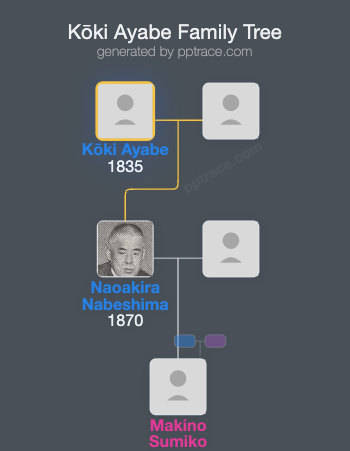
Family Tree
Tap  to expand more relatives
Introduction
Kōki Ayabe (born December 21, Tenpō 5 / January 19, 1835 – March 17, 1899, Meiji 32) was a samurai of the Saga Domain during the late Edo period, a technologist, educator, and Christian evangelist during the Meiji era. During his time in Saga Domain, he studied English in Nagasaki and was baptized as a Christian. He was born in Saga Domain, the illegitimate son of a concubine of the Fukabori Nabeshima family. His birthdate was December 21, Tenpō 5 (January 19, 1835). His childhood name was Kakiyo, later called Shikanosuke.
Around the beginning of Kaei era, Ayabe became the adopted son of Kohei Ayabe, and studied Confucianism and martial arts at the domain school Kōdōkan. In 1862 (Bunkyū 2), he was dispatched to Nagasaki along with Ijirō Shimouchi upon orders from the domain’s reserve team, where he began studying English. That autumn, together with Shūzō Honno, a retainer of his half-brother Masanori Murata, he visited Fr. Fribdech in Nagasaki, where he studied the Bible and deepened his knowledge of Christianity. Notably, after the Ikedama incident, recognizing the worsening Japan-UK relations, he advised Fribdech to evacuate abroad.
He revisited Nagasaki in 1866 (Keiō 2), re-encountering Fribdech with his family. During this visit, he was baptized; he was the third Japanese, after Taku San’yū and Sōmura Shōzō, to receive Christian baptism before the ban was lifted. Subsequently, he was assigned to Dazaifu, where he guarded prominent court nobles including Sanjō Sanetomi.
In 1868 (Keiō 4), he traveled to Tokyo accompanying Naotaka Nabeshima and participated in the funeral procession as a special attendant. During this period, he also took part in military activities. In 1869 (Meiji 2), he held positions such as reserve officer in the army, assistant in artillery drill, and acting head of the surveying department, engaging in surveying and artillery training.
After the Meiji Restoration, he moved to Tokyo to serve as a government official. In 1870 (Meiji 3), he proposed the teaching of arithmetic in Tokyo, and in May 1871 (Meiji 4), under the auspices of Saga Prefecture, he worked as a junior engineer at the Shipbuilding Office of the Ministry of Industry and at Yokosuka Naval Arsenal, involved in advanced technical training. He later transferred to the Naval Ministry’s main shipyard, then moved to the Army Ministry, working in Sendai and Kumamoto.
In 1878 (Meiji 11), he resigned from the Army Ministry voluntarily and established the Suryō Gakusha (Survey and Mathematics School) in Ginza, Tokyo, engaging in educational activities. The following year, he joined the Tax Bureau of the Ministry of Finance, working on tax affairs.
In 1883 (Meiji 16), he resigned from the Ministry of Finance and founded Seishōsha in Kōjimachi, Tokyo, where he taught Chinese classics and Western mathematics. The school’s name was derived from a passage in the Analects. In 1887 (Meiji 20), the school was relocated to another site. Besides his educational activities, he renewed his interactions with Fribdech and resumed religious work, becoming involved with the activities of the American Methodist Episcopal Church.
Kōki Ayabe’s career encompassed education, technology, and religious activities during the Meiji era.