Henry Waters Taft
| Name | Henry Waters Taft |
| Title | American lawyer |
| Gender | Male |
| Birthday | 1859-05-27 |
| nationality | United States of America |
| Source | https://www.wikidata.org/wiki/Q5729899 |
| pptrace | View Family Tree |
| LastUpdate | 2025-11-17T06:42:41.778Z |
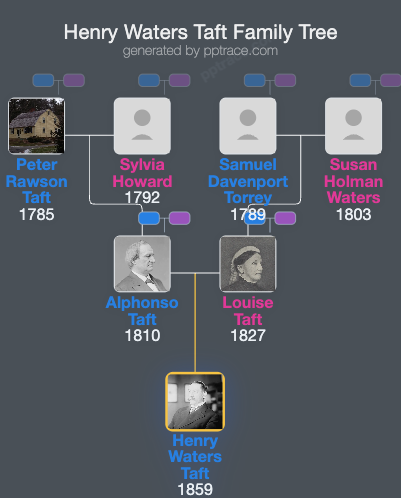
Family Tree
Tap  to expand more relatives
Introduction
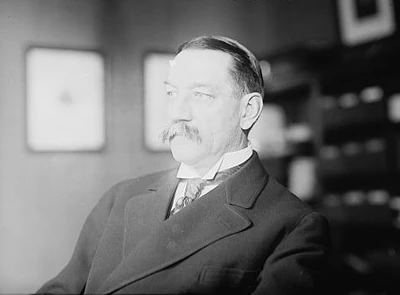
Henry Waters Taft (May 27, 1859 – August 11, 1945) was an American lawyer and writer. He was the son of Alphonso Taft and the brother of William Howard Taft, the 27th President of the United States.
He completed his undergraduate education at Yale University, earning a Bachelor of Arts degree in 1880. During his time at Yale, he was a member of the Skull and Bones society and served as the commencement orator for the class of 1880. He also attended Cincinnati Law School and Columbia Law School. In 1905, Yale awarded him an honorary Master of Arts degree.
Taft was admitted to the bar in 1882 and initially practiced law in Ohio. Subsequently, he joined the firm Strong & Cadwalader in New York City, which later became Cadwalader, Wickersham & Taft. He served as counsel to the New York, New Haven & Hartford Railroad.
In his legal career, Taft sought judicial appointment; he ran unsuccessfully for Justice of the New York Supreme Court. In 1907, he declined an appointment to the position offered by President Theodore Roosevelt. He was appointed to the New York Charter Revision Commission in 1908. Between 1905 and January 1907, he served as a special assistant to the United States Attorneys General William H. Moody and Charles Joseph Bonaparte, investigating and prosecuting the Tobacco Trust. During this period, he advocated for the production of certain books by the Tobacco Trust, which the company refused to produce as evidence.
Taft held several public service roles, including Chair of the Permanent Legal Advisory Board for Greater New York from 1917 to 1919 and membership on the New York State Commission on Reorganization from 1925 to 1926. In 1926, he was appointed to the Appellate Division of the New York Supreme Court.
He was actively involved in numerous organizations. He was a Trustee of the Mutual Life Insurance Company and the Central Savings Bank. From 1896 to 1900, he served on the New York City Board of Education. He was Trustee of the College of the City of New York from 1903 to 1905, and Trustee of the New York Public Library from 1908 to 1919. Additionally, he was President of the Council of the University Settlement House (1917–1919) and engaged in investigations related to public schools and education costs in New York City during the 1930s. He was a member of the Republican Party and served as a delegate to the 1920 and 1924 Republican National Conventions.
Taft authored several articles on the League of Nations for the New York Times and other newspapers, including The Times. He was a supporter of the League and wrote extensively on the subject.
He was involved with the Salvation Army, serving as Chairman of the Advisory Board for New York City from 1920 to 1940.
Taft participated in the annual convention of the American Bar Association, which included a visit to Bohemian Grove. He remarked on the cultural and social significance of the gathering, noting its unique community and the connection of his brother William Howard Taft to the Bohemian Club.
He was a member of various professional and social organizations, including the Association of the Bar of the City of New York (Vice President, 1911–1912), the New York County Lawyers' Association (Vice President, 1914–1918, 1923–1930; President, 1930–1932), and the New York State Bar Association (President, 1919–1920). His memberships also extended to the American Law Institute, the International Law Association, and the Maritime Law Association.
Taft served as President of the Japan Society of New York from 1923 to 1929 and again from 1934 until 1941, resigning following the attack on Pearl Harbor. He received honors from Japan, including the Order of the Sacred Treasure and the Order of the Rising Sun, Gold and Silver Star, both in 1929.
He authored several works, including “Occasional Papers and Addresses of an American Lawyer” (1920), “Japan and the Far East Conference” (1921), “Law Reform—Papers and Addresses by a Practicing Lawyer” (1926), and “A Century and a Half at the New York Bar” (1938).
Henry Waters Taft died in New York City on August 11, 1945, after being hospitalized for fourteen weeks due to a hip injury from a fall.