Philip Herbert, 4th Earl Of Pembroke
| Name | Philip Herbert, 4th Earl Of Pembroke |
| Title | English courtier and politician (1584-1650) |
| Gender | Male |
| Birthday | 1584-10-10 |
| nationality | Kingdom of England |
| Source | https://www.wikidata.org/wiki/Q1620547 |
| pptrace | View Family Tree |
| LastUpdate | 2025-11-26T23:21:03.628Z |
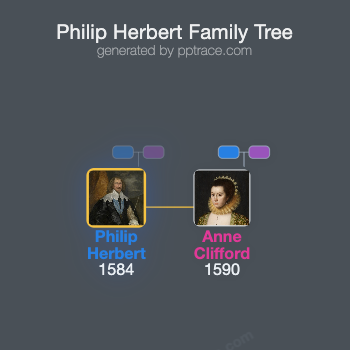
Family Tree
Tap  to expand more relatives
Introduction
Philip Herbert, 4th Earl of Pembroke and 1st Earl of Montgomery, was born on 10 October 1584 at Wilton House. He was the son of Henry Herbert, 2nd Earl of Pembroke, and his third wife, Mary Sidney, who was the sister of Sir Philip Sidney. Herbert was named after his maternal uncle and received early education at New College, Oxford, in 1593, although he left after a few months.
In 1600, Herbert made his first appearance at the royal court, and upon the accession of James I in 1603, he attracted the king's attention. His interests in hunting and hawking were noted as areas that drew favor from James I. Herbert was appointed a gentleman of the privy chamber and was made a Knight of the Bath in July 1603. In the same year, he married Susan de Vere, the youngest daughter of Edward de Vere, 17th Earl of Oxford, with the marriage ceremony taking place in December, facilitated by King James I. The marriage was notably supported by the king, who played a significant role in the arrangements and provided financial gifts.
Herbert was elected Member of Parliament for Glamorgan in 1604. During James I's reign, Herbert received numerous honors, including being created Baron Herbert of Shurland and Earl of Montgomery, and being made a Knight of the Garter in 1608. His interests extended to court masques, tournaments, and gambling, the latter resulting in substantial debts which King James eventually paid off in 1606 or 1607. Herbert served as high steward of Oxford in 1615 and was involved in several personal disputes, including conflicts with Henry Wriothesley, 3rd Earl of Southampton, and Lord Howard de Walden, though these were often resolved or forgiven with royal intervention.
Herbert was involved in early colonial ventures, participating in the Virginia Company from 1612, and was a founding member of the Northwest Passage Company and the Honourable East India Company in 1612 and 1614 respectively. He was appointed keeper of the Palace of Westminster and St. James's Park in 1617, Lord Lieutenant of Kent in 1624, and a privy councillor in December of the same year.
Following the accession of Charles I in 1625, Herbert continued to hold favor. He accompanied the Queen, Henrietta Maria, from Paris to England and participated in the coronation ceremony. Herbert succeeded his older brother as Earl of Pembroke in 1630 after his brother's death, inheriting additional titles and responsibilities, including Lord Warden of the Stannaries and high steward of the Duchy of Cornwall. His household in London and Wilton House in Wiltshire were sizable, with upwards of 80 and 150 staff members respectively.
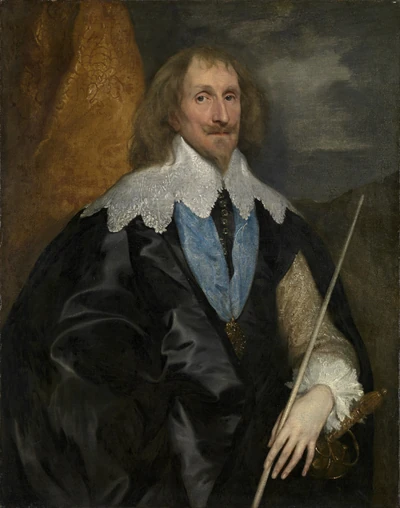
Pembroke was a patron of the arts, notably supporting painter Anthony van Dyck and being involved in the Whitehall group. He amassed a significant art collection and was engaged in literary patronage, including the dedication of more than forty books. His most renowned literary connection was as the dedicatee of Shakespeare’s First Folio of 1623, which was dedicated to him and his elder brother. He also promoted the careers of Philip Massinger and George Herbert, the latter through advocacy with Charles I.
Throughout the 1630s, Pembroke actively participated in cultural pursuits and hosted Charles I at Wilton House annually. He encouraged the rebuilding of Wilton House in the Palladian style, recommending Inigo Jones for the project. As a collector and patron, Pembroke maintained a keen interest in painting, literary works, and the arts. He was a member of the Whitehall group and supported artists such as Richard Gibson.
Religiously inclined toward "godly Protestantism" and sympathetic to Puritanism, Pembroke found himself in opposition to Queen Henrietta Maria and Archbishop William Laud. His political stance included support for the Covenanters during the Bishops’ Wars, advocating for peace. During the early 1640s, he was involved in negotiations with the Scots and contributed to parliamentary politics, including voting for the bill of attainder against Thomas Wentworth, 1st Earl of Strafford.
His relationship with King Charles I deteriorated over religious and political disagreements, culminating in his resignation as Lord Chamberlain after a violent altercation in 1642. During the English Civil War, which began in 1642, Pembroke aligned with the Parliamentarians, though he maintained a moderate position. His involvement in the political conflicts persisted until the late 1640s. Philip Herbert died on 23 January 1650.