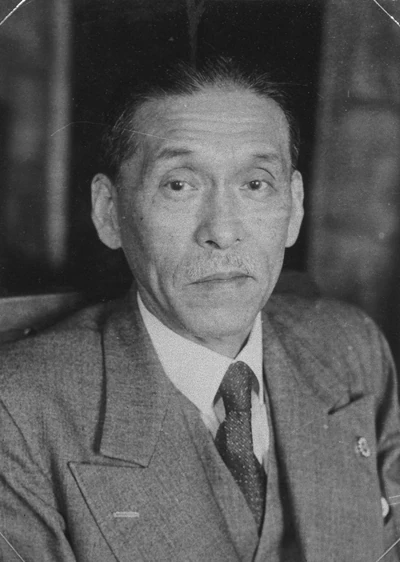
Hitoshi Ashida
| Name | Hitoshi Ashida |
| Title | Japanese politician (1887-1959) |
| Gender | Male |
| Birthday | 1887-11-15 |
| nationality | Japan |
| Source | https://www.wikidata.org/wiki/Q315725 |
| pptrace | View Family Tree |
| LastUpdate | 2025-11-17T06:46:12.720Z |
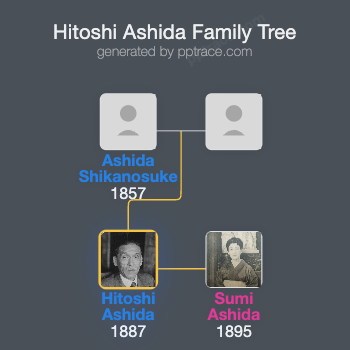
Family Tree
Tap  to expand more relatives
Introduction
Hitoshi Ashida (芦田 均, Ashida Hitoshi) was born on 15 November 1887 in Fukuchiyama, Kyoto, Japan. He was the second son of politician and banker Shikanosuke Ashida, who served as a member of the House of Representatives and as director of Nōkō Bank. His grandfather, Jizaemon Ashida, was a landed magnate and village headman (nanushi). Ashida pursued legal studies at Tokyo Imperial University, where he specialized in French civil law. Following his graduation, he worked in the Ministry of Foreign Affairs for approximately twenty years.
In 1932, Ashida was elected to the House of Representatives as a member of the Seiyūkai Party. During the political realignment in 1939, he aligned with Ichirō Hatoyama's "orthodox" faction following the split within Seiyūkai. After World War II, Ashida secured a seat in the newly established National Diet as a representative of the Liberal Party. He subsequently split from this party to form the Democratic Party through a merger with Kijūrō Shidehara's Progressive Party. He was elected president of the Democratic Party and was appointed Minister of Foreign Affairs in 1947 under Prime Minister Tetsu Katayama, who was associated with socialist policies.
Ashida played a significant role in constitutional reform efforts, chairing the Committee on the Bill for Revision of the Imperial Constitution and serving as chairman of the Kenpō Fukyū Kai from 1946 to 1948. During this period, he contributed to amendments to Article Nine of the Japanese Constitution, facilitating the establishment of the Japan Self-Defense Forces.
In 1948, Ashida became Prime Minister of Japan as the head of a coalition government comprising Democratic and Socialist members. His tenure lasted approximately seven months, ending in June 1948 due to a corruption scandal involving two cabinet ministers. The scandal, known as the Shōwa Denkō Jiken, implicated Takeo Kurusu, a state minister without portfolio, among others, which led to the resignation of Ashida’s cabinet. His government faced additional challenges, including operating on a temporary budget until a full fiscal budget was approved in July 1948.
Following his brief tenure as Prime Minister, Ashida concentrated on Japan's regional relations and re-armament. He became an advocate for establishing a Japanese defense force, emphasizing the importance of national security in light of the outbreak of the Korean War. He supported the idea of Japanese volunteers participating alongside United Nations forces in Korea and toured Japan in 1951 to promote his interpretation of Article Nine, asserting that Japan's constitution did not prohibit the development of defensive forces.
In 1958, Ashida was officially cleared of all charges related to the corruption allegations. He passed away on 20 June 1959 at the age of seventy-one.