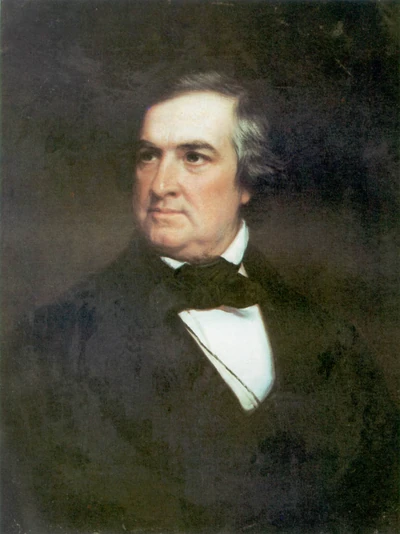
James Madison Porter
| Name | James Madison Porter |
| Title | American politician (1793-1862) |
| Gender | Male |
| Birthday | 1793-01-06 |
| nationality | United States of America |
| Source | https://www.wikidata.org/wiki/Q331036 |
| pptrace | View Family Tree |
| LastUpdate | 2025-11-17T06:40:21.117Z |
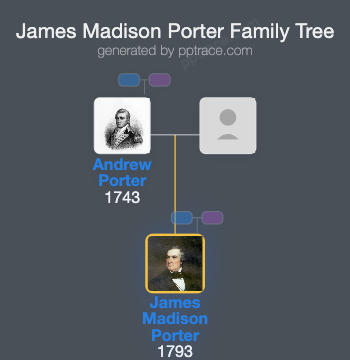
Family Tree
Tap  to expand more relatives
Introduction
James Madison Porter was born on January 6, 1793, in Norristown, Pennsylvania, on his family's estate called Selma. He was the youngest of thirteen children born to General Andrew Porter and Elizabeth Parker Porter. During his early years, Porter and his older brother, Judge Robert Porter, received homeschooling and later attended Norristown Academy for further education.
In 1809, Porter began his career studying law and worked as an office clerk, partly at the request of his father, who served as Pennsylvania's Surveyor General. This early experience provided him with foundational knowledge leading to his admission to the bar in 1813. Subsequently, he was appointed attorney general for Northampton County, Pennsylvania.
Porter’s military involvement commenced during the War of 1812. In 1813, he organized militia units along the Delaware River amid rumors of British invasion, an effort that was well received by the local community despite British threats not materializing. His military service paused after he moved to Easton, Pennsylvania, in 1818; he resumed public service in 1843 when appointed Secretary of War ad interim by President John Tyler.
Porter served in the cabinet for approximately eleven months. His appointment was a recess appointment and was not confirmed by the Senate, owing to strained relations between President Tyler and the Senate. Following the Senate's rejection, Porter resigned his position and returned to Easton.
In the business sector, Porter was influential in railroad development and resource extraction industries. He was the first president of the Delaware, Lehigh, Schuylkill, and Susquehanna Railroad, which was incorporated in 1847 and later became the Lehigh Valley Railroad in 1853. He declined re-election in 1856 when the company moved its headquarters to Philadelphia. Additionally, he served as president of the Belvidere Delaware Railroad Company and the Easton Delaware Bridge Company, which opened its line from Easton to Mauch Chunk in 1855.
Porter's investments extended to natural resources; in 1817, he organized the Northampton Quarry Company to operate a slate quarry near the Delaware River in Upper Mount Bethel County. By the 1830s, this enterprise was renamed the Pennsylvania Slate Company. He also invested in limestone quarries, coal mines, and iron ore mines. Furthermore, Porter founded the Dime Savings Institute of Easton, a local savings bank, and was involved in establishing the Farmers’ and Mechanics’ Institute of Easton, aimed at promoting the arts and trades.
His political career included serving as deputy attorney general for Northampton County starting in 1818 and participating in efforts to reform Pennsylvania's constitution in 1838. In that year, he was elected to the Pennsylvania General Assembly, where he served as chairman of the Committee on the Bill of Rights. In 1839, appointed by his brother David Rittenhouse Porter, who was then governor of Pennsylvania, James received a recess appointment as President Judge for judicial districts including Dauphin, Schuylkill, and Lebanon counties, but he was never confirmed by the Senate.
In 1849, Porter was elected to the Pennsylvania House of Representatives, serving for a year. From 1853 to 1855, he served as President Judge in a judicial district encompassing Wayne, Pike, Monroe, and Carbon counties. Due to health concerns, Porter retired from public service around age 63.
Porter was a founder of Lafayette College. The initiative was inspired by Lafayette's visit to America in 1824-1825. Influenced by Lafayette's presence and personal exchanges, Porter envisioned establishing a college in Easton. He collaborated with other community leaders to draft a charter for Lafayette College, which was ratified by the Pennsylvania General Assembly on January 6, 1826, and later approved by the governor on March 9, 1829. The college was intended to provide higher education, including instruction in military science and the German language, reflecting local heritage.
James Madison Porter died on November 11, 1862.