
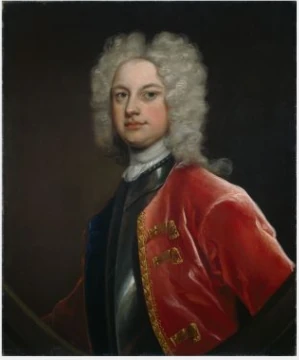
William Cosby
| Name | William Cosby |
| Title | British military officer, governor of the province of New York |
| Gender | Male |
| Birthday | 1690-01-01 |
| nationality | — |
| Source | https://www.wikidata.org/wiki/Q8007142 |
| pptrace | View Family Tree |
| LastUpdate | 2025-11-26T23:24:26.211Z |
Family Tree
Tap  to expand more relatives
Introduction
William Cosby (1690 – 10 March 1736) was a British military officer and colonial administrator who served as the governor of New York from 1732 until his death in 1736.
**Early Life and Family Background**
William Cosby was born in 1690 in Stradbally Hall, Queen's County, Ireland. His father was Alexander Cosby of Stradbally, a member of an English family that emigrated to Ireland in 1590. His mother was Elizabeth L'Estrange, associated with the Protestant Ascendancy. In 1709, at the age of 19, Cosby traveled to Italy, earning money through gambling, before enlisting in the British Army in Spain in 1710 under General Stanhope's command.
**Military Career and Marriage**
Cosby’s military progression included ranks such as cornet of the 5th Dragoon Guards in 1705, captain of the 2nd Dragoon Guards in 1711, and colonel of the Royal Regiment of Ireland from 1717 to 1732. In 1711, he married Grace Montagu, the sister of George Montagu, 1st Earl of Halifax. The couple had five children: William (born 1713), Grace (born 1716), Henry (born 1719), Elizabeth (born 1721), and another Grace (born 1723). All children were born in Britain, mainly in Westminster. Both sons pursued careers in the military. A third son, Alexander, was born in 1717 and was likely Grace’s son, not William’s, based on contemporary records.
**Service in the Balearic Islands**
In 1717, Cosby became colonel of the Royal Regiment of Ireland, which was transferred to Menorca in the Balearic Islands in 1718. He served as governor of Menorca during this period. His administration was relatively unremarkable, though it involved an incident where he illegally seized a Portuguese ship and attempted to appropriate its cargo of snuff.
**Governorship of New York**
Following the accession of King George II, Cosby was appointed on 13 January 1732 as "Captain General & Governor in Chief of the Provinces of New York, New Jersey and Territories depending thereon in America." He succeeded John Montgomerie, who had died shortly after assuming office, with Rip Van Dam serving as interim governor until Cosy’s arrival. At that time, New York had approximately 50,000 inhabitants, with a port that was experiencing significant commercial activity.
**Land Grants and Promotions**
In 1734, King George II granted Cosby 22,000 acres on the Mohawk River, in present-day Herkimer County, New York. These lands were known as Cosby's Manor and were later sold in 1772. During his governorship, Cosby was promoted to vice admiral on 29 September 1735 and to brigadier general on 30 November 1735.
**Political Disputes and administrative conflicts**
Cosby’s tenure was marked by disputes over salaries. Upon his arrival, he demanded that acting governor Van Dam transfer half of his salary, leading to legal conflict. Cosby subsequently took Van Dam to court, insisting on proceeding through equity jurisdiction, which was unpopular among colonists. He also dismissed Justice Lewis Morris from the provincial court and replaced him with loyalists, actions that contributed to accusations of tyranny. Cosby and his supporters formed the "court party," which was opposed by the "country party," led by Morris and others. These conflicts shaped the political landscape of New York during this period.
**Land Encroachments and Native Relations**
Cosby engaged in illegal land seizures in Hopewell, New Jersey, favoring royalist allies. These actions led to local unrest and retaliatory attacks by settlers. On the frontier, Cosby was criticized for neglecting Native American relations, resulting in military defeats by various tribes and the reorganization of the Iroquois Confederacy.
**The Zenger Trial**
Supported by opposition newspapers, notably the New York Weekly Journal founded by John Peter Zenger, Cosby attempted to suppress criticism through arrests and censorship. In 1734, he ordered the burning of certain issues of the newspaper, and Zenger was arrested on charges of seditious libel. His trial in 1735 resulted in Zenger’s acquittal, establishing an important precedent for freedom of the press in America.
**Death**
William Cosby died on 10 March 1736 while still serving as governor of New York.
