
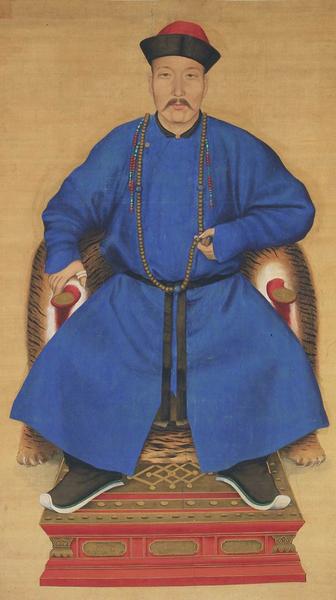
Ts'ering
| Name | Ts'ering |
| Title | Qing dynasty person |
| Gender | Male |
| Birthday | 1650-00-00 |
| nationality | Qing dynasty |
| Source | https://www.wikidata.org/wiki/Q7368579 |
| pptrace | View Family Tree |
| LastUpdate | 2025-10-27T03:41:10.551Z |
Family Tree
Tap  to expand more relatives
Introduction
Cerleng (Mongolian script: ᠴᠡᠷᠢᠩ; Cyrillic: Цэрэн; Manchu script: ᡮ᠊ᡝᡵᡳᠩ; transliteration: ts῾ering; 1672–1750), of the Borjigit clan, a Kharakhtai Tümedge Minai (Khan), and the twentieth grandson of Genghis Khan. His great-grandfather was Tumunken.
His life and career began with his ancestors' surrender to the Qing Dynasty. In the thirty-first year of Kangxi (1692), his grandfather Danlü's wife Gechulehatan brought Cerleng and his younger brother Genglerabután from their initial residence in Tämür into the Qing Empire. Kangxi granted high official titles: Cerleng was appointed as a Light Car Carriage Captain, remained in Beijing to study in the inner court, and his subordinate divisions were incorporated into the Plain Yellow Banner of the Banners of the Kharchin. In the forty-fifth year of Kangxi (1706), he was betrothed to the emperor’s tenth daughter, receiving the title of Heshuo Efu and the Bofen rank. They married in May, and his wife was granted the title of Heshuo Chunque Gongzhu. Subsequently, he was ordered to return to the old Tämür area, successfully repelling invading Zunghar forces. In the fifty-ninth year of Kangxi (1720), he participated in multiple campaigns with Fülhürdan against the Zunghars, earning the rank of Zasak.
In the first year of Yongzheng (1723), he was specially appointed as a Duke of the Tuo clan. In the second year (1724), he was stationed in Altai, promoted to Vice-General, and awarded the title of Kharakhtai Tümedge Wang due to military achievements. His mother-in-law, Tongpin, was also promoted because of his military successes. That same year, his daughter from Princess Dunke married him and Subešritt, the son of Princess Chunque. Additionally, the accompanying retainers of Princess Dunke and the wife of Genglerabután, Princess Chunque’s younger brother-in-law, were incorporated into the Mongolian Banner under the Plain Yellow Banner, managed by Subešritt. Subešritt was also ennobled as a Fuguo Gong (Duke of a Successor State), rated higher than a Mongolian duke. In the fifth year of Yongzheng (1727), he accompanied Imperial Grand Secretary Sigei and others to the Chukuro River to meet with Russian envoys SaValev and set boundary markers, signing the Bureinsky Treaty; in the ninth year (1731), he achieved a great victory over the Zunghar forces at Odenchule, was promoted to Heshuo Qinwang (Junior Prince), awarded ten thousand taels of silver, and given the title of Kharakhtai Dazasaq. In the tenth year of Yongzheng (1732), following the Battle of Guangxansi, he was granted the title of Chao Yongqinwang (Supreme Courageous Prince) and promoted to Guluen Efu (Emperor’s Consort). The Qing court allocated 19 banners from Tüshitu Khan's territories to him, collectively called the Sai Nuo Yan division. In the eleventh year of Yongzheng (1733), he was appointed as Left Vice General of Dingbian and stationed in Khovd.
In the first year of Qianlong (1736), he stationed troops at Uliya Su Tai. He died in the fifteenth year of Qianlong (1750) and was worshipped at the Xiannian Temple in the capital. Cerleng had eight sons; his eldest son, Chengun Zhab, was named heir apparent and later inherited the Zasak Prince title and the position of Mönkhtai (alliance leader). His second son was Cebüden Zhab. Additionally, he was one of the two Mongols officially honored alongside Prince Zheng in the Imperial Ancestral Temple of the Qing Dynasty, recognized for his contributions in pacifying the Zunghar threat and being related to the imperial family.
