John Spencer
| Name | John Spencer |
| Title | English politician (16th century) |
| Gender | Male |
| Birthday | — |
| nationality | — |
| Source | https://www.wikidata.org/wiki/Q16863731 |
| pptrace | View Family Tree |
| LastUpdate | 2025-11-26T13:06:51.008Z |
Family Tree
Tap  to expand more relatives
Introduction
Sir John Spencer (died 1610) was an English merchant and served as Lord Mayor of London. He was the son of Richard Spencer of Waldingfield in Suffolk. Spencer moved to London, where he became known as "Rich Spencer" for his success in trade. His commercial activities involved extensive dealings with Spain, Turkey, and Venice; in 1591, he was accused of engrossing the entire trade with Tripoli alongside two other merchants.
In 1570, Spencer acquired Canonbury House from Thomas Wentworth, 2nd Baron Wentworth, and in 1581, Queen Elizabeth I is said to have visited him at this residence. Spencer was associated with the Clothworkers' Company, becoming a member at an unspecified date. He was elected alderman for the Langbourn ward on August 9, 1587, and served as Sheriff of the City of London during 1584–1585. He held the office of Lord Mayor of London in 1594–1595.
During his tenure as sheriff, Spencer was involved in efforts to suppress Catholicism in Holborn and nearby areas, including the detention of Anthony Bassano and other musicians employed by Queen Elizabeth I. At the end of 1594, a period marked by food scarcity, Spencer issued orders to the city companies to stockpile corn at the Bridge House granaries for relief efforts. He also resisted a request from Admiral Sir John Hawkins to take control of the Bridge House for naval use and biscuit production.
Spencer resided at Crosby Place in Bishopsgate Street during his mayoralty. He purchased and restored this mansion, which had previously belonged to Antonio Bonvisi and William Bond, the father of Martin Bond. In 1604, Spencer hosted prominent guests at Crosby Place, including the Duc de Sully (then M. de Rosny) and a young prince from the House of Orange, along with delegates like Barnevelt and Fulke, representing Holland.
Towards the end of his mayoralty, Spencer asserted the right of the City of London to elect a recorder freely, a prerogative that was feared might be challenged by the Crown. He was knighted prior to the conclusion of his mayoralty. In May 1609, Spencer declined to contribute to a funding initiative for King James I on behalf of Prince Henry Frederick, and he delayed a £200 contribution from the Clothworkers' Company meant for the Ulster settlement, which was eventually paid by his executors.
Spencer served as president of St. Bartholomew's Hospital from 1603. He died on March 3, 1610, at an advanced age, shortly after the death of his widow, who passed away on March 27, 1610. He was buried on March 22 in the parish church of St. Helen, Bishopsgate, where his memorial tomb was established. His funeral was notably elaborate. His wealth was estimated to be considerable, and his inheritance reportedly affected his son-in-law, Lord Compton.
Among Spencer's real estate holdings were the manors of Brooke Hall, Bower Hall, and Bocking, acquired from Queen Elizabeth I on August 1, 1599. He left no significant bequests to public causes. A residential square laid out in Canonbury in 1963 was named John Spencer Square in his honor; he was associated with the area in the early 17th century, having a country retreat there.
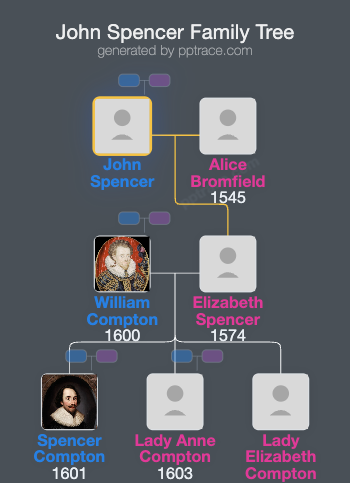
Spencer was married to Alice Bromfield, and they had a single daughter, Elizabeth. In 1598, William Compton, 2nd Lord Compton, sought to marry Elizabeth. Spencer disapproved of the match, and in 1599, he was imprisoned in the Fleet Prison for allegedly mistreating his daughter, who was then secretly married to Compton. Elizabeth was carried off from Canonbury Tower by her lover in a baker's basket, and the marriage followed thereafter. Spencer did not provide a marriage portion, and after Elizabeth became a mother in 1601, Spencer showed no immediate signs of reconciliation. It is suggested that Elizabeth and her husband reconciled with Spencer following intervention from Queen Elizabeth I.