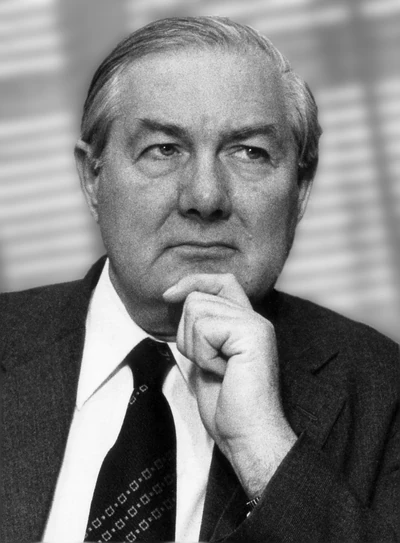
James Callaghan
| Name | James Callaghan |
| Title | former prime minister of the United Kingdom (1912–2005) |
| Gender | Male |
| Birthday | 1912-03-27 |
| nationality | United Kingdom |
| Source | https://www.wikidata.org/wiki/Q9576 |
| pptrace | View Family Tree |
| LastUpdate | 2025-11-26T23:33:32.382Z |
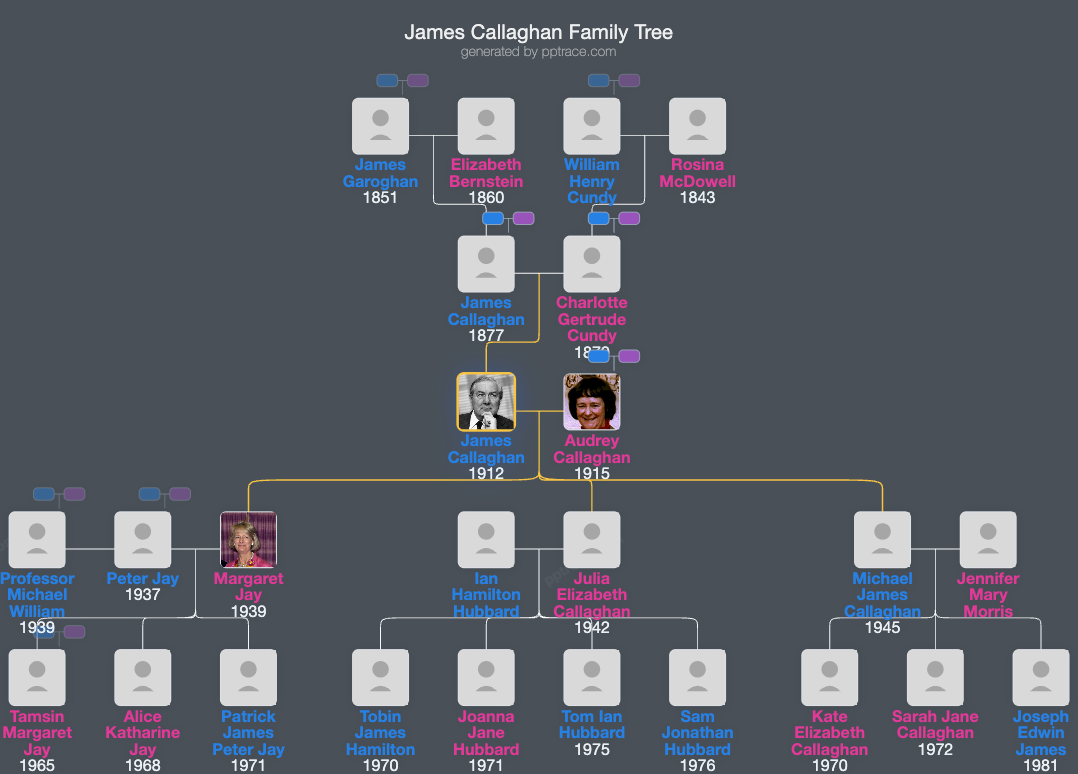
Family Tree
Tap  to expand more relatives
Introduction
Leonard James Callaghan, Baron Callaghan of Cardiff, was born on 27 March 1912 in Portsmouth, England, and died on 26 March 2005. He was a British politician affiliated with the Labour Party and held all four of the United Kingdom's Great Offices of State during his career. His full title was Baron Callaghan of Cardiff, and he was also known as Jim Callaghan.
He was born into a working-class family in the district of Copnor, Portsmouth. His father, James Callaghan, who had Irish Catholic and Jewish ancestry, served in the Royal Navy and later joined the Coastguard after World War I. His mother was Charlotte Callaghan, née Cundy, an English Baptist. James Callaghan's father went missing in the 1890s, having falsified his age and changed his surname to enlist in the Navy. After his father's death from a heart attack in 1921, the family faced financial hardship, which was alleviated in 1924 when the Labour government introduced policies providing widows' pensions.
Callaghan attended Portsmouth Northern Secondary School and obtained the Senior Oxford Certificate in 1929. Unable to afford university tuition, he took the Civil Service entrance exam and began working as a clerk for the Inland Revenue at age 17. He joined the Maidstone branch of the Labour Party and a trade union for civil service workers, serving as office secretary for the Association of the Officers of Taxes (AOT). In 1932, he advanced to become a senior tax officer after passing a Civil Service exam. By 1934, he transferred to London and, following union mergers in 1936, became a full-time union official and assistant secretary of the Inland Revenue Staff Federation.
In July 1938, Callaghan married Audrey Moulton, whom he met during his civil service career. His involvement with trade unions and Labour Party activities drew the attention of Harold Laski, a prominent academic and Labour Party figure, who encouraged him to enter Parliament.
During the Second World War, Callaghan applied to join the Royal Navy in 1940 but was initially rejected due to his union duties being considered a reserved occupation. He was eventually accepted into the Royal Navy Volunteer Reserve as an Ordinary Seaman in 1942. During his service, he was diagnosed with tuberculosis, which temporarily hospitalised him. After recovery, he served in the Admiralty in Whitehall and was assigned to the Japanese section, where he authored a service manual titled "The Enemy: Japan." He later served aboard the escort carrier HMS Activity in the East Indies Fleet and was promoted to sub-lieutenant in April 1944. His wartime service remains notable as he is the last British prime minister to be an armed forces veteran and the only one to have served in the Royal Navy.
Callaghan was elected Member of Parliament (MP) for Fullarton (later part of Cardiff South and Penarth) in the 1945 general election. He was considered to be on the left wing of the Labour Party early in his parliamentary career. In 1947, he was appointed a parliamentary secretary in the Attlee government.
He advanced through various ministerial roles, including Chancellor of the Exchequer from 1964 to 1967, during which he managed economic challenges, including a balance of payments deficit and speculative attacks on the pound sterling. Following the devaluation of the pound in 1967, he was made Home Secretary, overseeing operations in Northern Ireland and domestic security.
In 1974, Callaghan became Foreign Secretary, where he negotiated the UK's terms of membership with the European Communities and supported the 1975 referendum confirming membership. He became Leader of the Labour Party in 1976 after Harold Wilson's resignation and was appointed Prime Minister on 5 April 1976. His tenure as Prime Minister included navigating a fragile parliamentary majority, leading to a confidence and supply agreement with the Liberal Party. The "Winter of Discontent" strikes in 1978–1979 and the unsuccessful Scottish devolution referendum contributed to the loss of power. The Labour government was defeated in the 1979 general election, after which Callaghan served as Leader of the Opposition until 1980.
Following his retirement from front-line politics, he returned to the backbenches and became Father of the House of Commons from 1983 to 1987. In 1987, he was ennobled as Baron Callaghan of Cardiff and entered the House of Lords. He died in 2005, aged 92.