Mary Todd Lincoln
| Name | Mary Todd Lincoln |
| Title | First Lady of the United States from 1861 to 1865 |
| Gender | Female |
| Birthday | 1818-12-13 |
| nationality | United States of America |
| Source | https://www.wikidata.org/wiki/Q215062 |
| pptrace | View Family Tree |
| LastUpdate | 2025-11-17T06:40:05.943Z |
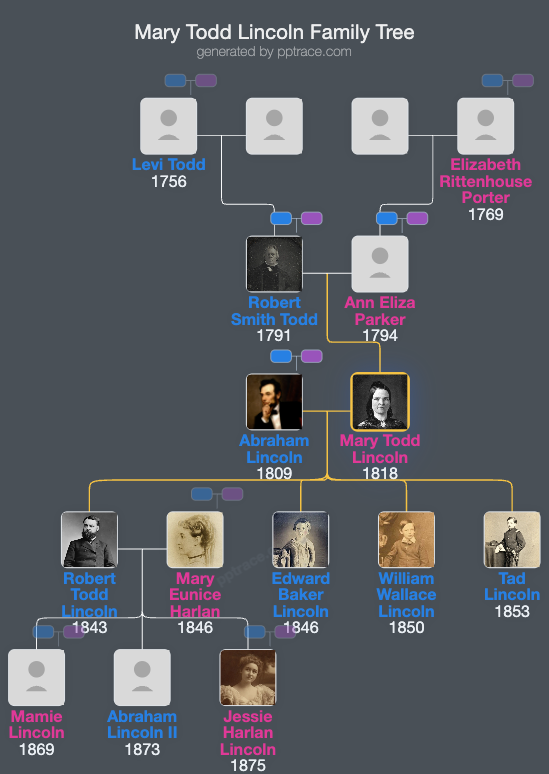
Family Tree
Tap  to expand more relatives
Introduction
Mary Ann Todd Lincoln was born on December 13, 1818, in Lexington, Kentucky, the daughter of Robert Smith Todd, a banker, and Elizabeth "Eliza" (Parker) Todd. She was the fourth of seven children in her family. Her mother died in childbirth when Mary was six years old. Subsequently, her father married Elizabeth "Betsy" Humphreys, with whom he had nine more children.
The Todd family resided in a 14-room house at 578 West Main Street in Lexington from 1832. Her paternal great-grandfather, David Levi Todd, was born in County Longford, Ireland, and immigrated through Pennsylvania to Kentucky. Other ancestors included Irish immigrants and individuals from England and Scotland. Mary Todd received private education at Madame Mentelle’s finishing school, where her studies focused on French language, literature, dance, drama, music, and social etiquette. She became fluent in French and developed an interest in social and political affairs from an early age.
In October 1839, Mary moved to Springfield, Illinois, to live with her sister Elizabeth Porter Edwards, who was married to Ninian W. Edwards, son of a former Illinois governor. Elizabeth served as Mary's guardian. In Springfield, Mary became well known among local societal circles. During this period, she was courted by Stephen A. Douglas, a Democratic politician and Lincoln's political adversary, but ultimately chose to pursue a relationship with Abraham Lincoln, a young lawyer and member of the Whig Party.
Mary Todd and Abraham Lincoln first met at her sister’s house. Their relationship was initially opposed by Elizabeth and Ninian Edwards due to Lincoln’s comparatively modest social standing and uncertain future. The engagement was broken off on January 1, 1841 — an event Lincoln referred to as "that fatal first of January." Following a period of separation, the couple rekindled their relationship secretly and married on November 4, 1842. Mary was 23 years old, and Abraham was 33. Their wedding took place at Ninian Edwards's house, after Lincoln confided his intentions to Ninian and received his approval.
The couple’s first home was a small apartment in a tavern in Springfield. They had four sons: Robert Todd Lincoln (1843–1926), Edward Baker Lincoln ("Eddie") (1846–1850), William Wallace Lincoln ("Willie") (1850–1862), and Thomas Lincoln ("Tad") (1853–1871). Robert was the only son to survive both parents, as Eddie and Willie died young, with Willie passing during Abraham Lincoln’s presidency, and Tad dying at age 18.
While Abraham Lincoln built his legal career in Springfield, Mary managed their household independently. The Lincoln family residence from 1844 until 1861 is preserved as the Lincoln Home National Historic Site. During Lincoln’s political rise, Mary supported his career and was active in social and political life, often hosting social functions and participating in her husband's political activities.
In 1860, Abraham Lincoln was elected President, and Mary became the First Lady of the United States in March 1861. Her tenure coincided with the American Civil War. Her family was divided over slavery; some of her half-brothers served in the Confederate Army, and one operated as a Confederate surgeon. Despite these divisions, Mary was loyal to her husband’s efforts to preserve the Union.
As First Lady, Mary Lincoln oversaw the refurbishment and redecorating of the White House, which involved significant expenditure and led to criticism for overspending. She was also known for her interest in jewelry, often purchasing pieces on credit, some of which were returned after her husband's assassination.
During her White House years, Mary endured personal hardships, including chronic migraines and depression, possibly bipolar disorder or pernicious anemia. She suffered the death of her son Willie in 1862 and experienced profound grief over her husband's assassination on April 14, 1865, at Ford’s Theatre in Washington, D.C., while seated beside him in the President’s Box.
Her marriage and family life were marked by the loss of her husband and three of their children. After Lincoln’s death, she faced financial difficulties and mental health challenges. She was briefly institutionalized in 1875 and subsequently traveled in Europe for several years. Later, she retired to her sister Elizabeth’s home in Springfield, where she died on July 16, 1882, at the age of 63. She is buried alongside Abraham Lincoln and three of her sons in the Lincoln Tomb, designated as a National Historic Landmark.