William Godolphin, Marquess Of Blandford
| Name | William Godolphin, Marquess Of Blandford |
| Title | British Marquess |
| Gender | Male |
| Birthday | 1700-01-01 |
| nationality | — |
| Source | https://www.wikidata.org/wiki/Q8009949 |
| pptrace | View Family Tree |
| LastUpdate | 2025-11-26T23:21:42.022Z |
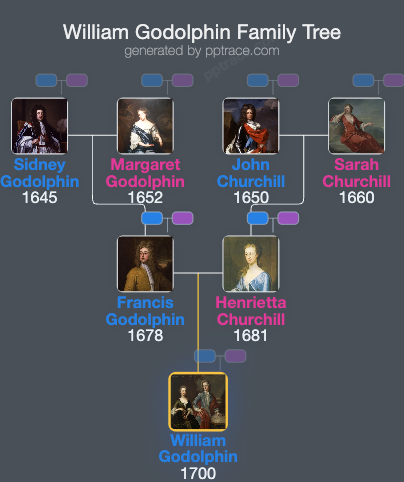
Family Tree
Tap  to expand more relatives
Introduction
William Godolphin, Marquess of Blandford (circa 1699 – 24 August 1731), was an English nobleman and politician. He was known earlier by the courtesy title Viscount Rialton until 1722. He served as a Member of Parliament (MP) in the House of Commons from 1720 to 1731. As the heir to the Dukedom of Marlborough and the Earldom of Godolphin, he was among the wealthiest individuals in England during his lifetime.
Family Background and Early Life:
William Godolphin was the eldest son of Francis Godolphin, 2nd Earl of Godolphin, and Lady Henrietta Churchill, who later became the suo jure Duchess of Marlborough. His grandparents included Sidney Godolphin, 1st Earl of Godolphin, and John Churchill, 1st Duke of Marlborough. In 1712, his father inherited the title of Earl of Godolphin, having been promoted to that rank in 1706. As the designated heir to the earldom, William adopted the courtesy title Viscount Rialton. He received education at Pembroke College, Cambridge.
Political Career:
On 9 June 1720, Hugh Boscawen, the MP for Penryn, was elevated to the House of Lords as Viscount Falmouth following succession. William Godolphin, then Viscount Rialton, was elected to the House of Commons on 24 June 1720, representing Penryn as a Whig. His familial relation to Lord Falmouth stemmed from both paternal and maternal lines, as Falmouth was a grandson of Sir Francis Godolphin and had married Charlotte Godfrey, daughter of Arabella Churchill. William served as MP for Penryn for the remainder of that Parliament and did not stand in the 1722 general election.
In 1722, upon the death of his maternal grandfather, the Duke of Marlborough, the title was inherited by his mother, Henrietta Churchill, through a special Act of Parliament. William then assumed the higher courtesy title of Marquess of Blandford, as he was now heir to the Marlborough dukedom as well as his father’s earldom. He returned to Parliament in the 1727 general election, winning a seat for Woodstock on 21 August. On 30 August 1730, he was awarded an honorary Doctor of Civil Laws degree from the University of Oxford.
Marriage and Personal Life:
William Godolphin married Maria Catherina Haeck de Jong on 25 April 1729. She was the daughter of Peter Haeck de Jong, a burgomaster of Utrecht. The marriage was conducted without the consent of William’s parents and was considered socially unconventional, as Lady Blandford was neither English nor of noble birth. Her sister, Isabella, had married the Earl of Denbigh. Despite the lack of noble status, Lady Blandford was noted to have had a jointure of four thousand pounds per year and was regarded as a good wife.
Death and Succession:
William Godolphin died suddenly of apoplexy at Balliol College, Oxford, on 24 August 1731. His death was possibly precipitated by excessive drinking, according to Lord Egmont’s diary. He left no children and had no surviving brothers; consequently, the succession to his family titles was affected. The heir to the Marlborough dukedom became his first cousin, the Earl of Sunderland. John Spencer, brother of the Earl of Sunderland, was elected MP to replace William in January 1732. The Earldom of Godolphin had no direct heir, but in 1735, Lord Godolphin was granted a barony to provide opportunities for more distant family members to succeed the title.
Widow’s Later Life:
Lady Blandford remarried on 1 June 1734 to Sir William Wyndham, a Tory Member of Parliament, at Harlington, Middlesex. She was widowed again in 1740 and died at Sheen on 7 September 1779.
Assessment:
Contemporary commentary, such as that from Lord Egmont’s diary, described William as a man of several commendable qualities, including charity and virtue, especially regarding his conduct with women prior to marriage. However, he was also noted for drinking excessively and associating with low company. Despite his piety and lack of pride or ambition, his personal faults and social environment were seen to influence his character. Historian Vicary Gibbs suggested that inherent qualities were hindered by the joviality of the times and his educational errors, leading him astray.
See also:
- William Feilding, 5th Earl of Denbigh
(Note: The biography contains only factual information available from the original source up to October 2023. No subjective or evaluative language has been included.)