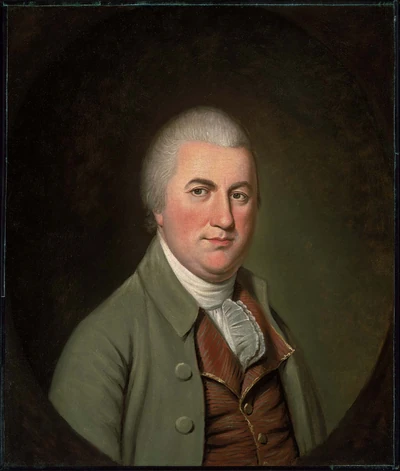
Nathaniel Gorham
| Name | Nathaniel Gorham |
| Title | American businessman and politician 1738-1796 |
| Gender | Male |
| Birthday | 1738-05-27 |
| nationality | United States of America |
| Source | https://www.wikidata.org/wiki/Q1378295 |
| pptrace | View Family Tree |
| LastUpdate | 2025-11-17T06:38:21.038Z |
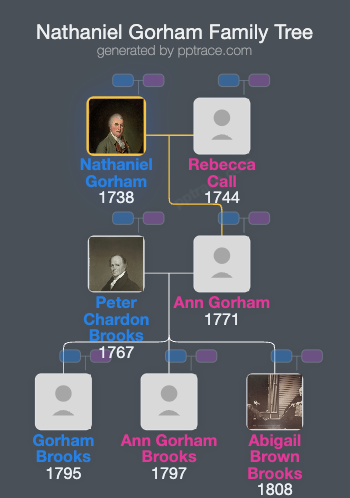
Family Tree
Tap  to expand more relatives
Introduction
Nathaniel Gorham (May 27, 1738 – June 11, 1796) was an American politician, merchant, and Founding Father associated with Massachusetts. His early life included an apprenticeship with a merchant in New London, Connecticut, starting at age 15, followed by the establishment of a merchant house in Charlestown, Massachusetts, in 1759.
Gorham was involved in political affairs during the American Revolution. He served in the Massachusetts General Court from 1771 to 1775, was a delegate to the Provincial Congress from 1774 to 1775, and was a member of the Board of War from 1778 until its dissolution in 1781. In 1779, he participated in the Massachusetts state constitutional convention.
He served as a delegate to the Congress of the Confederation in two periods, from 1782 to 1783 and from 1785 to 1787. During his second term, he presided over the Congress as its president from June 6 to November 5, 1786, succeeding John Hancock. Gorham also served as a judge of the Middlesex County Court of Common Pleas.
Gorham was a candidate for the U.S. Congress in the 3rd district in 1788 and in 1790, winning the primary ballot in 1788 but losing in the subsequent election, and was the runner-up for the U.S. Senate in 1790. He married Rebecca Call (1744–1812), who descended from Anglican vicar John Maverick and his wife Mary Gye Maverick. They had nine children.
In 1786, Gorham allegedly suggested to Alexander Hamilton that Prince Henry of Prussia might become the president or king of the United States; the proposal was revoked before the prince could respond. Gorham was one of the Massachusetts delegates to the United States Constitutional Convention in 1787, often presiding over the Convention's Committee of the Whole during deliberations.
Following the Convention, Gorham actively supported the ratification of the U.S. Constitution in Massachusetts. He was involved in land acquisitions with Oliver Phelps in 1788, purchasing pre-emption rights from the state of Massachusetts to a large tract in western New York across the Genesee River, which had been ceded from New York. He was responsible for surveying, laying out townships, and selling land to settlers and speculators, including his son Nathaniel Gorham Jr.
Phelps and Gorham later defaulted on their payments, selling remaining lands east of the Genesee to Robert Morris, who resold those lands to the Pulteney Association. They surrendered the remaining Native American land in 1790, which was then acquired by Morris and resold to others.
Nathaniel Gorham died in Charlestown in 1796. He is buried in the Phipps Street Cemetery in Charlestown. His legacy includes places named in his honor, such as Gorham Street in Madison, Wisconsin, and the town of Gorham, New York.
Gorham's descendants number in the thousands. Notable among them are his son Benjamin Gorham, a U.S. Representative from Massachusetts; Bishop Phillips Brooks, known for the Christmas carol "O Little Town of Bethlehem"; and members of the Adams family, including Charles Francis Adams Jr., John Quincy Adams II, Charles Francis Adams III, and Charles Francis Adams IV. Other descendants include William Everett, a U.S. Representative; Henry Adams, a historian and author; and several prominent individuals in business and law.