Nicholas Longworth
| Name | Nicholas Longworth |
| Title | American politician (1869-1931) |
| Gender | Male |
| Birthday | 1869-11-05 |
| nationality | United States of America |
| Source | https://www.wikidata.org/wiki/Q465874 |
| pptrace | View Family Tree |
| LastUpdate | 2025-11-29T01:00:49.600Z |
Family Tree
Tap  to expand more relatives
Introduction
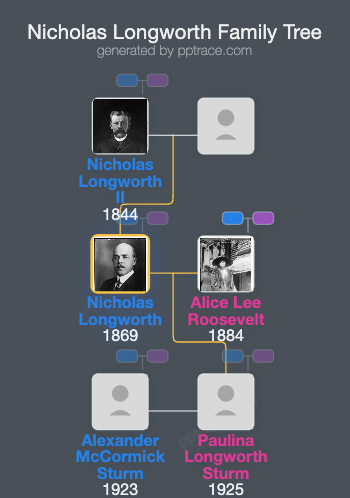
Nicholas Longworth III was born on November 5, 1869, in Cincinnati, Ohio. He was the son of Nicholas Longworth II and Susan Walker, belonging to the Longworth family, which was prominent, wealthy, and influential in Cincinnati. His paternal lineage included Joseph Longworth and Nicholas Longworth I, a distinguished winemaker.
Longworth attended the Franklin School in Cincinnati and later graduated from Harvard College in 1891. At Harvard, he was a member of the Delta Kappa Epsilon fraternity and the Porcellian Club. After receiving his bachelor's degree, he spent one year at Harvard Law School before transferring to Cincinnati Law School, where he earned his law degree in 1894.
He was known to play the violin and had an active interest in music. His first visit to Bayreuth was documented by his wife, Alice Lee Roosevelt, as a significant musical experience. Longworth's musical talents and understanding were recognized by prominent conductor Leopold Stokowski, who described Longworth as having a natural understanding of music.
After completing his education, Longworth established a law practice in Cincinnati. His early involvement in public service began with a position on Cincinnati's Board of Education in 1898. As a protege of Republican boss George B. Cox, Longworth was elected to the Ohio General Assembly, serving in the Ohio House of Representatives in 1899 and 1900, and subsequently in the Ohio State Senate from 1901 to 1903.
In 1902, Longworth played a key role in the formulation and passage of the Longworth Act, legislation regulating municipal bonds issuance in Ohio. This law has been recognized as one of Ohio's most successful legislative efforts.
Longworth was elected to the United States House of Representatives from Ohio's 1st congressional district, which included Cincinnati and nearby counties. He began his congressional career as a bachelor but married Alice Lee Roosevelt, the daughter of President Theodore Roosevelt, on February 17, 1906, in a ceremony held at the White House. The marriage drew considerable public attention.
In 1925, Roosevelt gave birth to a daughter, Paulina Longworth, conceived from her affair with Senator William Borah. Although Longworth was supportive of his daughter, biographers suggest he was likely aware of Borah's paternity.
Throughout his political career, Longworth was involved in issues such as foreign relations and tariffs. During the internal split within the Republican Party in 1910–12, he sided with the conservatives supporting President William Howard Taft against Theodore Roosevelt. The partisan rift affected his political standing, leading to his narrow defeat in his re-election bid in 1912.
Longworth returned to Congress in 1915 after defeating his successor, Stanley E. Bowdle, and served continuously until his death in 1931. He became House Majority Leader in 1923 and then served as Speaker of the House from 1925 until his death in 1931. As Speaker, he aimed to restore the powers of the speakership, controlled House committees, and prioritized fiscal conservatism and opposition to expanding government programs.
He opposed President Herbert Hoover's veto of the veterans bonus bill in 1931, supporting its passage despite the veto, which led to the Bonus March of 1932. Longworth maintained a working relationship with Democrats, notably House Minority Leader John Nance Garner. They hosted informal gatherings in the Capitol known as the "Bureau of Education," fostering cross-party collaboration.
Longworth died suddenly of pneumonia on April 9, 1931, while visiting friends in Aiken, South Carolina. His remains were interred at Spring Grove Cemetery in Cincinnati. The Longworth House Office Building was named in his honor in 1962.
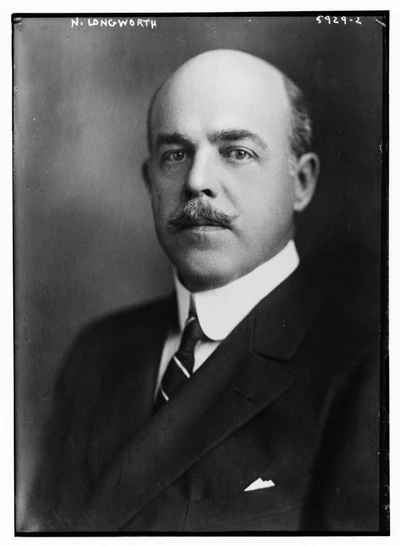
In personal character, Longworth was described as debonair and aristocratic, often seen wearing spats and carrying a gold-headed cane. His demeanor was cheerful, witty, and friendly. He was recognized for leadership qualities and tact, exercising substantial influence over House proceedings in a manner that combined authority with grace.