Prince George, Duke Of Cambridge
| Name | Prince George, Duke Of Cambridge |
| Title | British prince and military commander (1819-1904) |
| Gender | Male |
| Birthday | 1819-03-26 |
| nationality | United Kingdom of Great Britain and Ireland |
| Source | https://www.wikidata.org/wiki/Q435182 |
| pptrace | View Family Tree |
| LastUpdate | 2025-11-12T01:16:52.265Z |
Family Tree
Tap  to expand more relatives
Introduction
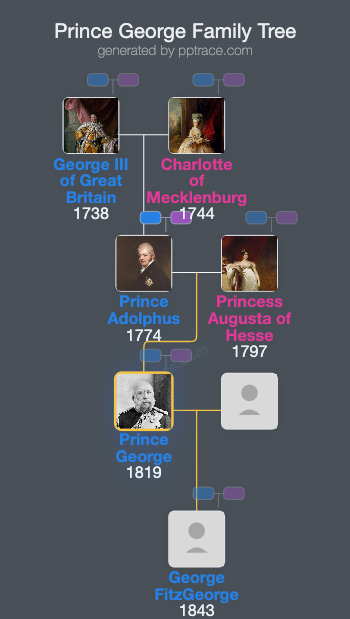
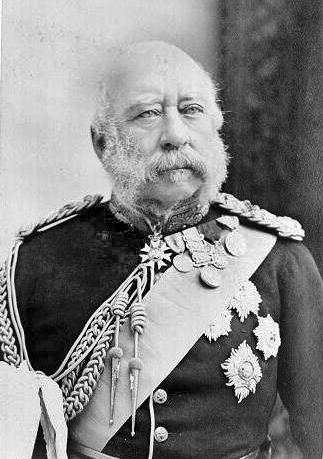
Prince George William Frederick Charles, Duke of Cambridge (26 March 1819 – 17 March 1904), was a member of the British royal family and a grandson of King George III. He was born at Cambridge House in Hanover. His father was Prince Adolphus, Duke of Cambridge, the seventh son of King George III and Queen Charlotte. His mother was Princess Augusta of Hesse-Kassel, known as the Duchess of Cambridge. Prince George was baptized on 11 May 1819 at Cambridge House by Reverend John Sanford, his father's Domestic Chaplain. His godparents included the Prince Regent (represented by the Duke of Clarence), the Duke of Clarence and St Andrews (represented by the 4th Earl of Mayo), and the Dowager Queen of Württemberg (represented by the Countess of Mayo).
Following the death of his father in 1850, he was granted an annuity of £12,000 from the Civil List. He was educated in Hanover and later in England by Rev. J. R. Wood, a canon of Worcester Cathedral. He embarked on a military career, initially serving as a colonel in the Hanoverian Army. On 3 November 1837, he became a brevet colonel in the British Army. He was attached to the staff at Gibraltar from October 1838 to April 1839. Subsequently, he served in Ireland with the 12th Royal Lancers and was appointed substantive lieutenant-colonel of the 8th Light Dragoons on 15 April 1842, and colonel of the 17th Lancers on 25 April 1842. From 1843 to 1845, he served as a colonel on the staff in the Ionian Islands, and was promoted to Major-General on 7 May 1845.
He succeeded his father as Duke of Cambridge, Earl of Tipperary, and Baron Culloden on 8 July 1850. In 1852, he became Inspector of the Cavalry. During the Crimean War (1853–1856), he received command of the 1st Division of the British army in the East at an early stage. He was promoted to lieutenant-general on 19 June 1854 and participated in significant battles, including Alma, Balaclava, and Inkerman, as well as the Siege of Sevastopol.
In December 1854, due to illness, he returned to England, as did Earl of Cardigan. The death of Lord Raglan on 28 June 1855 led to successive commanders in Crimea. The Crimean War concluded in March 1856. On 5 July 1856, he was appointed general commanding-in-chief of the British Army, a position which later became known as the commander-in-chief of the forces in 1887. He was promoted to general on 15 July 1856, and advanced to field marshal on 9 November 1862. He held the position of commander-in-chief for 39 years.
His policies included the encouragement of trials for breech-loading carbines, the formation of the Staff College and Royal Military School of Music, and the modernization of the Royal Military Academy, Woolwich. He also introduced reforms limiting corporal punishment, allowing flogging only in specific wartime scenarios for serious misconduct.
The Duke of Cambridge opposed many reforms proposed in the late 19th century, especially efforts to subordinate the Commander-in-Chief to the Secretary of State for War. He resisted changes prompted by the War Office Act of 1870 and the abolition of the purchase of commissions. His resistance was partly due to fears about the efficacy of reservist forces and regimental traditions. Queen Victoria supported reforms but also aimed to preserve longstanding military traditions. Under increasing pressure and aged, the Duke resigned on 1 November 1895 and was succeeded by Lord Wolseley. He was thereafter granted the honorary title of colonel-in-chief of various regiments.
The Duke was involved in mentoring military officers such as Douglas Haig, aiding his career development through the Staff College. His influence helped establish formal military staff structures later on, including the abolition of the Commander-in-Chief position in 1909.
Regarding his personal life, the Duke married Sarah Fairbrother, an actress, on 8 January 1847, without Queen Victoria's consent. The marriage was considered invalid under the Royal Marriages Act 1772, making her ineligible for royal title and their children illegitimate. Prior to this, he had a long-standing affair with Louisa Beauclerk, whom he considered "the idol of my life." He had three sons with Mrs. FitzGeorge, all pursuing military careers.
He held numerous honorary military titles and received several British and foreign honours, including Knight Grand Cross of the Order of the Bath, Knight Grand Cross of the Royal Victorian Order, and foreign appointments from Hanover, Brunswick, France, and other states.
Prince George died of a stomach haemorrhage in 1904 at Gloucester House, Piccadilly, London. He was buried next to his wife in Kensal Green Cemetery, London. His estate was valued at under £121,000. A notable memorial to him is an equestrian statue outside the War Office in Whitehall, London, and streets named George Road and Cambridge Road in Kingston Vale and Norbiton.
His titles, styles, and honours changed throughout his life. He was styled His Royal Highness Prince George of Cambridge until 1850, after which he was His Royal Highness The Duke of Cambridge until his death. The title of Duke of Cambridge was later revived in 2011 for Prince William, the grandson of Queen Victoria and a descendant of the Duke of Cambridge.