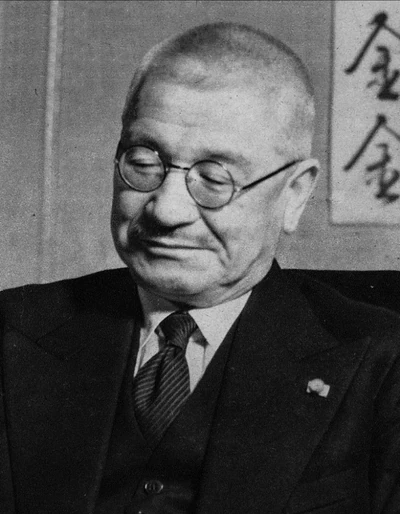
Nobuyuki Abe
| Name | Nobuyuki Abe |
| Title | general in the Imperial Japanese Army (1875-1953) |
| Gender | Male |
| Birthday | 1875-11-24 |
| nationality | Japan |
| Source | https://www.wikidata.org/wiki/Q315574 |
| pptrace | View Family Tree |
| LastUpdate | 2025-11-17T10:09:06.949Z |
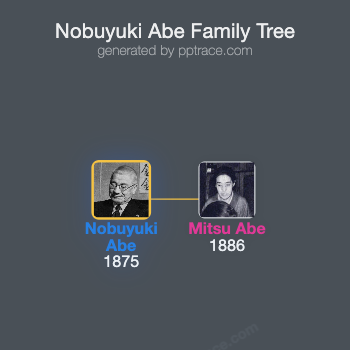
Family Tree
Tap  to expand more relatives
Introduction
Nobuyuki Abe (阿部 信行, Abe Nobuyuki) was born on November 24, 1875, in Kanazawa, Ishikawa Prefecture, Japan. He was the son of Abe Nobumitsu, a former samurai who served the Kaga Domain. Abe had a brother-in-law, Shigeyoshi Inoue, who was an admiral in the Imperial Japanese Navy.
Abe attended Tokyo No.1 Middle School, also known as Tokyo Metropolitan Hibiya High School, and subsequently No.4 High School. During his student years, he volunteered for military service in the First Sino-Japanese War. Following the conflict, he graduated from the Imperial Japanese Army Academy in November 1897 and was commissioned as a second lieutenant on June 27, 1898. He was promoted to lieutenant in November 1900 and attended the Army Artillery School, completing his studies in December 1901. Abe achieved the rank of captain in November 1903 and enrolled in the 19th class of the Army War College, graduating in November 1907. Among his classmates was General Araki Sadao, noted for his ultranationalist views.
Abe was promoted to major in December 1908 and served as an instructor at the Army War College starting September 1909. In November 1910, he was posted as a military attaché to the German Empire at the Japanese embassy; in February 1913, he became a supplementary attaché at the embassy in Vienna. He advanced to lieutenant colonel in February 1915 and to colonel on July 24, 1918. From 1918 to 1921, he commanded the 3rd Field Artillery Regiment, which was sent to Siberia during Japan’s Siberian Intervention but was not engaged in combat.
Abe became secretary of the Army War College on June 3, 1921, and was promoted to major general on August 15, 1922. He was appointed Director of the General Affairs Division of the Imperial General Staff on August 6, 1923, shortly after the Great Kanto Earthquake of September 1, 1923; he was tasked with overseeing martial law in the Kanto region. On July 28, 1926, he became director of military service affairs in the Army Ministry, and on March 5, 1927, he was promoted to lieutenant general. He held positions including chief of the Military Affairs Bureau and Vice Minister of the Army, starting August 10, 1928. Abe commanded the 4th Infantry Division beginning December 22, 1930. In January 1932, he was appointed commander of the Japanese Taiwan Army, and he was promoted to full general on June 19, 1933. After serving on the Supreme War Council, he was placed on the reserve list on March 10, 1936.
Abe served as Prime Minister of Japan from August 30, 1939, to January 1940. His appointment came as a compromise after the collapse of the Hiranuma Kiichirō cabinet; he was supported by the Army and the ultranationalists, as well as a moderate faction within the Imperial Japanese Navy. During his tenure, Abe held the concurrent position of Foreign Minister. His government aimed to expedite peace talks to end the Second Sino-Japanese War and sought to maintain neutrality amid the escalating European conflicts. He opposed forming alliances with Nazi Germany and Fascist Italy. Due to diminishing support from military and political factions, he was replaced by Mitsumasa Yonai in January 1940.
Following his premiership, Abe was dispatched as a special envoy to China in April 1940 to advise the Japanese-supported regime of Wang Jingwei in Nanjing and to negotiate treaties securing Japanese economic and military interests in northern China. He maintained his position as ambassador in Nanjing until December 1940. Returning to Japan, Abe joined the House of Peers in 1942 and served as president of the Imperial Rule Assistance Political Association. In 1944 and 1945, he was appointed the 10th and final Governor-General of Korea. After World War II, Abe was removed from public office and detained by the American occupation authorities; he was not charged with war crimes and was subsequently released.
Abe received numerous honors, including the Grand Cordon of the Order of the Sacred Treasure in November 1930 and the Grand Cordon of the Order of the Rising Sun in April 1934.
He died on September 7, 1953.