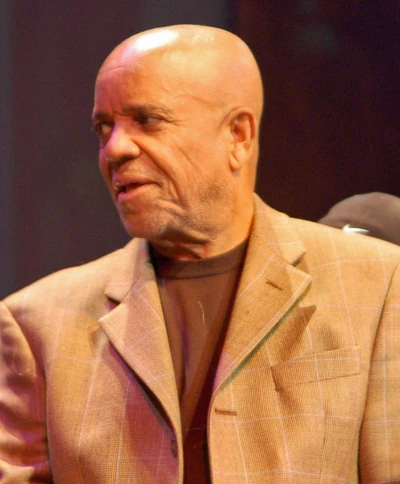
Berry Gordy
| Name | Berry Gordy |
| Title | American record producer, founder of Motown Records |
| Gender | Male |
| Birthday | 1929-11-28 |
| nationality | United States of America |
| Source | https://www.wikidata.org/wiki/Q355288 |
| pptrace | View Family Tree |
| LastUpdate | 2025-11-29T01:01:15.842Z |
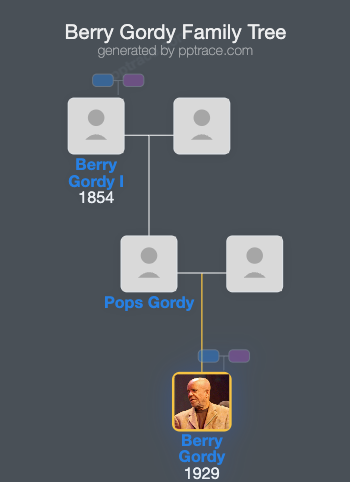
Family Tree
Tap  to expand more relatives
Introduction
Berry Gordy Jr. was born on November 28, 1929, in Detroit, Michigan. He was the seventh of eight children born to Berry Gordy (also known as Berry Gordy Sr.) and Bertha Fuller Gordy. His family relocated to Detroit from Oconee in Washington County, Georgia, in 1922, as part of the Great Migration. Gordy's grandfather, also named Berry Gordy, was the son of James Gordy, a white plantation owner in Georgia, and one of his slaves. The grandfather's lineage includes connections to President Jimmy Carter, as Gordy's half-brother James was the grandson of the elder James Gordy.
Gordy's early years were shaped by his family's occupations, including his father's ownership of a grocery store, a plastering and carpentry business, and a printing shop. He was less inclined toward the trades and more interested in dancing and music. He dropped out of Northeastern High School in the eleventh grade to pursue a career in boxing, aiming for financial success. Gordy boxed professionally until 1950, when he was drafted into the United States Army for service in the Korean War in 1951.
During his military service, Gordy was initially assigned to the 58th Field Artillery Battalion near Panmunjom and later served as a chaplain's assistant, playing organ at religious services and driving a jeep. His tour in Korea concluded in April 1953. After returning from military service, Gordy obtained a General Educational Development (GED) credential. In 1953, he married Thelma Louise Coleman in Toledo, Ohio.
Gordy's interest in music grew through songwriting and entrepreneurial efforts, including a record store called 3-D Record Mart that specialized in jazz music and 3-D glasses. The store was not successful, prompting him to seek employment at the Lincoln-Mercury plant. His family helped him connect with Al Green, owner of the Flame Show Bar Talent Club, where he met singer Jackie Wilson. In 1957, Wilson recorded "Reet Petite," a song Gordy co-wrote with his sister Gwen and Billy Davis. The song achieved modest success initially but gained popularity in the UK, reaching the Top 10, and later topped the charts upon re-issue in 1986. Wilson recorded additional songs co-written by Gordy, including "Lonely Teardrops," which topped the R&B charts and reached number 7 on the pop charts.
Gordy invested his songwriting earnings into producing music and discovering new artists. In 1957, he discovered The Miracles, originally called the Matadors, and began building a roster of successful acts. With encouragement from Smokey Robinson, leader of The Miracles, Gordy borrowed $800 from his family in 1959 to establish an R&B record company. The initial name, Tammy Records, was changed to Tamla Records after the original name was unavailable. Tamla began operations on January 12, 1959, issuing its first record, "Come to Me" by Marv Johnson. The record was distributed by United Artists Records and marked the beginning of Gordy’s focus on building a successful label.
In 1959, Gordy also released "Bad Girl," by The Miracles, which became a hit. The success of songs like "Money (That's What I Want)" by Barrett Strong and "Shop Around" by The Miracles helped solidify Motown as a major independent record label. The company officially incorporated as the Motown Record Corporation on April 14, 1960. Throughout the early 1960s, Gordy signed and promoted influential artists such as Mary Wells, The Marvelettes, The Supremes, Marvin Gaye, The Temptations, and Stevie Wonder. He managed their public images and choreography carefully, which contributed to their commercial success.
In 1972, Gordy moved to Los Angeles, where he produced films, including "Lady Sings the Blues" (1972), starring Diana Ross, and "Mahogany" (1975). He also produced "The Last Dragon" in 1985. Despite continued success, Motown’s influence waned over time. Gordy sold his interests in Motown Records to MCA and Boston Ventures on June 28, 1988, for $61 million. Additionally, he sold most of his publishing rights to EMI Publishing. Throughout his career, Gordy authored or co-authored approximately 240 songs among the roughly 15,000 recorded under his auspices.
Gordy was inducted into the Rock and Roll Hall of Fame in 1988, received the National Medal of Arts in 2016, the Kennedy Center Honors in 2021, and was inducted into the Black Music & Entertainment Walk of Fame in 2022.