Frederick Lamb, 3rd Viscount Melbourne
| Name | Frederick Lamb, 3rd Viscount Melbourne |
| Title | British diplomat |
| Gender | Male |
| Birthday | 1782-04-17 |
| nationality | United Kingdom of Great Britain and Ireland |
| Source | https://www.wikidata.org/wiki/Q5498235 |
| pptrace | View Family Tree |
| LastUpdate | 2025-11-12T01:17:20.529Z |
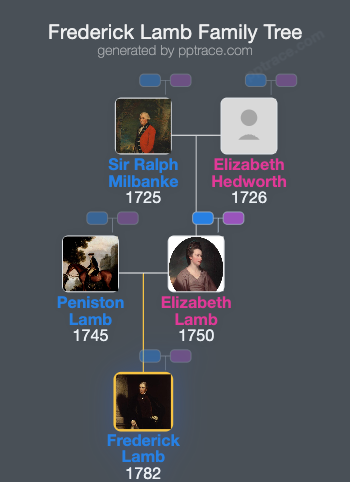
Family Tree
Tap  to expand more relatives
Introduction
Frederick James Lamb, 3rd Viscount Melbourne, was born on 17 April 1782 and died on 29 January 1853. He was a British diplomat and held the title of The Lord Beauvale from 1839 until 1848, after which he succeeded as the third Viscount Melbourne.
Early Life
Lamb was the younger son of Peniston Lamb, 1st Viscount Melbourne, and Elizabeth Milbanke. His older brother was William Lamb, who served as Prime Minister of the United Kingdom and became the 2nd Viscount Melbourne. His family had complex personal backgrounds; his mother's numerous romantic relationships have led to speculation about his paternity. Lamb received education at Eton College, followed by studies at the University of Glasgow from 1799 to 1801, where he studied alongside his brother William under Professor John Millar. He then attended Trinity College, Cambridge, beginning in 1801 and earning an M.A. degree in 1803. Throughout his life, Lamb maintained close familial relationships with his brother William and their sister Emily Lamb, Countess Cowper. The siblings generally remained close, although Frederick and Emily expressed dislike towards William's wife, Lady Caroline Lamb, whom they reportedly called "the little beast."
Career
Frederick Lamb served as the British Ambassador to Vienna, a position he held until 1841. He was invested as a Knight Grand Cross of the Order of the Bath and was admitted to the Privy Council in 1822. In 1839, he was elevated to the peerage as Baron Beauvale, of Beauvale in Nottinghamshire. Four years later, in 1848, he inherited the title of Viscount Melbourne upon the death of his elder brother.
Lamb's diplomatic career was characterized by a high level of trust from contemporary political figures. Notably, Lord Palmerston, who was Foreign Secretary, placed great confidence in Lamb and corresponded with him in a respectful tone that contrasted with his usual brusque style. Palmerston delegated much of the responsibilities at the Vienna Embassy to Lamb. The relationship between Lamb and Palmerston was complex, partly influenced by Palmerston’s long-standing affair with Lamb’s sister Emily, Lady Cowper. Lamb disapproved of the affair and their eventual marriage, though the union proved to be happy. Despite personal differences, Lamb and Palmerston collaborated professionally during the early stages of the Oriental Crisis of 1840. Their cooperation was largely pragmatic, and after the conflict, their relation improved, partly because both men appreciated Lamb’s wife, Alexandrina.
Personal Life
In 1841, Lord Beauvale married Alexandrina Julia Theresa Wilhelmina Sophia Gräfin von Maltzan, daughter of Joachim Charles Leslie Mortimer, Count (Graf) von Maltzan. The marriage was widely regarded as a love match. Alexandrina was born in 1818, making her more than thirty years younger than Lamb. Despite the age gap, Lamb was described as still handsome and debonair at age sixty.
Lamb died childrenless in January 1853 at the age of 70. His titles became extinct upon his death, as he had no heirs. The family estate, Melbourne Hall, was inherited by his sister Emily. His widow remarried in 1856 to John Weld-Forester, 2nd Baron Forester, and after being widowed again in 1873, she died in 1894. A memorial to Frederick James Lamb is located in St Paul's Cathedral.
Arms
[The detailed description of his heraldic arms is mentioned but not provided.]
References
Leigh Rayment's Peerage Pages.
External Links
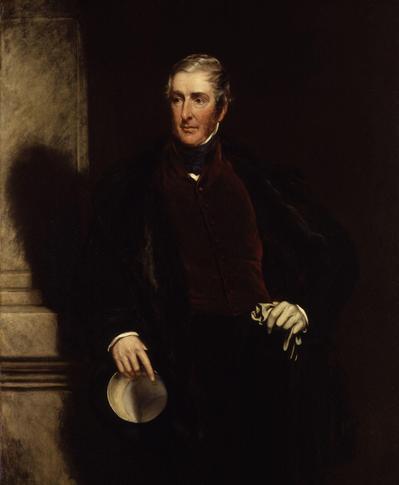
Portrait of Frederick James Lamb from 1846 is available for viewing.