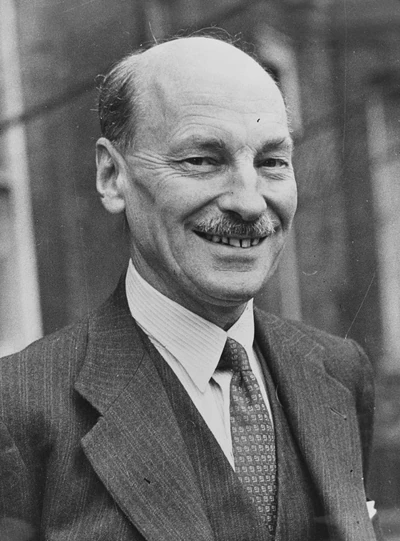
Clement Attlee
| Name | Clement Attlee |
| Title | Prime Minister of the United Kingdom from 1945 to 1951 |
| Gender | Male |
| Birthday | 1883-01-03 |
| nationality | United Kingdom |
| Source | https://www.wikidata.org/wiki/Q129006 |
| pptrace | View Family Tree |
| LastUpdate | 2025-11-26T23:32:58.434Z |
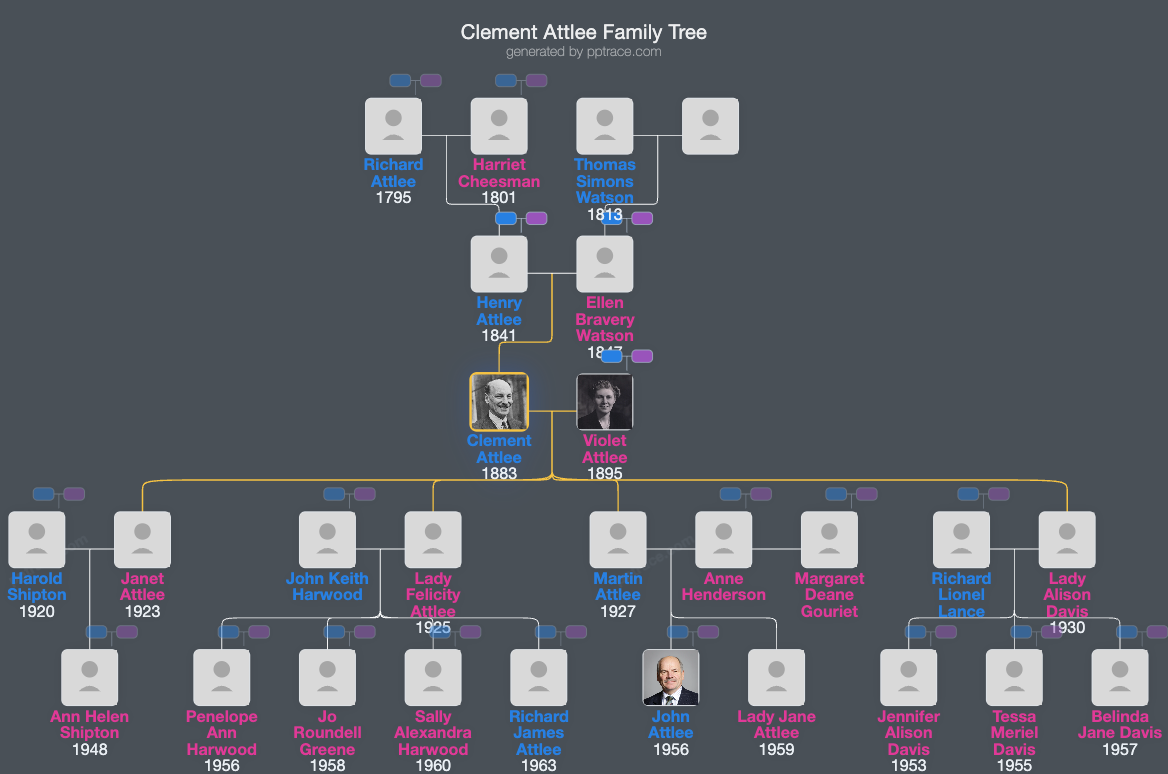
Family Tree
Tap  to expand more relatives
Introduction
Clement Richard Attlee, 1st Earl Attlee (3 January 1883 – 8 October 1967), was a British statesman who served as Prime Minister of the United Kingdom from 1945 to 1951. He was also the Leader of the Labour Party from 1935 to 1955 and held the position of Deputy Prime Minister during the wartime coalition government under Winston Churchill. Attlee was the longest-serving Labour leader in history and is recognized for his contributions to post-war social reforms.
Born in Putney, Surrey (now part of London), Attlee was the seventh of eight children in an upper middle-class family. His father, Henry Attlee, was a solicitor and a senior partner in a law firm, while his mother, Ellen Bravery Watson, was the daughter of Thomas Simons Watson, secretary for the Art Union of London. The family was committed to Anglican practices, and Attlee's upbringing included a large estate and staff, reflecting his family's social status.
Attlee attended Northaw Place preparatory school and later Haileybury College, where he studied from 1896 and was influenced by Darwinist views. He went on to study modern history at University College, Oxford, starting in 1901. He graduated with a Bachelor of Arts degree in 1904, earning second-class honours. He subsequently trained as a barrister at the Inner Temple, being called to the bar in 1906. During this period, he played football for Fleet, a non-League club.
In 1908, Attlee's father died, leaving him an estate valued at approximately £75,394 (equivalent to about £9.9 million in 2023). Following his father's death, Attlee abandoned his legal career to focus on social work and politics. His volunteer work at Haileybury House, a charitable organization for working-class boys in London's East End, sparked his interest in social reform. He joined the Independent Labour Party (ILP) in 1908 and became increasingly active in local politics and social activism.
Attlee initially held conservative views but shifted towards socialism after witnessing poverty firsthand. He worked with Toynbee Hall and Beatrice Webb, becoming involved in Fabian Society circles. In 1909, he served briefly as a secretary for Beatrice Webb and was involved in campaigns to promote the Minority Report. He also toured Essex and Somerset to explain the National Insurance Act of 1911, issued by Chancellor David Lloyd George. In 1912, he became a lecturer at the London School of Economics, teaching social science and public administration.
During the outbreak of the First World War in 1914, Attlee volunteered for the British Army and was commissioned as a temporary lieutenant in the South Lancashire Regiment. He was promoted to captain in 1915 and served in the Gallipoli campaign in Turkey. His decision to serve in the military caused a rift with his brother Tom, a conscientious objector who spent much of the war in prison.
Attlee’s political career progressed as he was elected as the Member of Parliament for Limehouse in 1922. He served in the first Labour minority government led by Ramsay MacDonald in 1924, and later joined the Cabinet during MacDonald’s second minority (1929–1931). After Labour's landslide defeat in 1931, he was elected Deputy Leader of the party. In 1935, he became the Leader of the Labour Party, initially advocating pacifism and opposing re-armament, and later criticising Neville Chamberlain's policy of appeasement ahead of World War II.
During the war, Attlee joined Winston Churchill's coalition government in 1940, initially as Lord Privy Seal, and later as Deputy Prime Minister from 1942. His leadership led to Labour's decisive victory in the 1945 general election, where the party prioritized reconstruction and welfare reforms amidst post-war shortages. His government implemented significant social reforms, including the nationalization of key industries, the creation of the National Health Service (NHS) in 1948, and the expansion of social security systems. His foreign policy focused on decolonization, including the partition of India in 1947, and he supported international alliances such as NATO.
Attlee’s government faced economic challenges, including shortages and currency crises, and despite reforms, poverty persisted for several years. Labour was defeated in the 1951 general election but he remained as leader until his retirement after the 1955 election. He was subsequently elevated to the House of Lords, where he served until his death in 1967.
Attlee was known for his modest and pragmatic demeanor, valued for his depth of knowledge, objectivity, and influence behind the scenes. He is widely recognized as one of Britain’s significant post-war prime ministers, notable for establishing the welfare state, the NHS, and maintaining the “Special Relationship” with the United States.