Bartholomew Dandridge
| Name | Bartholomew Dandridge |
| Title | American politician |
| Gender | Male |
| Birthday | 1737-01-01 |
| nationality | United States of America |
| Source | https://www.wikidata.org/wiki/Q4865239 |
| pptrace | View Family Tree |
| LastUpdate | 2025-11-28T19:57:06.303Z |
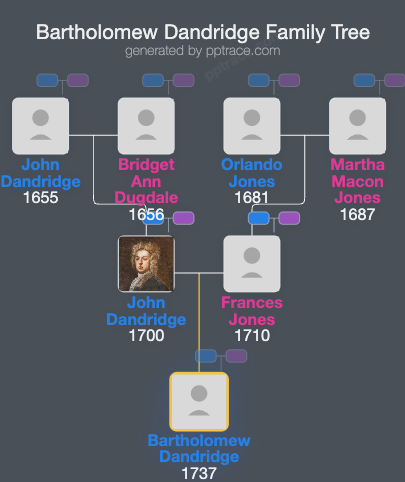
Family Tree
Tap  to expand more relatives
Introduction
Bartholomew Dandridge (December 25, 1737 – April 18, 1785) was an American planter, lawyer, and political figure in Virginia during the 18th century. He represented New Kent County in the Virginia House of Burgesses, participated in the Virginia Revolutionary Conventions, and served once in the Virginia House of Delegates before being appointed as a judge of the Court of Appeals, the predecessor to Virginia's Supreme Court.
Early Life
Dandridge was born at Chestnut Grove in New Kent County in the Colony of Virginia. His birth date is recorded as December 25, 1737. He was the fourth child of Colonel John Dandridge and Frances Jones Dandridge. The paternal grandfather, John Dandridge Sr., was originally from Oxfordshire, England, and became a member of the London Company of painters. His uncle, William Dandridge, emigrated to Virginia and became a merchant and planter by 1715. William owned Elsing Green plantation in King William County, a wharf in Hampton, and operated a merchant ship. William was connected to Virginia Governor Alexander Spottswood, through whom he was appointed to the Governor's Council and tasked with surveying the Virginia-North Carolina boundary.
On his mother's side, Rowland Jones, Dandridge's maternal great-grandfather, was the first rector of Bruton Parish Church in Williamsburg. His maternal grandfather, Orlando Jones, served multiple terms representing King William County in the House of Burgesses.
His father, John Dandridge, moved to Virginia and served as clerk of New Kent County from 1730 until his death in 1756. He also was an officer in the militia and operated the plantation known as Chestnut Grove, which relied on enslaved labor. Bartholomew had elder siblings named John Dandridge (1737–1749) and William Dandridge (1734–1776). His eldest sister, Martha Dandridge, later became the first First Lady of the United States through her marriage to George Washington.
Education and Family
Dandridge received private education suited to his social standing. His father died in Fredericksburg in August 1756, when Bartholomew was approximately 19 years old.
Marriage and Personal Life
Dandridge was married twice. His first wife's name is not recorded, but their daughter Anne married William Dandridge Claiborne, and another daughter Elizabeth married William Langhorne. His second wife was Mary Burbidge, daughter of Julius King Burbidge, who in 1744 purchased the Pamocra estate, an area within New Kent County. By 1782, Dandridge was paying taxes on the land where he lived with Mary Burbidge and their children.
The couple had seven children: four sons named John, Bartholomew, William, and Julius; and three daughters named Martha, Mary, and Frances. His eldest daughter Martha married Dr. William Halyburton of Scotland. His son John (born 1758) became a lawyer; he also served in the Virginia House of Delegates. Other descendants held various legal and public service positions.
Career
Dandridge studied law and gained a reputation as a lawyer. He managed his family estate while employing enslaved labor. His political career began with his election in 1772 as a representative of New Kent County to the House of Burgesses, a position he was re-elected to in 1774.
During the American Revolution, Dandridge became active in Virginia's revolutionary government. Following the suppression of the legislature by Royal Governor Lord Dunmore in 1775, Dandridge was elected to the first four Virginia Revolutionary Conventions, serving alongside contemporaries such as William Clayton. He was also elected to the Committee of Safety and the Committee of Privileges and Elections.
Dandridge contributed to the drafting of important revolutionary documents, including the resolution to dissolve ties with Great Britain and the Virginia Declaration of Rights. He was elected to the Council of State on June 29, 1776, but resigned in January 1778 to focus on family affairs.
In 1778, Dandridge was elected as a delegate to the Virginia House of Delegates representing New Kent County. His influence in the judiciary was demonstrated when, in 1778, he was elected to the General Court, and in 1779, he became a judge on the newly established Court of Appeals, which was the precursor to the modern Virginia Supreme Court. He officially took his seat on March 29, 1780. He participated in the case of Commonwealth v. Caton, which involved the principle of judicial review, although he declined to state an opinion on that issue.
Dandridge served as a judge until his death in 1785.
Death and Legacy
Dandridge and his mother died within days of each other in April 1785. His will allocated his property among his wife, children, and relatives, and included provisions for manumission of some of his slaves. His brother-in-law, George Washington, held a mortgage on some of his slaves and had plans to free them after his own death, as specified in his will.
His son, John Dandridge, followed a similar path in law and politics, serving in the Virginia House of Delegates. Another son, Julius Burbridge Dandridge, became a banker in Richmond, Virginia, and was involved in litigation before the Supreme Court of the United States.