William Lamb, 2nd Viscount Melbourne
| Name | William Lamb, 2nd Viscount Melbourne |
| Title | British politician (1779–1848) |
| Gender | Male |
| Birthday | 1779-03-15 |
| nationality | United Kingdom of Great Britain and Ireland |
| Source | https://www.wikidata.org/wiki/Q312567 |
| pptrace | View Family Tree |
| LastUpdate | 2025-11-12T01:17:19.644Z |
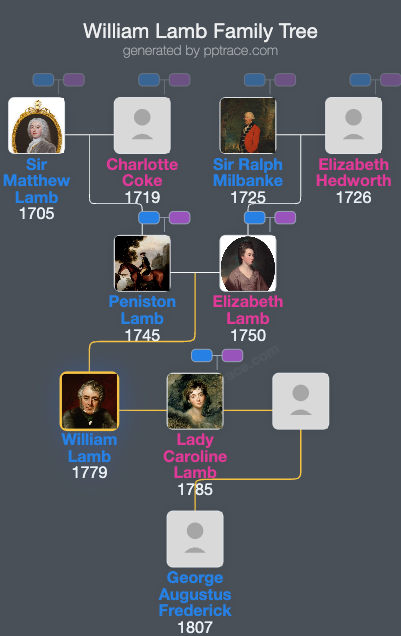
Family Tree
Tap  to expand more relatives
Introduction
Henry William Lamb, 2nd Viscount Melbourne, was born on 15 March 1779 in London, England. He was the son of Peniston Lamb (1745–1828) and Elizabeth Lamb (née Milbanke; 1751–1818). There was public speculation regarding his paternity, with some attribution to George Wyndham, 3rd Earl of Egremont, based on resemblance, though Lamb explicitly denied this. Lamb was a visitor at Petworth House, West Sussex, until Egremont's death in 1837. He was present at Egremont's deathbed but asserted that Egremont was not his father.
Lamb received education at Eton College, then at Trinity College, Cambridge, where he was admitted in 1796 and graduated with a Master of Arts in 1799. He further attended the University of Glasgow from 1799 to 1801, studying alongside his younger brother Frederick Lamb under Professor John Millar. He was admitted to Lincoln's Inn in 1797 and was called to the bar in 1804. During the Napoleonic Wars, he served as a Captain in 1803 and a Major in 1804 in the Hertfordshire Volunteer Infantry.
In 1805, Lamb succeeded his elder brother Peniston as heir to his father's title and also resigned his commission as captain of the Midland Troop, Hertfordshire Yeomanry. He married Lady Caroline Ponsonby, an aristocrat of Anglo-Irish descent. The marriage was marked by personal tragedies, including two miscarriages and the stillbirth of a child; their son George Augustus Frederick was born in 1807 and had epilepsy and mental handicaps, dying in 1836. They also had a daughter born prematurely in 1809, who lived only a day.
Lamb's political career began when he was elected to the House of Commons for Leominster in January 1806. He later represented Haddington Burghs and Portarlington, serving as an MP until 1812. He was subsequently elected as MP for Peterborough in 1816, with his political stance generally supportive of Whig principles, especially regarding the Glorious Revolution, though he opposed radical reform measures. He served as Chief Secretary for Ireland from 1827 to 1828.
In 1828, upon his father's death, Lamb inherited the title of 2nd Viscount Melbourne, thereby entering the House of Lords. As a backbencher for 25 years, he maintained a moderate political profile. He was appointed Home Secretary in 1830 under the Whig government of Lord Grey, where he handled domestic disturbances such as the Swing Riots (1830–31) by advocating enforcement of existing laws and rejecting emergency sedition legislation.
In July 1834, following Lord Grey's resignation, Melbourne was appointed Prime Minister after a brief hesitation. He initially served in 1834 but was dismissed in November by King William IV, marking the last instance of a monarch removing a sitting prime minister. He returned to the office in April 1835 and remained until 1841, guiding Queen Victoria through her early reign and acting as her political advisor. During his tenure, he navigated the passage of the Reform Act 1832 (though personally opposed to it), managed foreign policy issues including the First Opium War (1839–1842), the First Anglo-Afghan War (1839–1842), and the signing of the Treaty of Waitangi in New Zealand (1840).
His time in office saw involvement in the Bedchamber Crisis and other court-intrigue, as well as scandals related to his personal life, including attempts at blackmail involving Caroline Norton and romantic associations that drew public attention but did not topple his government. He was also involved in significant political events surrounding Queen Victoria's accession, notably her M
arriage to Prince Albert in 1840.
Melbourne's government fell after a vote of no confidence in August 1841, and he resigned as prime minister. Thereafter, he maintained a close correspondence with Queen Victoria but gradually withdrew from politics. He lived at Brocket Hall, Hertfordshire, until his death on 24 November 1848. He was buried at St Etheldreda's Church, Hatfield. A memorial in his honor is located at St Paul's Cathedral. The city of Melbourne in Australia was named after him in 1837, and Mount Melbourne in Antarctica was named by James Clark Ross in 1841.