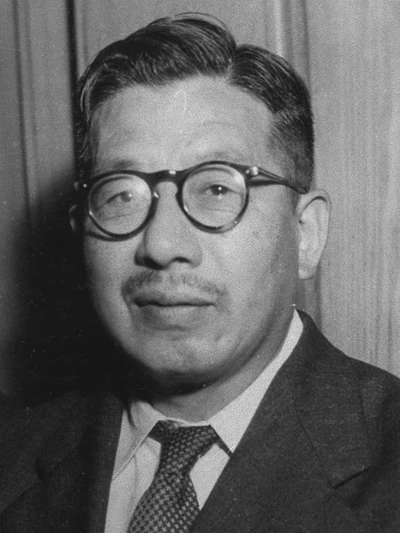
Tetsu Katayama
| Name | Tetsu Katayama |
| Title | Japanese politician (1887-1978) |
| Gender | Male |
| Birthday | 1887-07-28 |
| nationality | Japan |
| Source | https://www.wikidata.org/wiki/Q335194 |
| pptrace | View Family Tree |
| LastUpdate | 2025-11-17T10:09:40.375Z |
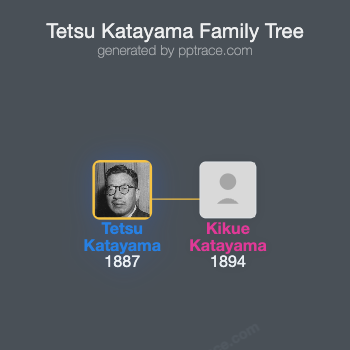
Family Tree
Tap  to expand more relatives
Introduction
Tetsu Katayama (片山 哲, Katayama Tetsu) was born on 28 July 1887 in Tanabe, Wakayama Prefecture, Japan. He graduated with a bachelor's degree in law from Tokyo Imperial University in 1912. Raised in the Christian faith, he was influenced by the Christian socialism of Abe Isoo. After completing his education, Katayama established a legal career, opening a law office in a rented YMCA dormitory and working as an attorney.
In 1926, Katayama became the secretary-general of the Social Democratic Party, a political organization established during this period. He was elected to Japan's House of Representatives in 1930, representing Kanagawa Prefecture. In the same year, he became involved with the Socialist Masses Party, joining its executive committee in 1932. His political activities in this era were interrupted when he was removed from the party after choosing not to participate in a session of the House where Takao Saito was expelled for his anti-military speech.
Following World War II, Katayama resumed political activity, serving as secretary-general of the newly established Japan Socialist Party in November 1945. By September 1946, he had become the chairman of the party's executive committee.
In the 1947 Japanese general elections, the Socialist Party secured the first position in the vote count. As a result, Katayama formed a coalition government with the Democratic Party and the National Cooperative Party. His tenure as Prime Minister commenced in 1947 and ended in 1948. His cabinet, though led by socialists, was characterized by significant influence from conservative members and was supported by the Allied occupation authorities. During this period, numerous progressive social reforms were enacted, including the establishment of Japan's first Labour Ministry, the passage of employment security and child welfare laws, and measures aimed at economic monopolies and zaibatsu controls.
Some of the key legislative achievements during Katayama's premiership included the Labour Standards Act, which introduced maternity leave and equal pay provisions; the Employment Security Law, which expanded government-operated employment services; the Child Welfare Law, which enhanced protections for children and established childcare systems; and the Law for the Elimination of Excessive Economic Concentration, targeting monopolistic companies. Further reforms included reorganization of local government, abolition of military and certain cabinet ministries, revisions to criminal law, and progress toward land reform.
Katayama's administration faced limitations, including insufficient political strength for more radical reforms, leading to his resignation in 1948. He subsequently lost his seat in the Diet in 1949 but remained influential in his political party’s right wing throughout the 1950s. He supported the Democratic Socialist Party from 1960 onward, advocating for pacifism, electoral reform, and international cooperation.
In his later years, Katayama served as president of the Japan Temperance Union. He withdrew from active politics in 1963 after losing his parliamentary seat. He was a signatory of the agreement to convene a world constitution, aiming to draft a global framework for peace and governance.
He was awarded the Grand Cordon of the Order of the Rising Sun in 1964. Posthumously, in 1978, he received the Grand Cordon of the Order of the Rising Sun with Paulownia Flowers. Tetsu Katayama passed away on 30 May 1978.