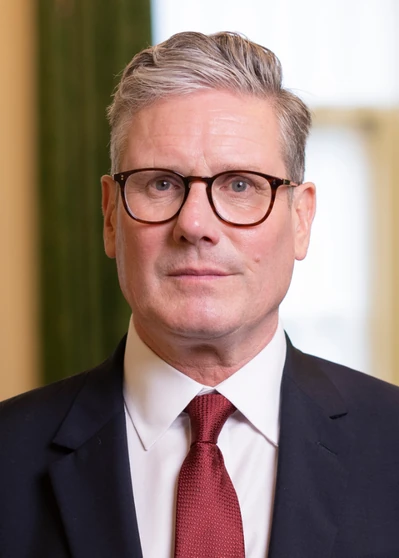
Keir Starmer
| Name | Keir Starmer |
| Title | Prime Minister of the United Kingdom since 2024 |
| Gender | Male |
| Birthday | 1962-09-02 |
| nationality | United Kingdom |
| Source | https://www.wikidata.org/wiki/Q6383803 |
| pptrace | View Family Tree |
| LastUpdate | 2025-11-26T23:34:21.088Z |
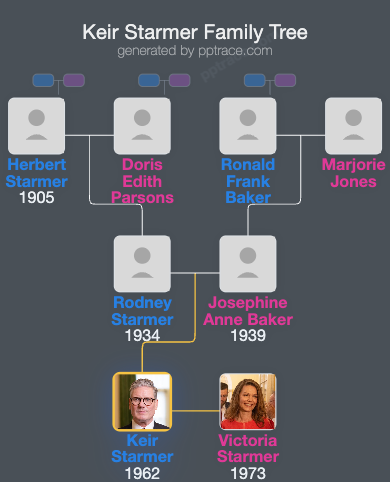
Family Tree
Tap  to expand more relatives
Introduction
Sir Keir Rodney Starmer (born 2 September 1962) is a British politician and lawyer who has served as Prime Minister of the United Kingdom since 2024. He has been Leader of the Labour Party since 2020 and was previously the Leader of the Opposition from 2020 to 2024. He has represented the constituency of Holborn and St Pancras as a Member of Parliament (MP) since 2015.
Starmer was born in Southwark, London, and raised in Oxted, Surrey. His parents were Josephine (née Baker), a nurse, and Rodney Starmer, a toolmaker. His mother developed Still's disease, and his father was an atheist. Starmer was nominally raised within the Church of England. Both of his parents supported the Labour Party, and it is reputed that he was named after Keir Hardie, the party's first parliamentary leader, though he has not confirmed this.
He attended Reigate Grammar School after passing the 11-plus examination. During his time there, the school transitioned into an independent fee-paying institution, but he received a bursary that allowed him to complete his education without parental contributions. In the sixth form, he studied mathematics, music, and physics, achieving A levels of B, B, and C respectively. His classmates included musician Norman Cook and future Conservative peer Andrew Cooper, as well as future conservative journalist Andrew Sullivan.
In his teenage years, Starmer became active in Labour politics, joining the Labour Party Young Socialists at age 16. He studied law at the University of Leeds, earning a first-class Bachelor of Laws (LLB) degree in 1985. He then pursued postgraduate studies at the University of Oxford, obtaining a Bachelor of Civil Law (BCL) degree from St Edmund Hall in 1986.
Starmer was called to the Bar in 1987 at the Middle Temple. He worked predominantly in criminal defence law, specialising in human rights. He served as a legal officer for the campaign group Liberty until 1990 and was involved with the Haldane Society of Socialist Lawyers, serving as its secretary, treasurer, and on its executive committee. In 1990, he co-founded Doughty Street Chambers, where he practiced until becoming a Queen's Counsel (QC) in 2002. That year, he became joint head of Doughty Street Chambers.
Throughout his legal career, Starmer was involved in significant cases, including representing individuals in the McLibel case before the European Court of Human Rights and defending the rights of those sentenced to death in Caribbean jurisdictions. He served as a human rights adviser to the Northern Ireland Policing Board and participated as a member of the Foreign, Commonwealth and Development Office's Death Penalty Advisory Panel from 2002 to 2008.
In 2008, Starmer was appointed Director of Public Prosecutions, serving until 2013. He handled major cases during this period, including the prosecution of the murder case of Stephen Lawrence. In the 2014 New Year Honours, he was appointed Knight Commander of the Order of the Bath (KCB) for his services to law and criminal justice.
Starmer's experience in Northern Ireland and his legal background influenced his decision to pursue a political career. He was elected as MP for Holborn and St Pancras during the 2015 general election. In the 2016 European Union membership referendum, he supported the Remain campaign and advocated for a second referendum on Brexit.
He served as Shadow Brexit Secretary under Jeremy Corbyn. Following Corbyn’s resignation after Labour's defeat in the 2019 general election, Starmer was elected as Labour leader in 2020. As leader, he moved the party toward the centre and sought to address issues of antisemitism within the party. Labour experienced electoral gains in the 2023 and 2024 local elections.
In the 2024 general election, Starmer led Labour to a majority government, ending 14 years of Conservative rule. His government has implemented policies including the termination of some Winter Fuel Payments, prisoner early-release schemes, and measures to address public-sector strikes. It has also established new security and disorder response units, restricted visa conditions, and amended migration policies. Legislation has included reforms to the planning system, workers’ and renters’ rights, and increased minimum wages. His government expressed continued support for Ukraine and Israel in ongoing conflicts and engaged in international trade negotiations with the EU, India, and the US. It facilitated the transfer of sovereignty over the Chagos Archipelago to Mauritius following a ruling by the International Court of Justice.
Public opinion of Starmer has been historically mixed, with his approval rating declining over his tenure as prime minister. As of November 2025, his net approval rating was approximately –46%, making him one of the least popular prime ministers on record.
Word count: 575