Thomas Bouldin
| Name | Thomas Bouldin |
| Title | American politician (1781-1834) |
| Gender | Male |
| Birthday | 1781-01-01 |
| nationality | United States of America |
| Source | https://www.wikidata.org/wiki/Q1710717 |
| pptrace | View Family Tree |
| LastUpdate | 2025-11-16T10:08:47.372Z |
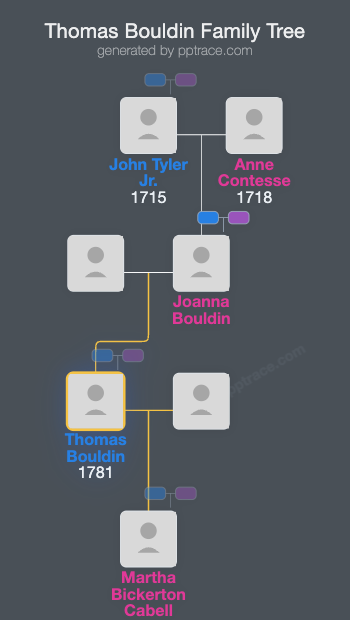
Family Tree
Tap  to expand more relatives
Introduction
Thomas Tyler Bouldin (1781 – February 11, 1834) was an American lawyer and politician who served as a United States Representative from Virginia. His terms in Congress were non-consecutive, spanning from 1829 until his death in 1834.
Born near Charlotte Court House in Virginia in 1781, Bouldin attended local country schools during his early life. He pursued legal studies and was admitted to the bar on December 6, 1802. Following his admission, he commenced practicing law in Charlotte Court House, Virginia. In addition to his legal career, Bouldin was appointed as a judge of the circuit court.
Bouldin owned and operated a slaveholding plantation called "Golden Hills" located near Drakes Branch, Virginia. At the time of his death, he held 30 slaves on this plantation.
In the political arena, Bouldin was elected as a Jacksonian to the Twenty-first and Twenty-second Congresses, serving from March 4, 1829, to March 3, 1833. He was an unsuccessful candidate for reelection to the Twenty-third Congress. However, he was subsequently elected to fill a vacancy in the Twenty-third Congress caused by the death of John Randolph. Bouldin served from August 26, 1833, until his death in Washington, D.C., on February 11, 1834.
His death occurred while he was addressing the House of Representatives, delivering a eulogy for his predecessor, John Randolph. His final words are recorded as: "But I cannot tell the reasons why his death was not announced, without telling what I told a friend I should say, in case..."
Thomas Bouldin was interred in a private cemetery on his plantation. Following his death, he was succeeded in Congress by his brother, James Bouldin.
In the elections prior to his final term, Bouldin was re-elected in 1829 with 46.09% of the vote, defeating Independents George William Crump and an individual known only as Miller. In 1831, he was re-elected with 58.62% of the vote, defeating Independent candidate George William Crump once again.
His contributions to Congress are documented in the Biographical Directory of the United States Congress and other historical sources.