Milton Stover Eisenhower
| Name | Milton Stover Eisenhower |
| Title | American university president (1899–1985) |
| Gender | Male |
| Birthday | 1899-09-15 |
| nationality | United States of America |
| Source | https://www.wikidata.org/wiki/Q4501243 |
| pptrace | View Family Tree |
| LastUpdate | 2025-11-17T06:44:27.321Z |
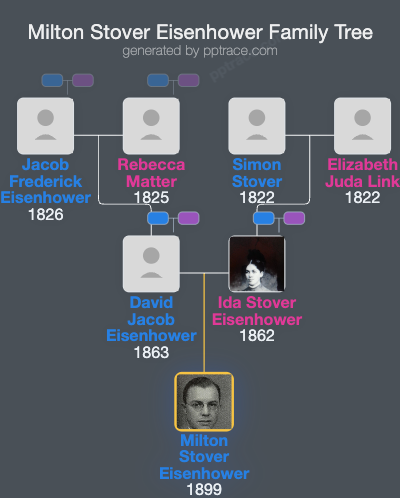
Family Tree
Tap  to expand more relatives
Introduction
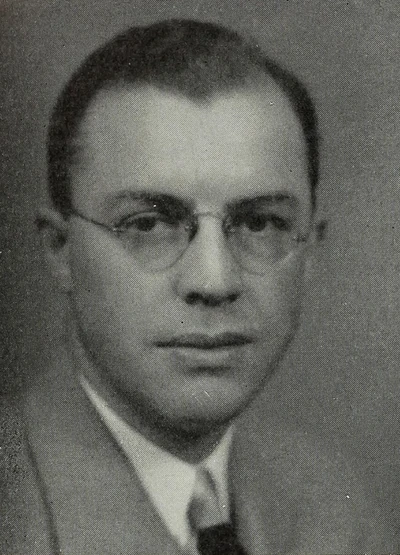
Milton Stover Eisenhower (September 15, 1899 – May 2, 1985) was an American academic administrator and public official. He served as president of Kansas State University, Pennsylvania State University, and Johns Hopkins University. Eisenhower was also the head of the United States delegation to the United Nations Educational, Scientific and Cultural Organization (UNESCO). He was the younger brother and advisor of Dwight D. Eisenhower, the 34th President of the United States.
**Early life and education**
Milton Eisenhower was born in Abilene, Kansas, to Ida Elizabeth Stover (1862–1946) and David Jacob Eisenhower (1863–1942). He was their seventh son, and the family experienced economic hardship. His mother reportedly treated him as female during his childhood, which was later described as embarrassing for the family. He attended public schools in Kansas and graduated from Kansas State University in 1924 with a Bachelor of Science degree in industrial journalism.
**Career**
Following his undergraduate education, Eisenhower worked as an assistant to the American consul in Dunfermline, Scotland, from 1924 to 1926. He then joined the U.S. Department of Agriculture, serving as Director of Information from 1928 to 1941. In this role, he acted as a spokesman for New Deal policies under Secretary Henry A. Wallace and previously served as secretary to Secretary of Agriculture William Marion Jardine.
In early 1942, Eisenhower was appointed director of the War Relocation Authority (WRA), overseeing the internment of Japanese Americans during World War II. He initially opposed the mass incarceration, advocating for policies to allow women and children to remain on the West Coast, but these proposals were rejected. During his tenure at the WRA, he established advisory councils, work programs, and student leave initiatives to mitigate the impacts of internment. He also sought to protect property and facilitate resettlement outside the exclusion zone. Eisenhower resigned from the WRA after approximately ninety days and subsequently served as associate director of the Office of War Information from June 1942 to mid-1943.
In May 1943, Eisenhower became president of Kansas State University, his alma mater, a position he held until 1950. During this period, he was also the first Chairman of the U.S. National Commission for UNESCO, organizing the first state-level UNESCO commissions, including one in Kansas. As head of the U.S. delegation to UNESCO, he promoted aid efforts for Palestinian refugees and appealed for international assistance.
He also advocated for racial integration in college athletics, pressing for the inclusion of African Americans in the Big Seven Conference in 1949. Although often called "Doctor," Eisenhower did not hold a doctoral degree but received an honorary doctorate of humane letters from the University of Nebraska in 1949.
After leaving Kansas State, Eisenhower served as president of Pennsylvania State University from 1950 to 1956, followed by two non-consecutive terms as president of Johns Hopkins University, from 1956 to 1967 and again from 1971 to 1972. During his tenure at Johns Hopkins, the university's income and endowment increased significantly, and numerous buildings, including the Milton S. Eisenhower Library, were constructed or named in his honor.
He retired in 1967 but returned briefly in 1971-1972 to assist during a transitional period after the resignation of Lincoln Gordon. Eisenhower was recognized for his fairness and leadership through this turbulent time.
**Political and advisory activities**
During the 1956 presidential campaign, allegations arose concerning Eisenhower’s influence on Latin American policy, which were denied by officials. He served as an adviser in the administrations of Presidents Dwight D. Eisenhower, John F. Kennedy, and Lyndon B. Johnson. In 1968, he was appointed chairman of the National Commission on the Causes and Prevention of Violence by President Johnson. He participated in negotiations to secure the release of Americans kidnapped in Cuba after the Bay of Pigs invasion. In 1964, he was briefly considered as a potential presidential candidate and was mentioned as a possible candidate opposing Barry Goldwater. In 1980, Eisenhower appeared on the ballot in Texas as the running mate of independent candidate John B. Anderson.
**Personal life**
Eisenhower married Helen Elsie Eakin on October 12, 1927. They had two children: Milton Stover Eisenhower Jr. (1930–2002) and Ruth Eakin Eisenhower (1938–1984). While attending Kansas State University, he was a member of multiple fraternities and served as editor of the campus newspaper, the Collegian.
He died from cancer in Baltimore, Maryland, on May 2, 1985.
**Legacy**
Several institutions and facilities are named after Eisenhower, including the Milton S. Eisenhower Library at Johns Hopkins University, which opened in 1964. The library's architecture is notable for being largely underground, with a windowed south wall. The Milton S. Eisenhower Research Center at the Johns Hopkins Applied Physics Laboratory, the Milton S. Eisenhower Auditorium at Penn State, and Eisenhower Hall at Kansas State University are also named in his honor. The Milton S. Eisenhower Symposium, a student-organized lecture series at Johns Hopkins University established in 1967, continues to be held annually.