Georg V Of Hanover
| Name | Georg V Of Hanover |
| Title | King of Hanover (1819-1878) |
| Gender | Male |
| Birthday | 1819-05-27 |
| nationality | Q164079 |
| Source | https://www.wikidata.org/wiki/Q57428 |
| pptrace | View Family Tree |
| LastUpdate | 2025-11-12T01:16:36.607Z |
Family Tree
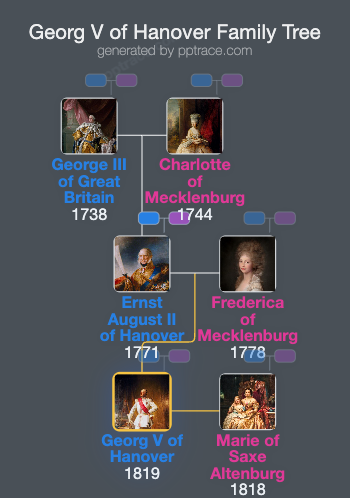
Tap  to expand more relatives
Introduction
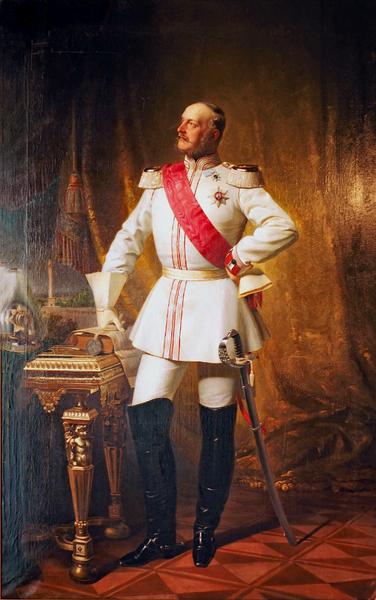
George V (full name: Georg Friedrich Alexander Karl Ernst August; born 27 May 1819 in Berlin; died 12 June 1878 in Paris) was the last King of Hanover, reigning from 18 November 1851 until 20 September 1866. He was the only child of King Ernest Augustus and Queen Frederica.
Early Life:
George was born in Berlin as the only son of Prince Ernest Augustus, Duke of Cumberland and Teviotdale, and Princess Frederica of Mecklenburg-Strelitz. His paternal grandfather was King George III of the United Kingdom, making George a grandson of the British monarch. His mother was the niece of Queen Charlotte, the wife of George III, and daughter of Charles II, Grand Duke of Mecklenburg-Strelitz, and Frederica of Hesse-Darmstadt. At birth, he was seventh in the line of succession to the British throne and later became the heir presumptive.
He was baptized on 8 July 1819 at a hotel in Berlin. His godparents included notable European royals and dignitaries such as the Prince Regent (represented by the Duke of Cumberland), Frederick William III of Prussia, Alexander I of Russia, and other Prussian princes, as well as members of the Mecklenburg, Russian, Dutch, and British royal families. George spent his childhood in Berlin and Great Britain. He experienced significant vision loss due to childhood illness and an accident, resulting in the loss of sight in one eye in 1828 and the other eye in 1833.
Crown Prince:
Following the death of King William IV and the accession of Queen Victoria in 1837, the personal union between the British and Hanoverian crowns ended due to Hanover's semi-Salic law, which prevented women from inheriting the throne. Ernest Augustus succeeded as King of Hanover, and George became the Crown Prince of Hanover. As a male-line descendant of George III, he remained second in line to the British throne until the birth of Victoria, Princess Royal, in 1840. Despite his blindness, his father decided he should succeed as King of Hanover.
Marriage:
On 18 February 1843, George married Princess Marie of Saxe-Altenburg, the eldest daughter of Joseph, Duke of Saxe-Altenburg, and Duchess Amelia of Württemberg.
Reign as King of Hanover:
George ascended to the throne on 18 November 1851 after the death of his father, becoming King George V of Hanover. His reign was characterized by a strong belief in royal authority and frequent disputes with the Hanoverian parliament (Landtag). He demonstrated a notable dislike for Prussia, bordering the Kingdom of Hanover, and generally supported the Austrian Empire in the German Confederation's affairs. He refused Prussia’s demands to join the German War and declined to allow Prussian railway construction through Hanover.
During the Austro-Prussian War in 1866, George refused to comply with Prussian demands that Hanover join their alliance and submit to their authority. Hanover joined Austria, and the Hanoverian Army was defeated and surrendered at the Battle of Langensalza on 29 June 1866. Subsequently, Hanover was occupied by Prussian troops, and on 20 September 1866, it was formally annexed by Prussia. George rejected the abdication proposed by his wife and went into exile in Austria. He never renounced his rights to the throne and did not acknowledge Prussia's annexation.
Exile and Later Life:
George and his family initially resided in Vienna, where he purchased a house now serving as the Czech Embassy. In 1868, he acquired a summer villa in Gmunden, Austria. From exile, George appealed to European powers to intervene on behalf of Hanover and maintained the Guelphic Legion at his own expense until 1870, hoping for its reconquest during the Franco-Prussian War, which ended in a Prussian victory. His campaign activities, including publishing the magazine "Situation" in Paris, were unsuccessful in restoring Hanover. Prussian authorities seized his assets, including the Guelph Fund, and used proceeds to suppress Guelph activities.
Honors and Titles:
In the United Kingdom, George's arms were granted in 1835, incorporating elements representing his British heritage, and he removed his heraldic label after 1851. His titles included His Royal Highness Prince George of Cumberland (until 1837), His Royal Highness The Crown Prince of Hanover (from 1837), and His Majesty The King of Hanover (from 1851). He was appointed an honorary full general in the British Army in 1876.
Death:
George V died in Paris on 12 June 1878, at his residence on Rue de Presbourg, where he had gone to seek support for re-establishing the Guelphic Legion. His funeral was held at the Lutheran Church in Paris, after which his body was transported to England for burial in St George's Chapel at Windsor Castle.
Legacy:
George’s reign saw efforts to support industrial development, including the founding of the "Georgs-Marien-Bergwerks- und Hüttenverein" in 1856, which contributed to the development of Georgsmarienhütte.