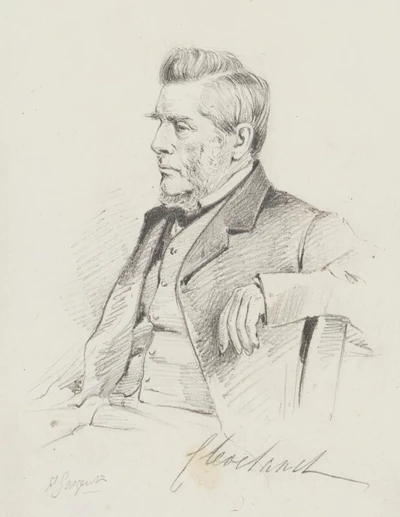
Harry Powlett, 4th Duke Of Cleveland
| Name | Harry Powlett, 4th Duke Of Cleveland |
| Title | British diplomat and politician (1803-1891) |
| Gender | Male |
| Birthday | 1803-04-19 |
| nationality | United Kingdom of Great Britain and Ireland |
| Source | https://www.wikidata.org/wiki/Q5609970 |
| pptrace | View Family Tree |
| LastUpdate | 2025-11-26T23:30:51.383Z |
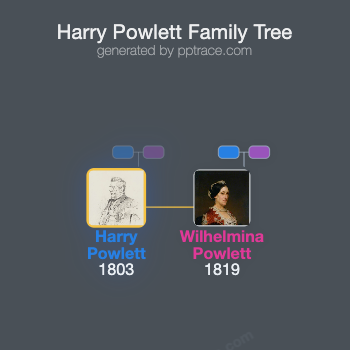
Family Tree
Tap  to expand more relatives
Introduction
Harry George Powlett, 4th Duke of Cleveland (born 19 April 1803, died 21 August 1891), was an English landowner, diplomat, and politician associated with the Whig party. He was styled The Honourable Harry Vane until 1827 and Lord Harry Vane from 1827 to 1864. In 1864, by Royal Licence, he adopted the surname and arms of Powlett in place of Vane, in accordance with the will of his maternal grandmother, the Duchess of Bolton.
Origins and Family background:
He was the third son of William Vane, 1st Duke of Cleveland, a Member of the Royal Garter (KG), and Lady Catherine Margaret Powlett. His paternal grandfather was Henry Vane the Elder, and his maternal grandfather was Admiral Harry Powlett, 6th Duke of Bolton. His elder brothers were Henry Vane, 2nd Duke of Cleveland, and William Vane, 3rd Duke of Cleveland.
Education and early career:
Vane was educated at Oriel College, Oxford. He entered the foreign service, holding diplomatic posts in Paris and Stockholm. Later, he became a Member of Parliament, representing South Durham from 1841 until 1859, when he was elected for Hastings. He served as a Member of Parliament until his accession to the peerage in 1864.
Peerage and titles:
Upon the death of his brother on 6 September 1864, he inherited the dukedom and was elevated to the House of Lords. On 18 November 1864, he legally changed his surname to Powlett under Royal Licence, aligning with the will of his maternal grandmother. He was invested as a Knight of the Garter in 1865.
Political considerations:
During the political crisis of 1866, which led to the fall of Lord Russell's government over debates on parliamentary reform, he was considered a potential candidate for a compromise prime minister in a coalition between Whigs and Conservatives opposing reform efforts. However, this did not materialize.
Later activities and landholdings:
In 1867, he served as treasurer of the Salop Infirmary in Shrewsbury. In 1885, he financed the rebuilding of the parish church at Uppington, Shropshire, located on part of his estates. He owned approximately 104,000 acres, including 55,000 acres in Durham, 25,000 acres in Salop, and 6,000 acres in Suffolk.
Marriage:
On 2 August 1854, at Chevening, he married Lady Dalmeny, born Lady Katherine Elizabeth Stanhope, the daughter of Philip Henry Stanhope, 4th Earl Stanhope. She was the widow of Archibald Primrose, Lord Dalmeny, and the mother of Archibald Primrose, 5th Earl of Rosebery, who later became Prime Minister of the United Kingdom. The marriage did not produce any children.
Death and succession:
Harry George Powlett, 4th Duke of Cleveland, died at the age of 88 in August 1891 at Cleveland House, 16 St James's Square, Westminster, London. Following his death, the line of succession to his peerages became uncertain. The House of Lords Committee for Privileges and Conduct declared the dukedom of Cleveland extinct in 1891, but recognized Henry Vane as the rightful heir to the title of Baron Barnard and the estates of Raby Castle and Barnard Castle, which had been purchased by the Vane family in 1626.