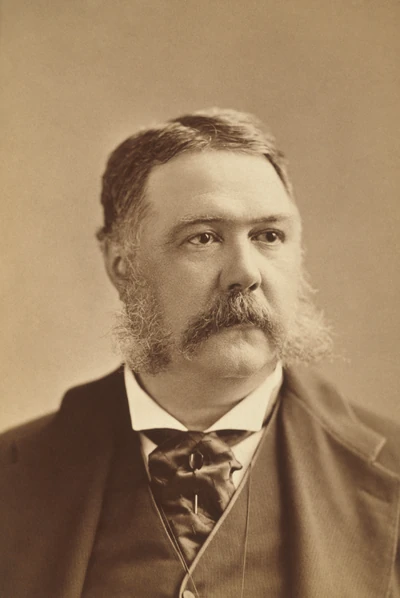
Chester A. Arthur
| Name | Chester A. Arthur |
| Title | president of the United States from 1881 to 1885 |
| Gender | Male |
| Birthday | 1829-10-05 |
| nationality | United States of America |
| Source | https://www.wikidata.org/wiki/Q35498 |
| pptrace | View Family Tree |
| LastUpdate | 2025-11-17T06:41:11.203Z |
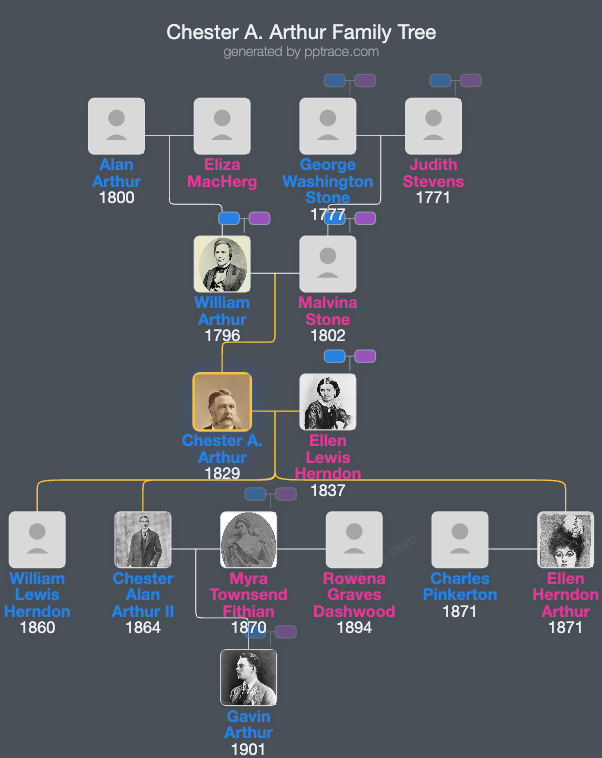
Family Tree
Tap  to expand more relatives
Introduction
Chester Alan Arthur (October 5, 1829 – November 18, 1886) was an American politician who served as the 21st president of the United States from 1881 to 1885. He previously held the position of the 20th vice president under President James A. Garfield.
Born in Fairfield, Vermont, Arthur was the son of William Arthur, an Irish immigrant and Presbyterian minister, and Malvina Stone, whose family had English and Welsh ancestry. His family moved frequently during his childhood, residing in various towns in Vermont and New York, ultimately settling in Schenectady, New York, in 1844. Arthur was the fifth of nine children. His father, William Arthur, was an abolitionist and a preacher who transitioned from a Presbyterian upbringing to become a minister of the Free Will Baptists.
Arthur attended Union College in Schenectady, where he studied classical subjects, joined the Psi Upsilon fraternity, and was elected to Phi Beta Kappa. He graduated in 1848, subsequently working as a teacher. He studied law at the State and National Law School in Ballston Spa, New York, and later in New York City at the office of Erastus D. Culver, a prominent abolitionist lawyer. He was admitted to the New York bar in 1854 and joined Culver's law firm.
During the American Civil War, Arthur served as quartermaster general of the New York Militia. After the war, he became involved in New York Republican politics and soon aligned with the political organization led by Senator Roscoe Conkling, a leader of the Stalwart faction of the Republican Party. In 1871, President Ulysses S. Grant appointed him as Collector of the Port of New York, a significant patronage position. His support for Conkling and the Stalwart faction positioned him prominently within party politics.
In the political disputes of the late 1870s, Arthur was dismissed by President Rutherford B. Hayes in 1878 as part of efforts to reform federal patronage. The 1880 Republican National Convention was marked by factional disputes between Ulysses S. Grant’s supporters, the Stalwarts, and the Half-Breeds led by James G. Blaine. The convention resulted in the nomination of James A. Garfield for president, with Arthur as vice president, to balance the ticket geographically and politically.
Garfield and Arthur were elected in 1880, and took office in March 1881. Following Garfield’s assassination in July 1881, Arthur assumed the presidency. His administration saw the expansion of the U.S. Navy and the enactment of civil service reform through the Pendleton Civil Service Reform Act of 1883. He vetoed the initial version of the Chinese Exclusion Act but signed a revised bill that limited Chinese immigration for ten years. Arthur appointed Horace Gray and Samuel Blatchford to the Supreme Court and enforced the Immigration Act of 1882 and the Tariff of 1883.
Though less politically active towards the end of his term due to poor health, Arthur made efforts to secure renomination in 1884 but was not successful. He retired from public life afterward. His health declined, and he died in 1886.
**Early Life and Family**
Arthur’s maternal family, the Stones, had roots in Vermont, with ancestors who fought in the American Revolution. His father, William Arthur, was born in Ireland and emigrated to North America in the early 19th century. The family moved across various locations in Vermont and New York during his youth. Arthur was the fifth of nine children; his siblings included Regina, Jane, Almeda, Ann, Malvina, William, George, and Mary.
**Education**
Arthur's early education included attendance at a grammar school in Schenectady and the Lyceum of Union Village. He showed early political support for the Whig Party and supported Henry Clay during the 1844 presidential election. He prepared for college at Union College, where he studied classical subjects, became president of the debate society, and was elected to Phi Beta Kappa. After graduating in 1848, he worked as a teacher and pursued legal studies in Vermont and New York. His law education culminated with his admission to the New York bar in 1854.