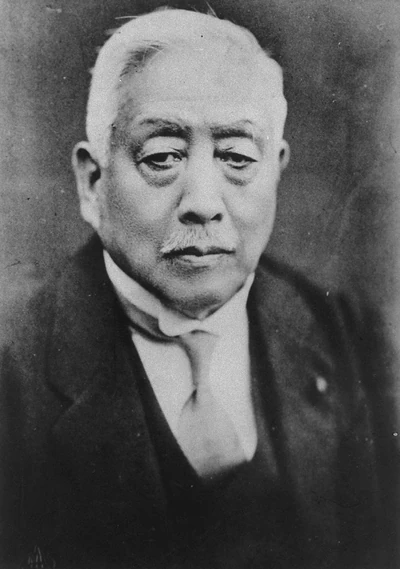
Saitō Makoto
| Name | Saitō Makoto |
| Title | Prime Minister of Japan (1858-1936) |
| Gender | Male |
| Birthday | 1858-12-02 |
| nationality | Japan |
| Source | https://www.wikidata.org/wiki/Q335188 |
| pptrace | View Family Tree |
| LastUpdate | 2025-11-17T10:08:45.069Z |
Family Tree
Tap  to expand more relatives
Introduction
Viscount Saitō Makoto (斎藤 実, 27 October 1858 – 26 February 1936) was a Japanese naval officer and politician. He was born in Mizusawa Domain, Mutsu Province, present-day Ōshū City, Iwate Prefecture. He was the son of a samurai belonging to the Mizusawa Clan.
Saitō graduated from the 6th class of the Imperial Japanese Naval Academy in 1879, ranking third out of 17 cadets. He received his commission as an ensign on 8 September 1882 and was promoted to sub-lieutenant on 25 February 1884. In 1884, he went to the United States as a military attaché and studied there for four years. He was promoted to lieutenant on 14 July 1886. Upon returning to Japan in 1888, he served on the Imperial Japanese Navy General Staff.
He was promoted to lieutenant commander on 20 December 1893, serving as an executive officer on the cruiser Izumi and the battleship Fuji. During the First Sino-Japanese War, Saitō commanded the cruisers Akitsushima and Itsukushima. He was promoted rapidly to the ranks of commander on 1 December 1897 and captain on 27 December 1897. On 10 November 1898, he was appointed Vice Minister of the Navy. He achieved the rank of rear admiral on 20 May 1900.
At the start of the Russo-Japanese War in 1904, Saitō served once again as Vice Minister of the Navy and was promoted to vice admiral on 6 June 1904. He was awarded the Order of the Rising Sun, 1st class, in 1906. He served as Japan's Minister of the Navy from 1906 to 1914, during which he aimed for naval expansion. On 21 September 1907, he was ennobled with the title of danshaku (baron) under the kazoku peerage system. He was promoted to full admiral on 16 October 1912.
His tenure as Navy Minister ended on 16 April 1914, when he was compelled to resign due to the Siemens scandal. Subsequently, he entered the reserves. In September 1919, Saitō was appointed as the third Governor-General of Korea, serving two terms (1919–1927 and 1929–1931). His appointment coincided with the aftermath of the Korean independence movement, and he faced an assassination attempt by Kang Woo-kyu, a Korean nationalist.
As governor-general, Saitō implemented measures to moderate Japan’s policies toward Koreans. His efforts earned him the Order of the Paulownia Flowers in 1924. On 29 April 1925, his peerage was elevated to shishaku (viscount). In 1927, he participated in the Geneva Naval Conference on Disarmament as part of the Japanese delegation and later became a privy councillor.
Following the assassination of Prime Minister Inukai Tsuyoshi in May 1932, Saitō was selected to succeed him as Prime Minister, serving from 1932 to 1934. During his administration, Japan recognized the independence of Manchukuo and withdrew from the League of Nations. His cabinet resigned on 8 July 1934 amid the Teijin bribery scandal, and Keisuke Okada succeeded him as prime minister.
Later, Saitō served as Lord Keeper of the Privy Seal starting on 26 December 1935. He was assassinated during the February 26 Incident in 1936 at his residence in Yotsuya, Tokyo, alongside Takahashi Korekiyo and other officials targeted by rebels. Posthumously, he was awarded the Supreme Order of the Chrysanthemum.
His honours included various Japanese and foreign decorations, such as the Grand Cordon of the Order of the Rising Sun with Paulownia Flowers, and honorary foreign awards including the Knight Grand Cross of the Order of the Bath (UK) and the Grand Officer of the Legion of Honour (France).