Priscilla Fane, Countess Of Westmorland
| Name | Priscilla Fane, Countess Of Westmorland |
| Title | British linguist and artist |
| Gender | Female |
| Birthday | 1793-01-01 |
| nationality | United Kingdom of Great Britain and Ireland |
| Source | https://www.wikidata.org/wiki/Q7245589 |
| pptrace | View Family Tree |
| LastUpdate | 2025-11-26T23:27:36.906Z |
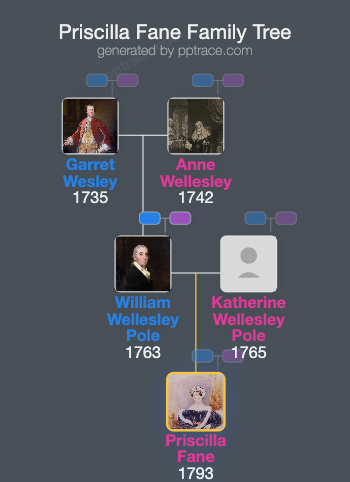
Family Tree
Tap  to expand more relatives
Introduction
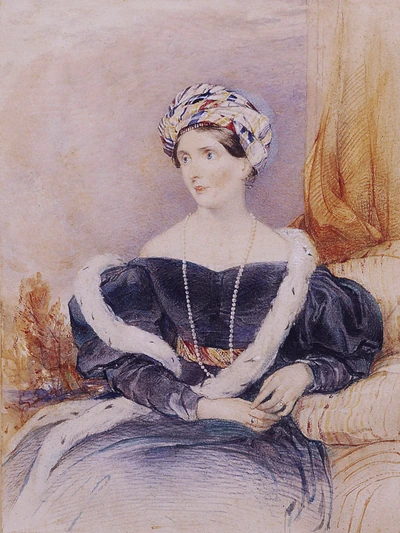
Priscilla Anne Fane, née Wellesley-Pole, known as the Countess of Westmorland from 1841 until her death, was born in 1793 and died on 18 February 1879. She was a British linguist and artist, and was styled Lady Burghersh from 1811 to 1841.
Family background and early life:
Priscilla Anne Wellesley-Pole was the fourth child of the Honourable William Wellesley-Pole, who later became the first Baron Maryborough and the third Earl of Mornington. Her mother was Katharine Elizabeth, the eldest daughter of Admiral the Honourable John Forbes. Her uncle was Arthur Wellesley, the 1st Duke of Wellington.
Marriage and children:
In 1811, she married John Fane, Lord Burghersh, who was the son of John Fane, the 10th Earl of Westmorland. The marriage produced five sons and one daughter; only two of her children survived her: Francis Fane, who became the 12th Earl of Westmorland, and Lady Rose Weighell. Upon her husband's succession as the 11th Earl of Westmorland in 1841, she acquired the title of Countess of Westmorland.
Career and accomplishments:
Priscilla Fane was recognized for her proficiency in languages and her talents as an artist. As Lady Burghersh, she exhibited six figure paintings at the Suffolk Street Exhibition between 1833 and 1841. Additionally, in 1843 and 1857, she submitted two scriptural subjects to the British Institution. Her artwork included a notable portrait of Anne, Countess of Mornington, depicted surrounded by her three prominent sons: Lord Wellesley, the Duke of Wellington, and Lord Cowley. This portrait was engraved and gained recognition.
Mentorship and patronage:
She studied art under William Salter, who benefited from her support. An anecdote involves Salter overhearing and witnessing a victory banquet at the Duke of Wellington's residence while he was on horseback in Hyde Park. Burghersh persuaded the Duke of Wellington to permit Salter to create a painting commemorating the event. The resulting masterpiece included 83 portraits.
Political influence and connections:
Priscilla Fane was well-regarded in political circles, reportedly held in high esteem by her uncle, the Duke of Wellington, for her political judgment. Lord Melbourne also valued her opinion, employing her as an intermediary in discussions concerning the potential formation of a coalition government in 1837.
Death and legacy:
She passed away at her residence at 29 Portman Square, London, and was interred at Apethorpe, Northamptonshire. Her daughter, Lady Rose Weigall, later edited two volumes of her correspondence, providing insights into her personal and political relationships.
Published works:
Her correspondence from Germany and France during the campaign of 1813-1814 was published posthumously in 1893 under the title "The Letters of Lady Burghersh from Germany and France during the campaign of 1813-14." Another collection, titled "Correspondence of Lady Burghersh with the Duke of Wellington," was published in 1903.
References:
This biographical entry includes information from the "Dictionary of National Biography," published by Smith, Elder & Co., in the period 1885–1900.