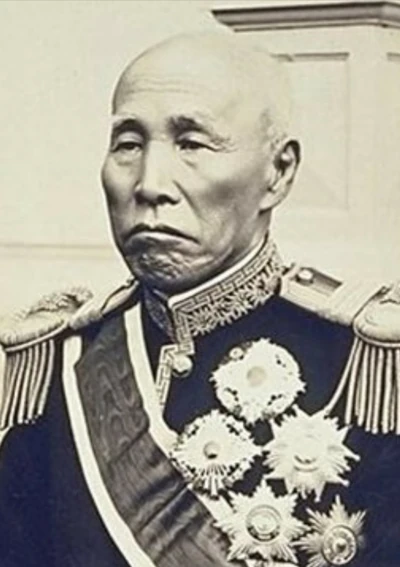
Ōkuma Shigenobu
| Name | Ōkuma Shigenobu |
| Title | Japanese politician (1838-1922) |
| Gender | Male |
| Birthday | 1838-03-11 |
| nationality | Japan |
| Source | https://www.wikidata.org/wiki/Q243141 |
| pptrace | View Family Tree |
| LastUpdate | 2025-11-17T10:07:47.369Z |
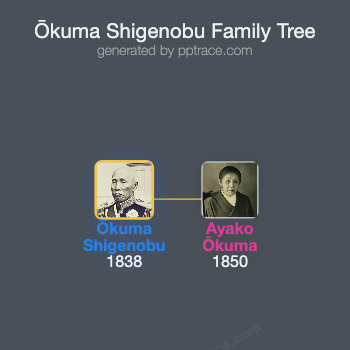
Family Tree
Tap  to expand more relatives
Introduction
Marquess Ōkuma Shigenobu (大隈 重信, 11 March 1838 – 10 January 1922) was a Japanese statesman active during the Meiji and Taishō eras. He served as Prime Minister of Japan twice, first in 1898 and again from 1914 to 1916. Ōkuma was a prominent advocate for the modernization of Japan, promoting Western science and culture, and was instrumental in establishing parliamentary democracy.
Born in Hizen Province, in what is now Saga Prefecture, he was the eldest son of a middle-ranking samurai family. His father was an artillery officer of the Saga Domain. Ōkuma's early education was characterized by rebellion and dissatisfaction with traditional curricula; he was expelled from the domain's official school, the Kōdōkan, at the age of seventeen. He was particularly critical of Chinese characters used in calligraphy and classical texts, referring to them as "the devil's characters," and favored Western studies, including Dutch and English languages, as well as science and military tactics.
In 1861, he studied English and constitutional law under American missionary Guido Verbeck in Nagasaki and was influenced by key political figures such as Kido Takayoshi of Chōshū. Despite opportunities to study abroad, Ōkuma chose to remain in Japan due to a strong sense of nationalism. During the Bakumatsu period, he sympathized with movements advocating reverence for the emperor and expulsion of foreigners.
His career in the Meiji government began in 1868 when he was appointed to oversee Nagasaki. He quickly rose through various positions, including Vice-Minister of Foreign Affairs, Vice-Minister of Civil Affairs, and Vice-Minister of Finance. In these roles, he played a crucial part in establishing Japan’s financial infrastructure, including the creation of a national mint, a national budget, and the railway system. He was influential in the abolition of the han system in 1871 and the creation of prefectures, as well as land tax reforms.
In 1873, Ōkuma became the Minister of Finance and published Japan’s first national budget. He opposed the 1873 Seikanron debate advocating for the invasion of Korea but supported the 1874 Taiwan Expedition. During the Saga Rebellion, he maintained a detached stance, signaling a shift from domain allegiance to national loyalty. His financial policies included efforts to stabilize the economy by establishing the Yokohama Specie Bank and supporting industrial development, notably Mitsubishi.
Ōkuma was politically an outsider from Hizen and balanced relationships among rival factions, notably Satsuma and Chōshū. After the assassination of Ōkubo Toshimichi in 1878, he became one of the dominant figures in the government alongside Itō Hirobumi.
In 1881, Ōkuma played a leading role in advocating for a constitutional government modeled after Britain. His draft proposal called for the prompt establishment of a diet and a cabinet responsible to that legislature, challenging the prevailing conservative model favored by other oligarchs, particularly Itō Hirobumi. This proposal, which emphasized parliamentary accountability, led to a political crisis within the oligarchy, as it threatened the power of the existing elites and the emperor’s authority.
In addition to his political roles, Ōkuma founded Waseda University, contributing to education and modernization efforts. His involvement in political reform, finance, and education marked significant contributions during Japan's rapid transformation into a modern nation-state in the late 19th and early 20th centuries.