Naoto Kan
| Name | Naoto Kan |
| Title | 94th Prime Minister of Japan |
| Gender | Male |
| Birthday | 1946-10-10 |
| nationality | Japan |
| Source | https://www.wikidata.org/wiki/Q47846 |
| pptrace | View Family Tree |
| LastUpdate | 2025-11-17T06:48:48.432Z |
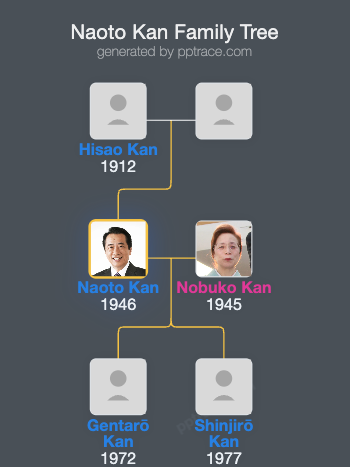
Family Tree
Tap  to expand more relatives
Introduction
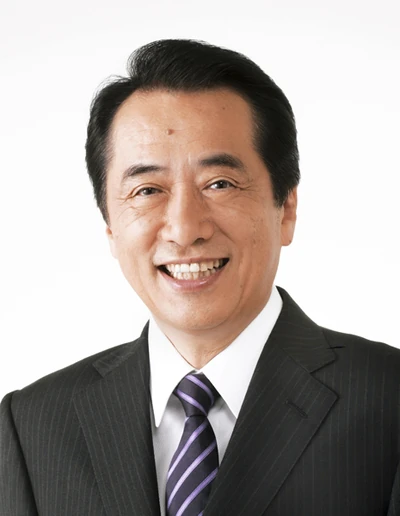
Naoto Kan (菅 直人, Kan Naoto), born on 10 October 1946 in Ube, Yamaguchi Prefecture, Japan, is a former Japanese politician who held the office of Prime Minister of Japan from June 2010 to September 2011. He also served as President of the Democratic Party of Japan (DPJ) during that period.
Early Life and Education:
Kan was the eldest son of Hisao Kan, who was the executive director of the glass manufacturing company Central Glass. He graduated from Tokyo Institute of Technology in 1970 and obtained a license as a benrishi (patent attorney) in 1971.
Career and Political Beginnings:
After completing his education, Kan worked at a patent office for four years. He was actively engaged in grassroots civic movements and served on the election campaign staff for Fusae Ichikawa, a women's rights activist. Kan contested in several elections before securing a seat in the House of Representatives in 1980 as a member of the Socialist Democratic Federation. He later joined the New Party Sakigake.
In 1996, during the coalition government with the Liberal Democratic Party (LDP), Kan was appointed Minister of Health and Welfare under Prime Minister Ryutaro Hashimoto. During his tenure, he gained national recognition for publicly admitting the government's responsibility for the spread of HIV-tainted blood in the 1980s and issuing a direct apology to the victims.
Founding the Democratic Party:
In September 1996, after leaving his cabinet post, Kan co-founded the Democratic Party of Japan (DPJ) with Yukio Hatoyama. In 1998, allegations of an extramarital affair involving television newscaster Yūko Tonomoto surfaced, but both parties denied the claims.
Political Activities and Leadership:
Kan assumed leadership of the DPJ multiple times, notably after Yukio Hatoyama resigned as leader. In 2003, the DPJ and Ichirō Ozawa's Liberal Party agreed to form a united opposition ahead of the anticipated fall election. During the 2003 campaign, Kan was positioned as a key alternative to then-Prime Minister Junichiro Koizumi, using his image as the campaign's symbol.
In 2004, Kan resigned from the DPJ leadership amid allegations of unpaid annuities, which he explained as an administrative error. In 2005, he proposed establishing a "Dankai (baby boomer) Party" to provide political opportunities for Japan's retiring baby boomers.
Minister of Finance:
Kan was appointed Minister of Finance and Deputy Prime Minister in January 2010 under Prime Minister Yukio Hatoyama. He prioritized economic growth and publicly specified a desirable dollar-yen exchange rate, which drew some criticism from government colleagues.
Prime Minister and Domestic Policy:
Following Hatoyama’s resignation in June 2010, Kan was elected leader of the DPJ with broad support from party members. Subsequently, he was appointed Prime Minister of Japan by the Diet and formally sworn in by Emperor Akihito on 8 June 2010.
His tenure was marked by efforts to address Japan’s economic challenges, including controversial proposals to raise the sales tax from 5% to 10%, which faced opposition within his party and contributed to electoral setbacks in July 2010. Kan's leadership was challenged by Ichirō Ozawa, but Kan secured the leadership with support from local party members and the wider public.
Foreign Policy and International Incidents:
During his premiership, Kan faced diplomatic issues such as the 2010 arrest of a Chinese fishing boat captain near the Senkaku Islands, which escalated tensions between Japan and China. His government also intervened in currency markets to weaken the yen and adopted economic stimulus measures to combat deflation.
Fukushima Nuclear Disaster:
Following the magnitude 9.0 earthquake and tsunami on 11 March 2011, Kan was heavily involved in the response to the Fukushima Daiichi nuclear disaster. He visited the plant early the next morning, coordinating emergency actions and addressing the crisis amidst challenges, including venting operations and explosion responses.
Resignation and Later Roles:
Kan announced his resignation as Prime Minister on 26 August 2011, with Yoshihiko Noda succeeding him. In August 2012, he was named to the UN high-level panel on the post-2015 development agenda by Secretary-General Ban Ki-moon. Kan retired from politics in November 2023.
In 2024, he published a memoir titled *Fifty Years of Citizen Politics* (市民政治50年, Shimin Seiji 50-nen), reflecting on his political career.