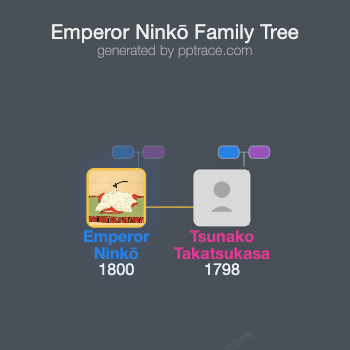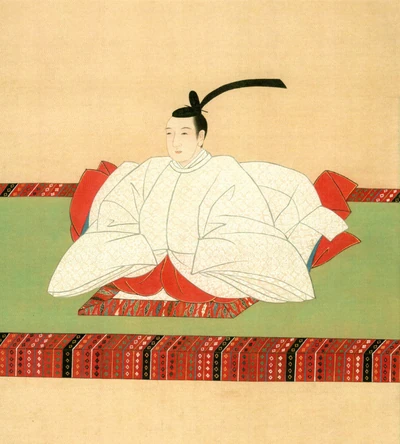
Emperor Ninkō
| Name | Emperor Ninkō |
| Title | emperor of Japan (1800-1846) |
| Gender | Male |
| Birthday | 1800-03-16 |
| nationality | Tokugawa shogunate |
| Source | https://www.wikidata.org/wiki/Q312351 |
| pptrace | View Family Tree |
| LastUpdate | 2025-11-17T10:08:10.909Z |
Family Tree
Tap  to expand more relatives
Introduction
Ayahito (恵仁) was born on 16 March 1800 and died on 21 February 1846. He is posthumously honored as Emperor Ninkō (仁孝天皇, Ninkō-tennō), recognized as the 120th emperor of Japan according to the traditional order of succession. Ninkō's reign lasted from 1817 until his death in 1846, during which the power of the ruling shōgunate continued to decline amidst natural disasters, corruption, and increasing Western interference.
Born as the fourth son of Emperor Kōkaku, his personal name was Ayahito (恵仁). He was the only one among his sixteen siblings to survive into adulthood. In 1809, he was designated as crown prince after being adopted by his father’s chief wife, Imperial Princess Yoshiko (欣子内親王), also known as Shin-Seiwa-in (新清和院). His birth mother was Kajyūji Tadako (勧修寺婧子), one of Emperor Kōkaku’s concubines.
He was enthroned as Emperor on 31 October 1817 following his father’s abdication. During his reign, Ninkō aimed to restore certain court rituals and practices, including the revival of the imperial title "tennō." He established institutions such as the Gakushūsho, the predecessor of the Gakushūin, for the Court Nobility, located near the Imperial Palace.
A significant event during Emperor Ninkō's reign was the Tenpō famine, which persisted from 1833 to 1837. The famine was primarily due to flooding and cold weather, affecting northern Honshū. His reign also witnessed the decline of shōgunal authority; natural disasters and famines eroded public confidence in the bakufu government. In 1837, Ōshio Heihachirō led a revolt in Osaka against corrupt officials who failed to assist the impoverished residents. That same year, an American merchant vessel was repelled by coastal artillery, indicating growing Western presence and influence.
The political influence of the emperor remained limited during this period, as executive power was concentrated with the shōgun. The era names (nengō) during his reign included Bunka (1804–1818), Bunsei (1818–1830), Tenpō (1830–1844), and Kōka (1844–1848). The court's hierarchy consisted of high-ranking officials such as Kampaku, Sadaijin, Udaijin, Naidaijin, and Dainagon, though their power was largely ceremonial relative to the shōgun.
Emperor Ninkō's family comprised seven sons and eight daughters from various concubines. Among his children, only three survived beyond childhood: the future Emperor Kōmei, Princess Sumiko (Sumiko-naishinnō), and Princess Chikako (Chikako-naishinnō). His immediate family members, including his spouse and concubines, are noted in historical records, but detailed accounts are limited.
He was succeeded by his fourth son, Imperial Prince Osahito, who became Emperor Kōmei upon Ninkō’s death in 1846. Emperor Ninkō was enshrined in the imperial mausoleum known as Nochi no Tsukinowa no Higashiyama no misasagi, located at Sennyū-ji in Higashiyama-ku, Kyoto. This site also contains the tombs of his immediate predecessors since Emperor Go-Mizunoo and includes the mausoleum of Emperor Kōmei and Empress Dowager Yoshikō.