Alpheus Spring Packard
| Name | Alpheus Spring Packard |
| Title | American entomologist, palaeontologist (1839-1905) |
| Gender | Male |
| Birthday | 1839-02-19 |
| nationality | United States of America |
| Source | https://www.wikidata.org/wiki/Q2839658 |
| pptrace | View Family Tree |
| LastUpdate | 2025-11-17T06:39:44.857Z |
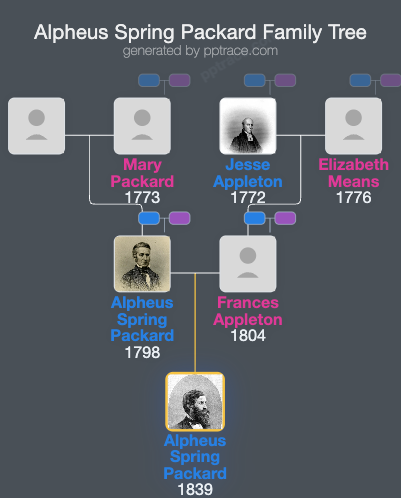
Family Tree
Tap  to expand more relatives
Introduction
Alpheus Spring Packard Jr. (February 19, 1839 – February 14, 1905) was an American scientist known for his contributions to entomology and paleontology. He described more than 500 new animal species, primarily butterflies and moths, and was a founding member of The American Naturalist journal. Packard held a professorship at Brown University.
Early Life and Education
Packard was born in Brunswick, Maine, as one of four sons of Alpheus Spring Packard Sr. (1798–1884) and Frances Elizabeth, the daughter of Reverend Appleton, who served as president of Bowdoin College. His mother died shortly after his birth, and Packard was raised by an aunt. His father was a professor of Greek and Latin at Bowdoin College. Encouraged by Paul A. Chadbourne of Williams College, Packard pursued zoology.
He was a member of the Lyceum of Natural History and participated in an expedition to Labrador and Greenland. He completed his bachelor's degree at Bowdoin College in 1861. Subsequently, he studied under Louis Agassiz at Harvard University in Cambridge. His first publication appeared in 1863, focusing on insect types. He earned a medical degree in 1864 and undertook a second trip to Labrador with artist William Bradford, with a particular interest in geology.
Career
Initially, Packard worked as an entomologist for the state of Maine. Between 1862 and 1865, he served as an assistant surgeon in the First Regiment of Maine Volunteers, during which he collected insects during military marches. His primary scientific focus included the classification and anatomy of arthropods, economic entomology, zoogeography, and the study of insect metamorphoses.
He worked as a librarian and custodian at the Boston Society of Natural History and contributed to collections from Labrador. In 1866, he joined the Peabody Academy of Science along with colleagues Putnam, Morse, and Hyatt. In 1877, Packard was appointed to the United States Entomological Commission, serving alongside Charles Valentine Riley and Cyrus Thomas.
From 1878 until his death, he was a professor of Zoology and Geology at Brown University in Providence, Rhode Island. During the scientific debate over Darwinism, he supported Neo-Lamarckism, a theory of evolution alternative to Darwin's.
Publications and Memberships
Packard authored several textbooks, including "Zoölogy for High Schools and Colleges," with its eleventh edition published in 1904. His monograph "Of the Bombycine Moths of North America" was published in three parts (1895, 1905, 1915), edited by T. D. A. Cockerell. He was elected to the American Philosophical Society in 1878.
Personal Life
In October 1867, Packard married Elizabeth Darby Walcott in Salem, Massachusetts. Elizabeth was the daughter of Samuel B. Walcott. The couple had four children: Martha Walcott, Alpheus Appleton, Elizabeth Darby, and Frances Elizabeth. Their daughter Elizabeth Darby died at age eight. Packard died on February 14, 1905, in Providence, Rhode Island. His wife and children outlived him.
Writings
Among his notable publications are "Report on the insects collected on the Penobscot and Alleguash Rivers" (1861), "Guide to the Study of Insects" (1869, third edition 1872), "The Mammoth Cave and its Inhabitants" (1872, with F. W. Putnam), "Life-History of Animals" (1876), "A Naturalist on the Labrador Coast" (1891), "Lamarck, the Founder of Evolution: His Life and Work" (1901), and "First Lessons in Zoology" (1886).
References
Sources about Packard include biographical memoirs, historical accounts of entomology, and biographical dictionaries focusing on American naturalists.