Takaharu Kuki
| Name | Takaharu Kuki |
| Title | Son of Tatatomo Kuki |
| Gender | Male |
| Birthday | 1886-06-00 |
| nationality | Japan |
| Source | https://www.wikidata.org/wiki/Q108528437 |
| pptrace | View Family Tree |
| LastUpdate | 2025-11-17T09:47:13.181Z |
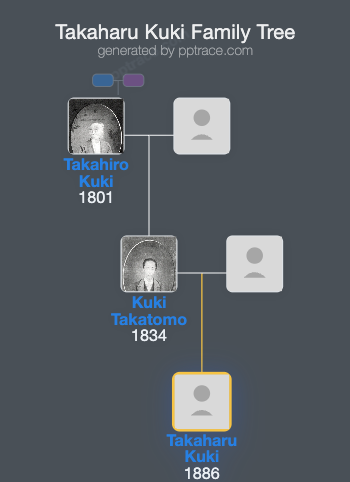
Family Tree
Tap  to expand more relatives
Introduction
Takaharu Kukami (June 21, 1886 – March 25, 1980) was a member of Japan's former nobility and held the title of viscount. He came from the clan of the Ayabe Domain and was the 11th head of the Ayabe Kukami family. His father was Takumi Kuki, the 10th daimyo of the Ayabe Domain.
In his lifetime, he was born in Kyoto Prefecture on June 21, 1886. He inherited his family headship and the title of viscount in 1897. He graduated from the Gakushuin High School and later completed studies at the Tokyo Political School (now Hosei University).
Career-wise, he served as a director of Teikoku Shōsankyō (Imperial Industrial Enterprise) in 1916. Additionally, in 1922, he became a director of the Taiwan Securities Exchange and served as the head of the Imperial Art Preservation Society.
In his private life, he married Sakiko Kajarri, and in 1918, established a residence in Akashi City, his hometown.
Regarding religious and cultural activities, the Kukami family was responsible for the rites of the Kan'nami Kinkōjin, regarded as the chief deity of the Ōmoto religion. Takaharu Kukami claimed related assertions about this deity. As part of his assertions, he negotiated with Ōmoto, resulting in an agreement where the Kukami family was promised an inheritable estate of 100,000 yen and the construction of a residence in Ayabe, Tanba.
He is also noted to have faced financial difficulties. According to the Osaka Mainichi Shimbun, Takaharu was characterized as "poor" and "impetuous," and was reported to have pawned the family heirlooms due to financial hardship.
During the Taishō period, he became acquainted with Seichi Tsuge, who later sent him financial support. Tsuge was involved in forging and falsely appending inscriptions by Tetsushū Yamaoka to paintings by Naoichi Yamaoka, leading to his arrest in 1921 for illicit accumulation of wealth.
As a religious organization, based on the tradition that the sacred image of Kan'nami Kinkōjin was discovered from the bottom of a chest in his home in 1920, Kukami founded the Imperial Way Promotion Society (Kōdō Sen'yō-kai). Notables such as Fumimaro Konoe, Ichirō Hatoyama, and Seishiro Ita were supporters. In 1934, he used timber from the Great Ceremony for Emperor Shōwa's accession to build the main hall and a meditation hall at the foot of Mount Takami.
Additionally, to expand and study his teachings, he entrusted the 'Kuki Manuscripts' to the Shinto scholar Ichirō Miura for research. Based on these, a work titled 'Research on the Kuki Manuscripts' was published in 1941. However, subsequent analysis indicated that the 'Kuki Manuscripts' were fraudulent, heavily influenced by Ōmoto doctrines and the Takeuchi Manuscript. Consequently, at a symposium in 1943, scholars such as Haruo Shimada criticized it as disrespectful. Miura himself was interrogated by the Tokkō (Special Higher Police).
After the war, the organization was renamed the Takami Shrine (Kōdō Sen'yō-kai to Takami Jingu). His son, Munetaka Kukami, led the shrine, which was subsequently succeeded by family members including Ietaka Kumano, who became the chief priest of Kumano Taisha, and Hisami Asada, who served as the chief priest of Suwa Shrine.
His death was confirmed on March 25, 1980.