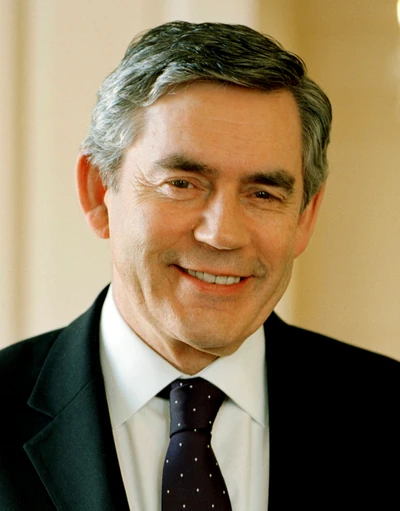
Gordon Brown
| Name | Gordon Brown |
| Title | Prime Minister of the United Kingdom from 2007 to 2010 |
| Gender | Male |
| Birthday | 1951-02-20 |
| nationality | United Kingdom |
| Source | https://www.wikidata.org/wiki/Q10648 |
| pptrace | View Family Tree |
| LastUpdate | 2025-11-26T23:33:52.239Z |
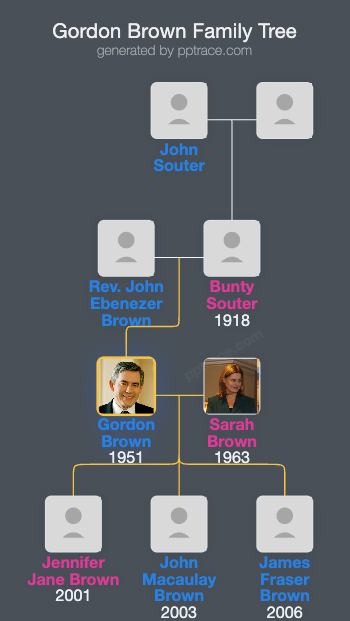
Family Tree
Tap  to expand more relatives
Introduction
James Gordon Brown was born on 20 February 1951 in Giffnock, Renfrewshire, Scotland. His father, John Ebenezer Brown (1914–1998), was a minister of the Church of Scotland, and his mother was Jessie Elizabeth "Bunty" Souter (1918–2004), the daughter of a timber merchant named John Souter. The family relocated to Kirkcaldy, Fife, when Brown was three years old, and he was raised there alongside his elder brother John and younger brother Andrew in a manse.
Brown received his early education at Kirkcaldy West Primary School. He was selected for an experimental fast stream education program, which expedited his progression to Kirkcaldy High School. He expressed later that he disliked this program. At age 16, he was accepted to the University of Edinburgh to study history. During his studies, he suffered a retinal detachment after an injury during a rugby match, which resulted in temporary blindness in one eye, and later surgery saved his other eye.
Brown graduated with a First-Class Honours Bachelor of Arts degree in history from the University of Edinburgh in 1972. He continued his academic pursuits at Edinburgh, earning a Doctorate of Philosophy (PhD) in history in 1982, with a thesis titled "The Labour Party and Political Change in Scotland 1918–1929." During his university years, Brown was involved romantically with Margarita, Crown Princess of Romania, who later described their relationship as "a very solid and romantic story."
Before entering Parliament, Brown worked as a lecturer in politics at Glasgow College of Technology from 1976 to 1980 and also served as a tutor for the Open University. In the 1979 general election, he stood as a Labour candidate for Edinburgh South but was defeated by the Conservative candidate, Michael Ancram. From 1980, Brown worked as a television journalist for Scottish Television, eventually becoming a current affairs editor.
Brown was elected as a Member of Parliament (MP) for Dunfermline East in the 1983 general election. His initial tenure in Parliament saw him working as an opposition spokesman on Trade and Industry in 1985, followed by roles as Shadow Chief Secretary to the Treasury from 1987 to 1989 and Shadow Secretary of State for Trade and Industry afterward. In 1992, he was appointed Shadow Chancellor of the Exchequer after Labour's defeat in the general election.
In the realm of Scottish politics, Brown participated in the Scottish Constitutional Convention and signed the Claim of Right for Scotland in 1989. He was involved in the Yes campaign during the 1979 Scottish devolution referendum, opposing the cross-party campaign advocating a 'Yes' vote and maintaining a pro-Scottish independence stance.
Following Labour's victory in the 1997 general election, Brown was appointed Chancellor of the Exchequer, a role he held until 2007. During his tenure, he implemented significant reforms to Britain’s financial governance, including transferring interest rate setting authority to the Bank of England, expanding the Treasury's domestic policy powers, and transferring banking supervision to the Financial Services Authority. His period as chancellor was marked by a record length of economic growth in Britain, and he outlined five economic tests to determine whether the UK should adopt the euro. Brown's fiscal policies included the abolition of advance corporation tax relief and the sale of UK gold reserves between 1999 and 2002.
In 2007, Brown succeeded Tony Blair as leader of the Labour Party and Prime Minister, serving in these roles until 2010. His premiership was characterized by the continuation of New Labour policies, maintaining close US relations, and upholding the UK's commitment to the Iraq War. His government responded to the 2008 global financial crisis with bank rescue packages, nationalizing major banks such as Northern Rock and the Royal Bank of Scotland and injecting public funds into others. In 2008, the government passed the world's first Climate Change Act and introduced the Equality Act 2010.
Following the decline in Labour's popularity during the recession, the 2010 general election resulted in a hung parliament, and the Conservative Party, led by David Cameron, formed a coalition government with the Liberal Democrats. Brown was succeeded as Prime Minister by Cameron and as Labour leader by Ed Miliband. Brown continued to serve as an MP for Kirkcaldy and Cowdenbeath until he relinquished his seat in 2015.
After leaving active politics, Brown engaged in occasional political commentary and authored books on political themes. He played a notable role in the Scottish independence referendum campaign of 2014 and authored a report on devolution in 2022 for Labour leader Keir Starmer. Brown has been involved in international public service roles, including serving as the United Nations Special Envoy for Global Education since 2012 and as the World Health Organization's Ambassador for Global Health Financing in 2021.
In the 2024 Birthday Honours, Brown was awarded the Order of the Companions of Honour by King Charles III for public and charitable services. His tenure as Chancellor was highly regarded for economic stability, and he is often considered the most successful post-war Chancellor of the UK in terms of economic management. His time as Prime Minister has been viewed as average in historical rankings, with public opinion improving after his departure from office.