Charles Edward, Duke Of Saxe-Coburg And Gotha
| Name | Charles Edward, Duke Of Saxe-Coburg And Gotha |
| Title | Duke of Saxe-Coburg and Gotha from 1900 to 1918 |
| Gender | Male |
| Birthday | 1884-07-19 |
| nationality | German Reich |
| Source | https://www.wikidata.org/wiki/Q160467 |
| pptrace | View Family Tree |
| LastUpdate | 2025-11-12T01:18:09.724Z |
Family Tree
Tap  to expand more relatives
Introduction
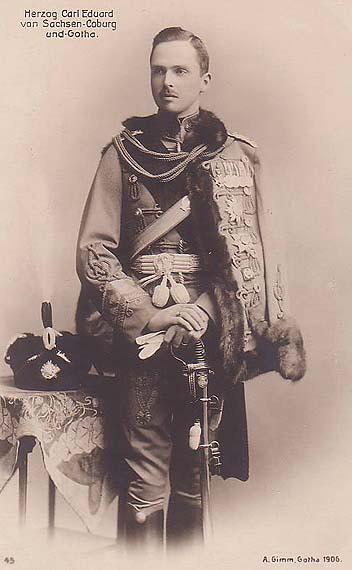
Charles Edward (Leopold Charles Edward George Albert), born on 19 July 1884 in Surrey, England, and died on 6 March 1954 in Coburg, Germany, was a prominent figure whose life spanned various roles, including British prince and royal duke, German duke, and Nazi politician.
Family Background and Early Life:
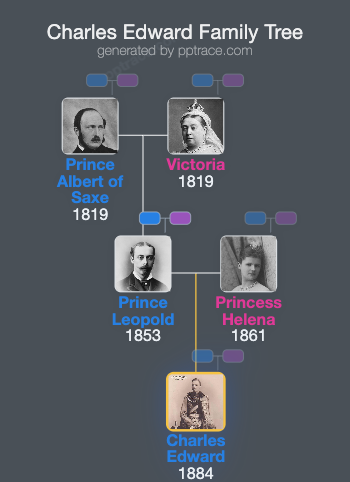
He was the son of Prince Leopold, Duke of Albany, the youngest son of Queen Victoria of the United Kingdom, and Princess Helen of Waldeck and Pyrmont. His paternal grandparents were Queen Victoria and Prince Albert of Saxe-Coburg and Gotha. Prince Leopold died prior to Charles Edward's birth; thus, he was raised as a British prince with the style His Royal Highness the Duke of Albany, inheriting his father's peerage titles at birth.
Childhood and Education:
He was privately educated, including attendance at Eton College. As a child, he was considered delicate and nervous, described by family accounts as "delicate and sensitive" and suffering from health issues possibly related to maternal grief during pregnancy. He developed a close relationship with his grandmother, Queen Victoria, and his sister Alice, with whom he was nicknamed "Siamese twins." In 1899, at age 15, he moved to Germany to prepare for succession as heir to the Duchy of Saxe-Coburg and Gotha, guided by his cousin, German Emperor Wilhelm II.
Ascension and Family:
He became the last ruling Duke of Saxe-Coburg and Gotha in 1900 following the death of his uncle, Duke Alfred, but reigned through a regency until 1905. In 1905, he married Princess Victoria Adelaide of Schleswig-Holstein-Sonderburg-Glücksburg. They had five children, including Princess Sibylla, who was the mother of King Carl XVI Gustaf of Sweden.
Political and Military Roles:
At 16, he inherited the ducal throne upon his uncle's death, with Prince Ernst of Hohenlohe-Langenburg serving as regent until he came of age. His education in Germany focused on military science and governance, attending institutions like Bonn University. His relationships with German Emperor Wilhelm II and the imperial court influenced his political attitudes. He supported nationalist sentiments, participated in local civic life, and invested in technological innovations like airship docking facilities.
World War I and Changing Loyalties:
During World War I, Charles Edward supported Germany, siding against Britain and renouncing his British titles—an act that led to his British honours being revoked in 1915. He served supportively on the Eastern Front and witnessed the destruction in Belgian territory. His health was compromised by arthritis, and he did not hold combat command. His connections extended to Bulgaria, acting as an intermediary and advising Ferdinand I. He was denounced as a traitor in Britain for his allegiance to the Central Powers.
Postwar Developments and Support for Extremism:
Following Germany's defeat, he was deposed in 1918, and his titles and properties were confiscated or transferred to the state. He continued to live in Coburg under economic hardship and was heavily involved in right-wing politics, supporting paramilitary groups and antisemitic activities. From the 1920s onward, he financially supported the Nazi Party, publicly shook Hitler's hand, and became a member of the Nazi Party in 1933. He held several positions, including leadership roles in the German Red Cross under Nazi control, and served as a Reichstag member until 1945. His support extended to eugenics programs and participation in promoting racist policies.
Diplomatic and International Activities:
Charles Edward undertook diplomatic missions for Nazi Germany, touring Japan, the United States, and other countries, often acting as an informal diplomat. He attempted to cultivate pro-German sentiment among the British aristocracy and maintained relationships with prominent figures, including members of the British royal family. His participation in these activities was characterized by efforts to support Nazi aims and foster alliances.
World War II and Later Life:
During World War II, he remained committed to Nazi policies, aiding in various diplomatic and propaganda activities. He was on Hitler's suspected kill order in 1945 and was captured by Allied forces, imprisoned, and subsequently subjected to denazification proceedings. He was classified as a follower of lesser guilt and lost much of his remaining property. Postwar, he lived in seclusion, suffering from illness and poverty, until his death from cancer in 1954.
Legacy:
His family and historical assessments have varied, with some viewing him as a victim of circumstance and others as an active supporter of Nazi policies. His biography is intertwined with discussions of aristocratic support for extremism, the German monarchy’s role in the Nazi regime, and the decline of European monarchies in the 20th century.
Honours and Arms:
He was granted numerous honours, including those from the UK, Germany, Denmark, Italy, and Norway, though many were revoked or lost after his political alignments changed. His arms reflected his statuses as a British prince and Duke of Saxe-Coburg and Gotha, with various coats of arms and monograms associated with his titles.
He is buried at the Waldfriedhof Cemetery near Callenberg Castle in Coburg.