John Leland
| Name | John Leland |
| Title | American Baptist minister |
| Gender | Male |
| Birthday | 1754-05-14 |
| nationality | United States of America |
| Source | https://www.wikidata.org/wiki/Q6244498 |
| pptrace | View Family Tree |
| LastUpdate | 2025-11-29T01:00:21.240Z |
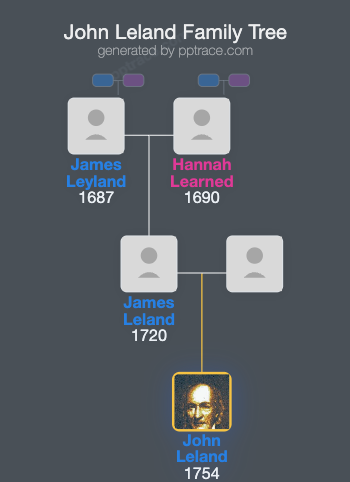
Family Tree
Tap  to expand more relatives
Introduction
John Leland (May 14, 1754 – January 14, 1841) was an American religious figure active in the late 18th and early 19th centuries. Born in Grafton, Massachusetts, he was the son of Congregationalist parents. Leland was baptized in June 1774 by Elder Noah Alden and joined the Baptist Church in Bellingham, Massachusetts, in 1775. Shortly thereafter, he traveled to Virginia, where he married Sally Devine on September 30, 1776, and subsequently served as the pastor of Mount Poney Baptist Church in Culpeper until 1778.
Following his tenure in Culpeper, Leland moved to Orange County, Virginia, and undertook itinerant preaching across Orange and York counties. His influence extended into the naming of the community of Grafton, Virginia, which is believed to have been named in part due to his associations there. During his time in Virginia, Leland engaged in political and religious discussions with prominent figures such as James Madison. In 1788–89, while still residing in Virginia, Leland met Madison at what is now the Leland–Madison Memorial Park; during this encounter, Leland agreed not to oppose Madison's political career in return for assurances of religious liberty in the U.S. Constitution. Madison later secured religious freedoms through the First Amendment.
Leland returned to Massachusetts in the winter of 1791, the same year the Bill of Rights was ratified. His departure from Virginia followed an anti-slavery sermon. Back in New England, Leland contributed to establishing Baptist congregations in Connecticut. His support for religious liberty was later recognized in President Thomas Jefferson’s 1802 letter to the Baptist community in Danbury, Connecticut.
An incident notable in Leland's life involved the Cheshire Mammoth Cheese, a large cheese sent by the residents of Cheshire, Massachusetts, to President Jefferson. Leland transported the cheese to Washington, D.C., where he presented it to Jefferson on January 1, 1802. During his visit, Leland also delivered a sermon to Congress and the President, and he later wrote about his journey, noting that he preached throughout the trip, which was partly motivated by curiosity to see the "Mammoth Priest" (an indirect reference to himself).
Leland is recognized for his advocacy of religious freedom and his opposition to the rise of missionary societies among Baptists. He held the position that government should protect individuals' right to think and speak freely, advocating for a comprehension of liberty beyond mere toleration, emphasizing equal freedom for all religious groups. His writings include assertions that truth does not require legal aid for its defense and that individuals should have the liberty to serve God according to conscience.
In the political arena, Leland was elected to the Massachusetts House of Representatives, representing Cheshire in 1812. He remained active in religious and social issues until his death on January 14, 1841, in North Adams, Massachusetts. His tombstone bears the inscription: "Here lies the body of John Leland, of Cheshire, who labored 67 years to promote piety and vindicate the civil and religious rights of all men."
Leland was also a hymn writer; one of his hymns, "The Day Is Past and Gone, The Evening Shades Appear," has been included in numerous hymnals, and several hymns authored by him are preserved in the Sacred Harp collection.
He opposed theological seminaries, though a later institution—the John Leland Center for Theological Studies in Virginia—was named in his honor. The center was established to commemorate his firm stance on religious liberty, his opposition to slavery, and his service as a pastor and evangelist.
Selected writings by Leland include statements advocating for religious freedom, the inalienable right to conscience, and the abolition of slavery, such as a 1789 resolution opposing slavery as a violation of natural rights and inconsistent with republican government.
Sources for further information include collections of his writings, scholarly articles, and historical accounts documenting his life and influence.